God’s Wrath and the Susceptibility of Crowds

Sad but true

Historicism is one of these concepts which I first encountered during my readings for my long ago abandoned MA thesis on Nietzsche, Hegel and matters which were in vogue in the mid 1990s such as the End of History.

Historicism essentially holds to the idea that human nature changes over time, that as civilisation grows in sophistication, we change, hopefully for the better.

[Nietzsche argued something different – that the advent of Christianity saw us abandon our heroic nature, and adopt the morality of slaves.]

Whilst we are far less hairy than our distant ancestors, and probably cannot digest raw meat too readily, I am starting to think that probably Historicism is too optimistic about both human nature and our intellects.

Back in antiquity, long before we had electricity, people used to believe that plagues and earthquakes and volcanic eruptions and other catastrophes were signs of the wrath of gods, needing to be assuaged by sacrifices. The exiled Athenian general and historian Thucydides was rather sardonic about such not so idle superstitions amongst his countrymen in his writings.

Early church doctor Saint Augustine, in his City of God, had to do a lot of intellectual fancy footwork to explain why the collapse of the Roman Empire around the ears of his fellow citizens was not the fault of the rise of Christianity. Earlier Christians, of course, are commonly believed to have been fed in large numbers to lions in Rome in order to offset the wrath of the gods.

Such views have continued to be held until more recent times. Look at the Spanish Inquisition and the witch burnings, including in Salem in early colonial America. These were the products of superstition and ignorance.

The Darkness was here yesterday, as Joseph Conrad wrote.

And perhaps it is here today.

The two years of this pandemic has been an object lesson in the susceptibility of large volumes of people to ignorance and modern superstition.

In previous times, where education of limited availability and there was a vested interest in keeping the people ignorant (for example, prior to the King James Version, the existence of any English translation of the Bible was banned in England so that the clergy could have a monopoly on access to and understanding of scripture), ignorance was a sad fact of life for the overwhelming majority of the populace.

Now, in the first world, where education is universal, ignorance is a choice, and therefore quite possibly unforgivable.

I read a lot of peculiar things on the internet. One of the most peculiar yet sophisticated is the theory (complete with elaborate graphics) about the various covid vaccines being actually graphene nanotubes holding the virus, programmed to release it into the bloodstream when triggered by a 5G signal.

Another intriguing one is that the various pandemics of the past century or so, going back to the influenza pandemic of 1918-20, have each been triggered by the sudden proliferation of a new type of electromagnetic radiation, with the introduction of radio, TV, then mobile phones and now 5G each more than just coinciding with a pandemic.

A supposedly leading astronomer is believed to have argued that the virus has come from Outer Space, and that the appearance and waves of disease are connected to various meteor showers at various times and parts of the world. [I am not sure how that theory can be consistent with the very terrestrial microbiology of the virus.]

What I am getting at is that whilst we are more literate than our ancestors, and we are more skeptical about the supernatural than we were, such that we do not really believe in the wrath of the Gods or witchcraft, we have not changed that much. Instead of angry gods or malevolent witches, we remain susceptible to beliefs that there are all knowing cabals which are trying to control us or enslave or destroy us. Or that there are aliens with such plans in action.

Such stuff is very easy to find on the internet, along with other topics designed to stultify rather than enlighten us.

We don’t cry ‘Witch!’ anymore, but we do something similar in relation to developers of vaccines, particularly in countries like the USA, where so many people have supposedly achieved university level educations.

That seems to be an enduring problem with human nature. Whilst we now have access at our fingertips to all the information that humanity has ever discovered, we choose so frequently either wilful ignorance or the contemporary equivalent of superstition.

Looking online at pictures of cats, whilst most unproductive, seems to be a much more harmless use of social media and the internet generally.
Enid Blyton’s Posthumous Thought Crimes

Doesn’t he look like a spiv?

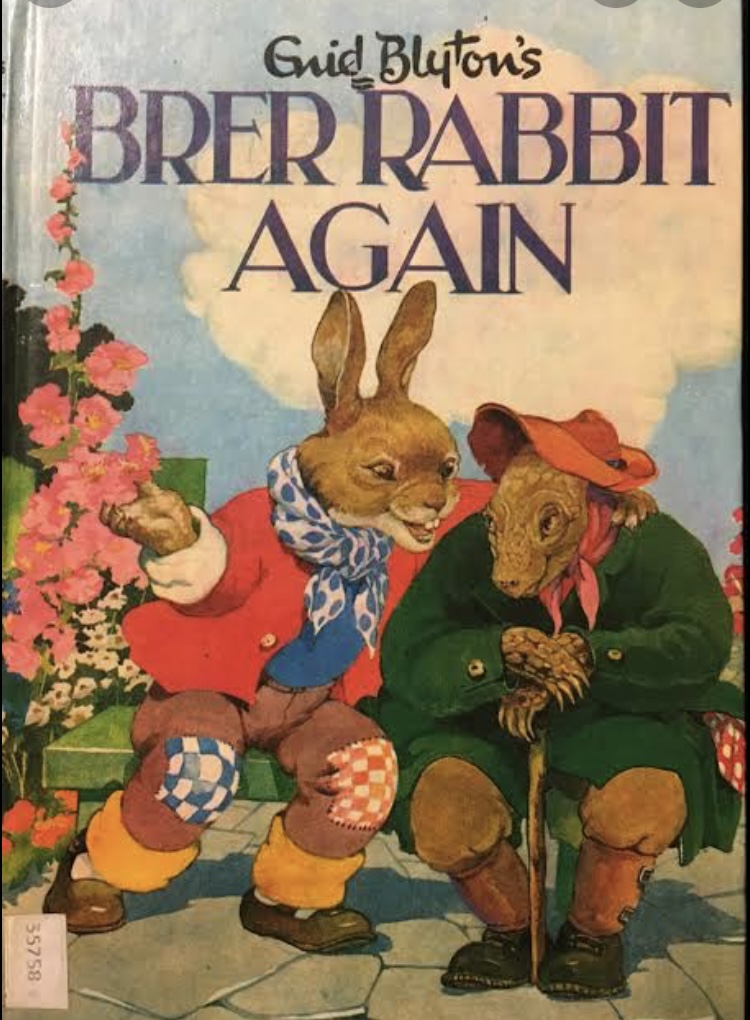
As a child in the 1970s, I avidly read much Enid Blyton. My favourite was the mischievous trickster Brer Rabbit, always getting the better of Brer Fox and Brer Wolf and Brer Bear with his quick wit.

It was only when I re-read a few of the stories about a decade ago that I realised, to my dismay, that Brer Rabbit is not exactly a laudable hero. He is a con-artist and a fraudster, forever taking advantage of the trust and good nature of those around him. He is what the English, of a later generation and lower social class than Mrs Blyton, would call a spiv.

From the 1980s onward, Enid Blyton has been regarded as a literary persona non grata in children’s literature by many who are too clever to believe in witches but who are still willing to burn them. She is regarded as misogynistic and racist, through her portrayal of women as weak characters in her books, and through the inclusion of golliwogs (sometimes even as the heroes, rather than as the villains).

Some even read a homo-erotic relationship into the friendship between Noddy of Toytown and his elderly neighbour Big Ears. (Whether this is seen as a thought crime in the same light as the issues raised in the previous paragraph, I leave to you, gentle reader.)

You can read what you like into Blyton. Some of her greatest critics in 1980s England were the sort of people who ruled the Greater London Council, who banned the use of the terms ‘black’ or ‘white’ coffee from the workplace, because such terms were racist (instead you had to ask for coffee with or without milk).

Getting back to Brer Rabbit. Perhaps his subliminal influence as a trickster inspired the corporate fraudsters who plagued the UK in the late 80s and early 90s, like Nick Leeson of Barings Bank fame. Maybe he read too much of Blyton’s Brer Rabbit trilogy as a child?

I never read any of her secret society stories, ie the Famous Five and Secret Six. You might argue that those inspired people, when grown to nominal adulthood (like a cretinous former friend of mine) to join real secret societies like the Freemasons (or perchance bondage dungeons?).

But I do have a passing acquaintance with Noddy of Toytown, the hero of a series of stories for younger readers, complete with colourful illustrations.

Noddy, relationship with Big Ears aside, is the most inappropriate of Blyton’s characters, when reviewed through the eyes of her modern day critics. But they have tried to save him, with some careful historical revisionism to make him socially acceptable to the 21st century reader.

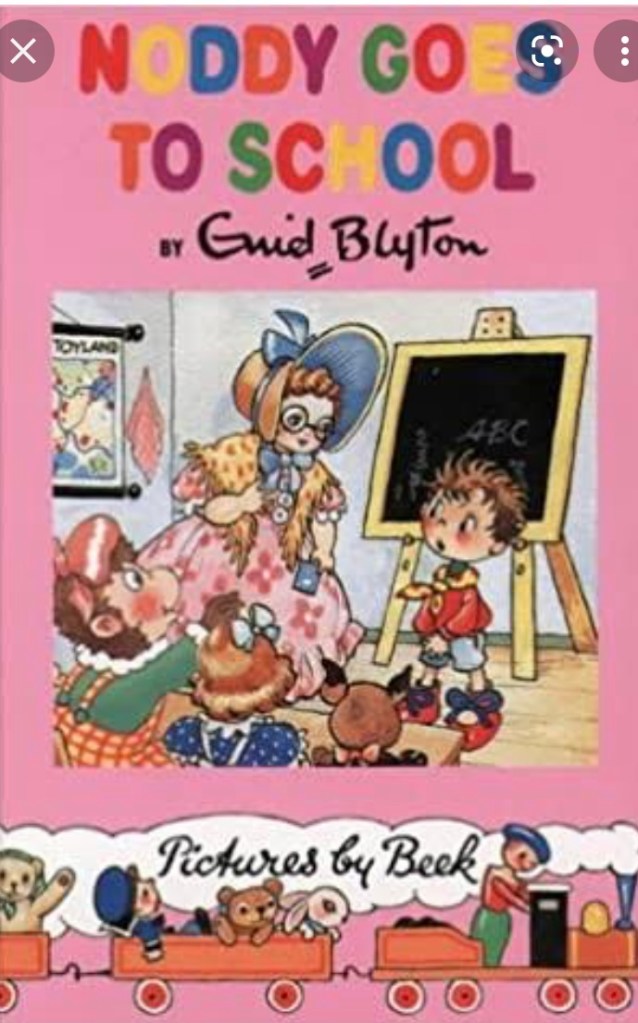
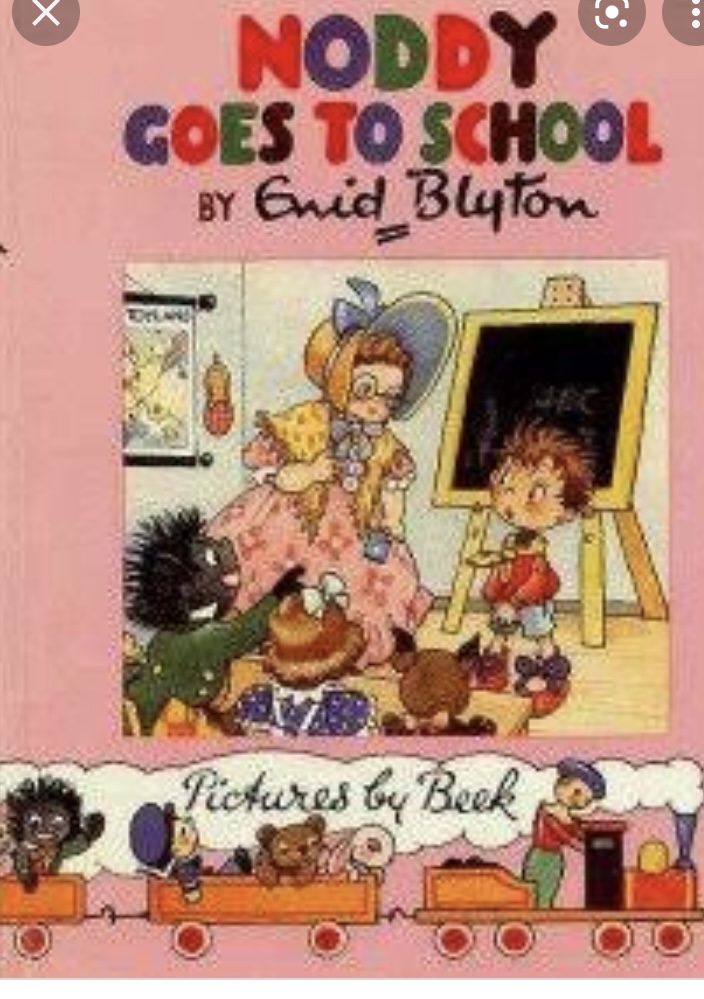
Let’s compare, and then comment, on the two covers of the highly inappropriate ‘Noddy Goes To School’. First the original, and then the sanitised one.

Inappropriate for readers
Appropriate version?!?

I think you can see a subtle difference there. The Golliwog (whose name, by the way, is Gilbert), has been removed. Exiled from Toytown, if you will. He has been replaced by a monkey.

Another subtle difference is that the slipper on the wall in the original version has been removed. This is consistent with the removal of a passage from the original story, in which one of the naughty children is asked to ‘fetch the slipper’ by the teacher, so that she can give him a spanking. Corporal punishment is a no-no these days.

I think that a more savage assessment of Noddy’s modern revisionist editors could be offered. Poet and literary critic TS Eliot was scathing about the translators of the Revised Standard Version of the Bible, whom he said were atheists without even realising it. In the revisionist Noddy, not only is Gilbert Golliwog exiled, but he is replaced as the principal antagonist of the story by a ‘cheeky monkey’.

You could say that not only are the characters of colour erased from Toytown completely by those revisionists, but they have chosen a ‘cheeky monkey’ as a replacement in a denial of their humanity. Those revisionists may be well meaning, in the same way that many ideological zealots are, including when they send people to the gulags, but a case could clearly be made that they are racist without even realising it, the very thought crime of which they accused Enid Blyton.

Grange or Hill Of Grace?

Yum yum
Also yum yum

I am a bit of a wine buff (which is a kind way of describing someone who probably should drink a lot less fine red wine than I do). Back in 1999 when I lived in Canberra for most of the year, I started reading about wine appreciation in order to relieve the boredom of dwelling in Australia’s most boring city. I also started paying attention to wine brands and labels, which I had not done before.

By that, I mean that I started to drink a lot of Penfolds wine as my preference, and not Poet’s Corner (thankfully I don’t think they make that anymore).

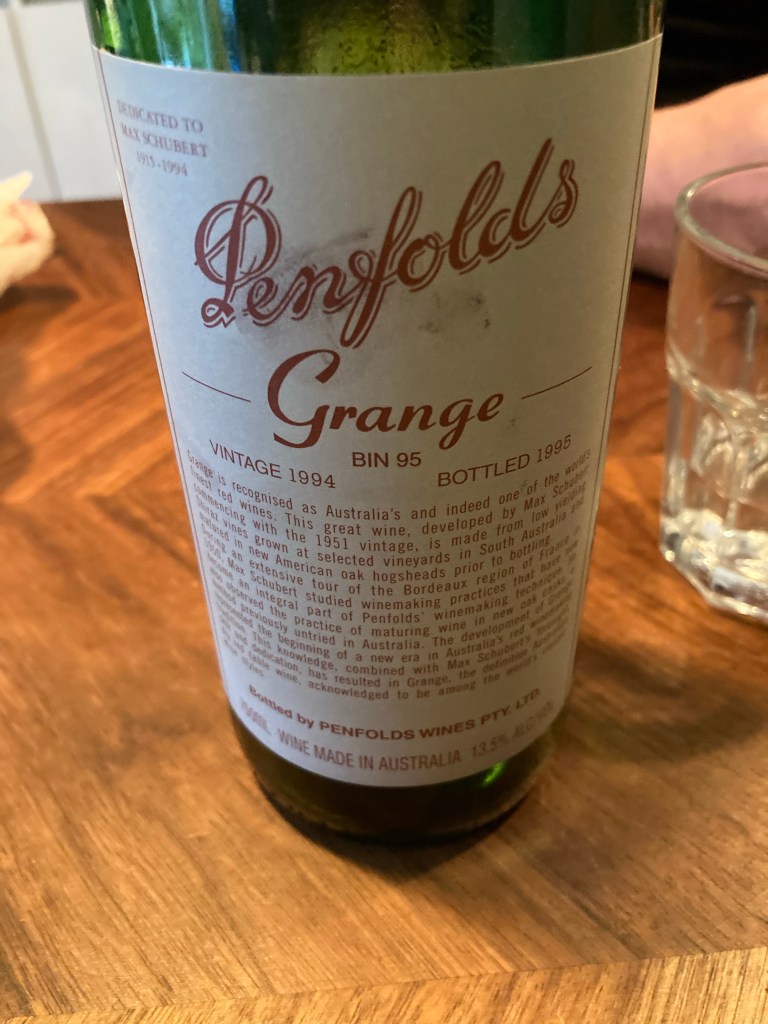
I also started investing in a rather expensive wine collection. At one point, I had 2 bottles of the 1994 Penfolds Grange, one bottle of the 1995 Grange, one bottle of the 1985 Grange, and one bottle of the 1994 Henschke Hill Of Grace stashed away in an esky in the wardrobe in my spare room.

Anywho, wines are made to be drank, rather than stashed away forever like a pile of gold coins under a dragon, and over the intervening two decades I have gradually gotten rid of my premium wines the sensible way, ie down the hatch.

This past month, I have gotten rid of my last two bottles of the good stuff – the 1994 Grange and Hill Of Grace. I am glad that I did, and the friends I shared them with would definitely agree.

The wines were still very good. I think the Hill Of Grace, which I had yesterday over yum cha with some friends, seemed a little disappointing (the only other time I have had the Hill Of Grace was the 1977 vintage in August 1999 at the Tang Dynasty in Kingston, and it was a mighty fine drop), but still very tasty. The Grange, which I had last month with a wagyu steak, really did live up to its reputation, more so than I remember from the past.

The big problem of course is the sealant. In both cases, the cork turned to powder as we were opening the bottles. This is nothing that could not be solved with a decanter, which we had on standby, but it does serve to illustrate the perils of holding onto quality bottles for too long.

Having said all this, I have one more thing to say to you, dear reader, and I do this as a shareholder of Treasury Wine Estate (the owners of Penfolds). And that is, go out there and buy as many bottles of Grange and other fine Penfolds wines (eg St Henri, RWT, Bin 707, Bin 389 etc) as you can. Do not care about the price, or whether you can afford them. Just buy them. Max out your credit card if you have to. Skip mortgage or rent payments. I say this because I want you to push up the price of Penfolds wine and increase the share price of TWE and its profitability so as to enrich me.

Bipartisanship as an affront to Democracy

Go on! Throw your vote away!

Several weeks ago I wrote a post in which I expressed my concerns about recent changes to federal electoral laws to make it harder for minor parties to operate.

Since that time, two long established minor parties, who have enjoyed a small degree of electoral success over the years, have had their registrations challenged by the major parties, due to the similarities of their names. One is the Liberal Democrats, whose existence is being objected to by the Liberal Party. The other is the Democratic Labour Party, who is being objected to by the Australian Labor Party.

A High Court case looms:

https://thenewdaily.com.au/news/2021/12/08/liberal-labor-minors-name-change/

It is disturbing when a major change to electoral laws occurs, with the support of both major parties, which radically alters the political ecosystem in which the minor parties have operated for many years. In the case of the DLP, who in the past 15 years have enjoyed a minor resurgence in Victoria (one Senator and two Legislative Councillors elected), they have operated under their existing name since the late 1950s, without any previous challenge to their existence.

It is a cosy stitch up, which shows how, whilst the major parties disagree on who should be in government, they agree on so much more when it comes to screwing over minor parties and alternatives.

Our political system is already very heavily loaded towards the two main political forces – the LNP coalition on one side and the ALP on the other. Compulsory voting makes campaigning a lot easier as it forces the apathetic out to make a choice on Election Day to avoid a fine. Taxpayer subsidies are given out to candidates and parties based on obtaining a certain threshold of votes.

These measures make it easier for established mainstream parties to operate and make it difficult for alternatives and protest movements to break into the system with any success.

I am not a big fan of proportional representation, except that I believe it is healthier for a cross bench to hold the balance of power in the upper house in order to prevent the government of the day from having its own unfettered way. But proportional representation does provide an opportunity for minor parties to make themselves somewhat more relevant, for as long as the electoral laws are not rewritten to impede their existence.

Why now has there been this change to the rules so that the major parties can put the screws to minor parties in an unprecedented way?

I think it has something to do with primary votes for the major parties collapsing. At the 2019 Federal Election, the primary vote for the Coalition was 41.44%, whilst for the ALP it was 33.34%. Compare that to 1980, where the primary votes were 46.40% and 45.15% respectively. Historically, for most of the second half of the 20th Century, both major parties could consistently count on a minimum primary vote of 45%.

The response from the major parties to the growing disenchantment in the electorate with their policies and personalities and general behaviour is not surprising. Instead of taking steps to try and re-engage with the voting public and recover their lost primary vote, the major parties are taking the lazy way out – trying to knobble the competition they fear from the minor parties.

None of this is healthy. Both of the major parties are locked in considerably vicious infighting at the moment. Branch stacking and purges have in recent years made front page news for both sides, revealing an inability to attract and retain genuine committed members.

Our democracy deserves much better than this.

Modern Monetary Mayhem

For a few days there, after finishing reading Stephanie Kelton’s book on Modern Monetary Theory, The Deficit Myth, I was starting to doubt my sanity. She sounded really convincing.

This is the problem with not have studied economics formally, but just having read a few textbooks to teach myself economics. There are always going to be gaps in my knowledge such that I cannot easily pick holes in what intuitively seem like quite bizarre theories.

Economics all comes down to how you interpret the simple concept of Supply and Demand. That might be quite simple, but Economics is a social science, so there is a lot of room for error, especially when you factor in the need to try and predict the behaviour of billions of people.

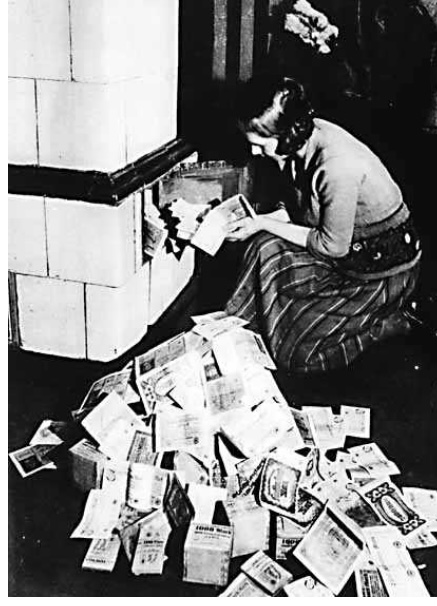
Intuitively, I know that money printing is going to result in inflation, lots and lots of it, and that this could manifest itself in high bread prices, or in high house prices (most likely the latter rather than the former). But I am not going to be able to explain exactly why because I am not a trained economist.

And when clever academics like Professor Kelton or L. Randall Wray write their books and tell me that MMT is NOT money printing (it is all keystrokes on a computer) and that it is not going to cause rampant inflation, I end up scratching my head and wondering how to rebut these assertions.

Thankfully, the answer was sitting in another book on my coffee table (a giant pile of unread books I am slowing getting around to reading), financial guru Jim Rickard’s most recent book, Aftermath. Rickard is one of those people who writes about doom and gloom and how you should stock up on gold for when the Financial Zombie Apocalypse finally hits.

In his chapter ‘Free Money’, Rickard demolishes MMT. He asserts that there are two related factors which the MMT acolytes do not take into account when blithely arguing that the US or Australian governments can create as much money as they like (and they should). Those are confidence, and velocity. When confidence in a currency drops, the velocity of money increases, ie people are going to change their money into other goods (eg gold coins, shotgun shells, tinned food, toilet paper etc) and will be doing so at a faster and faster speed, forcing the price of those goods to go up as confidence in the currency goes down. Ergo inflation, and possibly hyper-inflation.

Thank you Mr Rickard for providing me a sensible rebuttal of Money Monetary Theory and restoring my trust in my own sanity. Now I will resume stock piling toilet paper and packs of dry pasta for when the tough times really hit.

The Global Financial System Is Insane So Let’s Just Print Money

Money printing will make a cold winter warm…

I recently read a book about Modern Monetary Theory. I want to have an understanding as to what the current fashion is in financial policy, given that it does affect our wallets and our lives.

The author was at pains to emphasise that MMT is not money printing – it is creating money electronically by computer keystroke at a central bank (eg the Federal Reserve or the RBA).

Somehow, this does not reassure me.

What it did do was to leave me convinced that the post-Keynesian economic consensus since the mid 1970s is over. Those countries with a strong sovereign currency can issue, through their central banks, as much money as they like, until people no longer believe that the sovereign currency is all that strong anymore.

To a layperson like me, Economics appears to be part mathematics, part politics, and part psychology. It is a social science, and social sciences have never been particularly accurate at making predictions.

Last year I firmly believed that the share market recovery was founded on absurdities, and that there would be a long bear run. Today, I am not so sure.

What we have seen, despite the destruction of large parts of both the domestic and global economies through lockdowns and restrictions since the Covid started, is record share prices and housing prices. This makes me glad that FOMO made me pour my bank account back into my share portfolio over the past 13 months (mostly by last February).

My expectations now have changed. I believe that the financial policy makers, whether or not they actually are acolytes of MMT or other theories, will not allow a share market or housing market crash to occur on their watch. Policies will continue which will increase the money supply at least sufficiently to prevent such a crash from occurring. Such policies include the setting of low interest rates and putting more government bonds out into the market (which incidentally will result in more government spending).

Weeks like this one, where I have taken a 5% hit in my share portfolio, will be minor speed bumps. The access to the ability to borrow and spend more money will keep asset prices rising over the long term, rather than resulting in a crash.

Similarly, whilst I feel it absurd that my brick veneer dump in Avondale Heights is now valued at a million dollars (aka 11 or 12 times the average wage, as compared to the 5 or 6 times the average wage it was valued when I bought it 19 years ago), I do not see that house prices will be dropping to a more affordable level anytime soon.

For people making important life decisions like buying a family home, there is little room for error. If a median house is (optimistically) worth 9 or 10 times your annual salary, and you have a deposit saved of 20%, the risk to your financial security of a shift in interest rates could be severe. It is because of that risk that I get the feeling that interest rates are not going to be rising anytime soon.

Sainthood for Santamaria?

I was having a few beers the other day with a friend who is on speaking terms with various people associated with the remnant of B.A. ‘Bob’ Santamaria’s ‘Movement’ (although I am not sure that the NCC and the DLP are as unified as paranoiacs in the Labor Party would believe). He said that there is a minor push to canonise Bob Santamaria underway.

I have considerable ambiguity about Bob Santamaria. On the one hand, he played what I consider an invaluable role in eliminating the influence of the Communist Party from public and industrial life in Australia even before the advent of the Cold War [Anti-Communism is very much a good thing in my view, and watching his TV commentary ‘Point Of View’ on Sunday mornings as a child has helped shape my views on the subject]. On the other, his Machiavellian ruthlessness in pursuing the Communists with their own methods and his high degree of social conservatism [which makes me seem very progressive in comparison] were not so laudable.

I will leave aside his economic views, which are best described as unrealistically romantic, based on a medieval Utopianism where everyone would live on farms under the guidance of Mother Church, and where there is no room for Capitalism, as it is worldly and unspiritual.

But on the whole, I do still have a strong degree of sympathy for Bob Santamaria. Regardless of that, Sainthood for him would be a bad move for the Catholic Church, on the grounds of Divisiveness, Saintliness (or lack thereof), and Absurdity.

Taking Divisiveness first. The 1955 split in the Labor Party, precipitated by the politically inept but jurisprudentially brilliant H.V. Evatt, then Opposition Leader, was not one where Evatt himself was solely to blame.

It occurred sometime after the communists had been effectively purged from the union movement, with their influence within the ALP mostly eradicated. However, the various groups either led or predominately influenced by Santamaria (the Industrial Groups, the ‘Movement’, and Catholic Action) had continued their activities.

Mark Aarons, in his recent book ‘The Show’, has argued, with quite some evidence, that Santamaria’s Movement was aiming, with the communists purged, to transform the Labor Party into a party with predominantly Christian (ie Roman Catholic) values. Evatt, in that context, may well have had some justification for his preemptive strike.

The consequences of that decision led to the creation of what we now know as the DLP, which served as the principal thorn in the side of the ALP both federally and in Victoria and Queensland, well into the 1970s.

Federally, thanks to The Spilt, the ALP did not win government again until 1972, and in the states, it caused the fall of the Queensland and Victorian governments, with the ALP not winning government again in Victoria til 1982 and in Queensland til 1989.

There is still, given the romanticism of the myths woven around the ALP, a great degree of ill-feeling towards their antagonists in that Split, with Santamaria enjoying the role of principal villain.

Given that, even though we are a lot more secular now than we were in the 1950s, a lot of Catholics traditionally have tended to support the ALP, any canonisation of Santamaria (except in the Simpsonesque manner with an actual cannon) would not bode well for the Church.

There is also a lack of Saintliness around Santamaria. As Mark Aarons indicated in his recent book, not only was there was a degree of ruthlessness in the way that Santamaria ran his machine, but a degree of dissimulation (not to say mendaciousness) in his words.

In Shia Islam there is a concept called ‘Taqiya’, which involves a precautionary denial of one’s religious beliefs and practices in order to avoid persecution. This concept does of course lend itself to abuse, such as being used to gain advantage in less dangerous circumstances. Moral relativism, which most of us practise, whether we like it or not, does lend itself to rationalising our conduct. You could argue that in getting his followers to adopt a lot of the methods of the Communists, such as ballot fraud in union elections and covert tactics, Santamaria was practising a distorted form of Taqiya.

And then of course there is the Absurdity around the idea of Santamaria becoming a saint. After all, he was a mad keen Carlton supporter and can you imagine Carlton Football Club producing a saint?

Then, what would he become Patron Saint of, aside from Carlton Football Club? Branch Stacking?

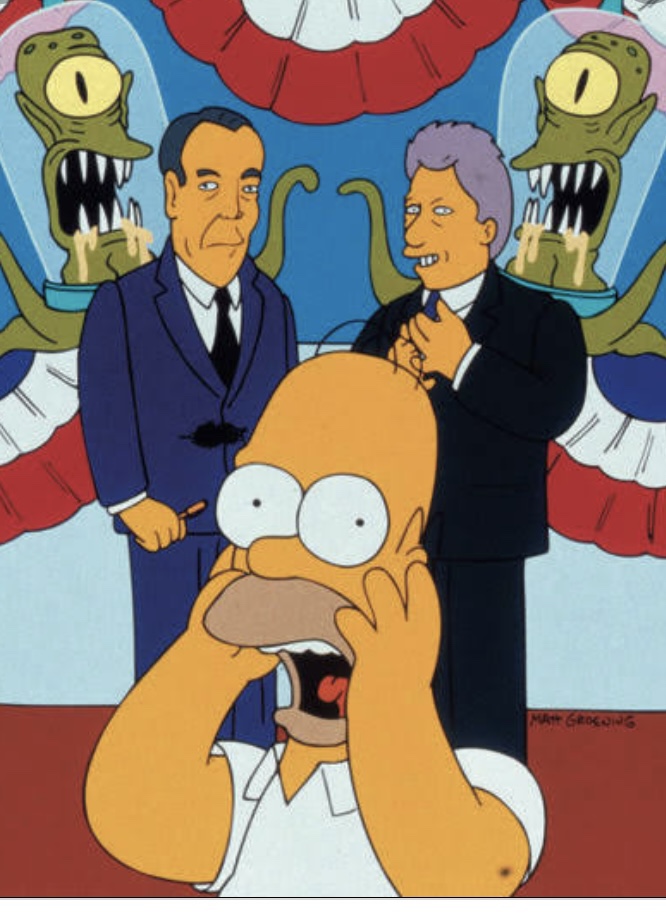
And whilst he went by ‘Bob’ publicly, the B.A. stood for Bartholomew Augustine. In an era defined by The Simpsons, can you really imagine there being a canonisation of a Saint Bart?

Anti-Technocrat Protests and Faux Anti-Fascist Outrage

Belt and Road is all about jobs for Victorians

There were protests in Melbourne this week, principally motivated by opposition to the technocratic pandemic bill proposed by the Andrews government, a proposed law with significant overreach, no sunset clause, no effective oversight by the Parliament (indeed, it represents an abdication of the Parliament’s duties), and limited (if any) right of review to the courts.

From what little I have gathered about it, there was a bit of a carnival atmosphere about the protests (we do miss our Moomba). Clown World have placed some considerable and interesting material on their page (aside from alluding to my recent mention of Julien Benda’s writings in this blog):

More seriously, there has been quite a lot of faux outrage and hypocrisy by apologists for the Andrews Government, particularly around bandying accusations of fascism around at people who are protesting against technocratic government policies.

Let me start by saying that I consider the use of accusations of ‘fascism’ in political argument as signs of either ignorance or immaturity by those who wield such terms. I recently was in a conversation with a fairly articulate (and therefore presumably intelligent) union organiser who spoke of opposition to capitalism and fascism in the same sentence. That did not really help her credibility.

Most people who are protesting are exercising their right of freedom of expression against some quite objectionable laws and repressive measures by a technocratic government. There is nothing illegitimate about protesting such appalling laws.

Yet they are being accused of being loonies or fascists, and herein lies a significant degree of hypocrisy on the part of the active ‘left’.

Take for example the use of placards featuring pictures of Daniel Andrews with a Hitler moustache. This has been subject to very loud howls of indignation.

Whilst parallels between the technocrat Daniel Andrews and the genocidal Hitler are excessive, and of course, extremely childish (ad hominem attacks of this nature are always a poor substitute for a rational argument), the degree of outrage against these placards is extremely hypocritical, given the eagerness of leftists to use such imagery and accusations against those they disagree with.

Take for example Melbourne during the 1990s, when Jeff Kennett was premier. His most unpopular policies involved necessary tax hikes and drastic cuts in government spending – necessary because of significant mismanagement by his predecessors.

Not only did this result in protests against his newly elected government within six weeks of his election (suggesting a contempt by those who organised such protests for the democratic process), but in the use of images of Kennett as Hitler. There was a novelty store in either Lygon Street or Brunswick Street which proudly featured in the front window plastic busts of Kennett with a Hitler moustache. Where was the outrage against that? I presume the people indignant at the portrayal of Premier Andrews in that guise would not have been offended by Kennett’s similar portrayal.

I believe that the right to protest is one which people are entitled to regardless of what they believe. During the past 18 months of repression of the right to protest, some people expressed the view to me that because the people protesting against the lockdowns or other measures were not the sort of people who protested against Australia Day, or in BLM marches, or climate change rallies, that somehow, their right to protest was less than (or inferior to, perhaps) those who protested for progressive causes. This is not so. A healthy democracy requires that all people who feel strongly about a cause should be able to peacefully protest in public without repression by the police.

Villainy in the novels of Alexander McCall Smith

I have been avidly reading the novels of Alexander McCall Smith for about twenty years, since I first discovered The Number 1 Ladies’ Detective Agency and avidly devoured the first four novels (all that was in the series at that time).

McCall Smith is quite prolific, and has since then started two other major series, the Isabel Dalhousie novels, and the Scotland Street novels, as well as several others which he picks up or puts down as time goes on (I have not seen Cordoroy Mansions in a while, whilst Professor Inglefeld has made a comeback, and I really enjoy his new Detective Varg series).

Having come out of lockdown recently, I have blitzed through the most current McCall Smith novels available, the latest of the Ladies Detective books, the third Detective Varg, and the newest of the Scotland Street books.

One of the very appealing things about McCall Smith is that he does not really have dark or villainous people in his books. Detective Varg is busy heading the Department of Sensitive Crimes, solving very strange puzzles which usually involve transgressions rather than victims, and husband stealing Violet Sepotho in the Ladies Detective books is usually showing up on the sidelines trying to gain some sort of unearned advantage only to be eventually thwarted by Precious Ramotswe and her cohorts.

There is usually a very bright and optimistic perspective on human nature in his writings.

There is, I think, one exception. That is the character of Irene Pollock in the Scotland Street novels. She is the mother of the long suffering seven year old Bertie, and (thankfully now estranged) wife of Stuart Pollock.

Irene is a misandrist, with a bleak view of males in general (although with the obvious exception of her lover, the psychiatrist in Aberdeen whom she has now joined, having deserted her husband and sons in Edinburgh).

What makes her a villain is the emotional and psychological abuse to which she has put her son Bertie (Ulysses, the obvious love child of the psychiatrist lover) and husband Stuart during the course of the novels, given her rampant misandry. Stuart has been gaslighted constantly over the novels, whereas Bertie has been regarded not as a boy, but as a ‘project’, who is forced to attend psychoanalysis, yoga, and Italian classes, where all he really wants to do is join the scouts, own a pen knife, and play rugby. Instead, Bertie has his nascent masculinity suppressed by his misandrist (and now mostly absentee) mother.

It does get difficult to read the passages involving the odious Irene without getting angry, and hoping that something rather more bad happens to her than to any of the other characters who get their comeuppances in McCall Smith’s novels.

Whilst there are many people, like Irene (who left Stuart under the pretence of starting a PhD in Aberdeen where her lover had moved to) who are very educated but still not very intelligent, out there in the real world, one really hopes that she is just a straw woman, and that such dogmatic misandrists like her do not exist in real life.

Sadly, I am probably wrong. After all, I have a passing acquaintance with the utterances of Clementine Ford, who is quite real.

Cleveland Browns Merchandise

I feel great affinity with Browns Fans

I can be quite the contrarian sometimes, particularly in relation to sports.

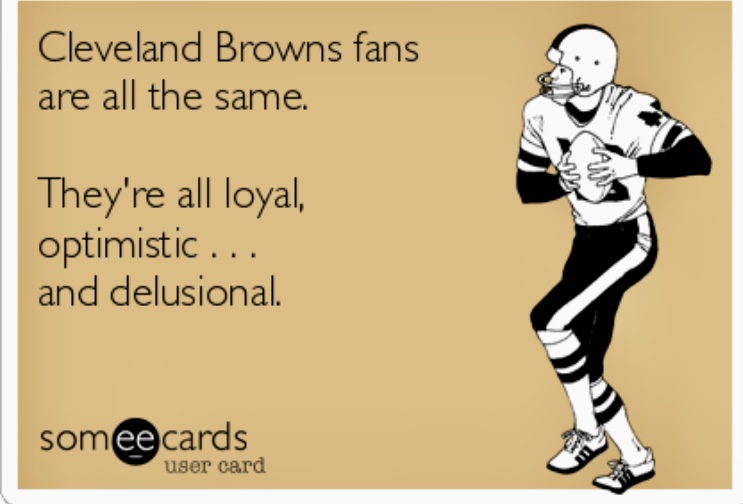
I have written a few times over the past couple of years about my decision to become a Cleveland Browns fan, specifically based on their lack of success, which reminds me of my beloved Footscray (aka Western Bulldogs), who, prior to the current golden era starting in 2016 under Luke Beveridge, had suffered from a particular lack of success.

Whilst they made the ‘play-offs’ last season (it takes a while for me to learn American jargon), this season they are sitting at 5-5, so I am not too optimistic about the Browns’ chances of doing better this year.

Obtaining fan gear to show my support for the Browns has been challenging as lack of local availability meant that I had to order a t-shirt online.

This has now changed. I discovered this past week that NFL merchandise can be bought from a shop at Highpoint, including caps, jerseys, and hoodies. And so I happily bought myself a Browns hoodie – brown with an orange helmet on it – on Thursday.

Until it gets too warm in the coming weeks, this will be my coat of choice.

Go Browns!