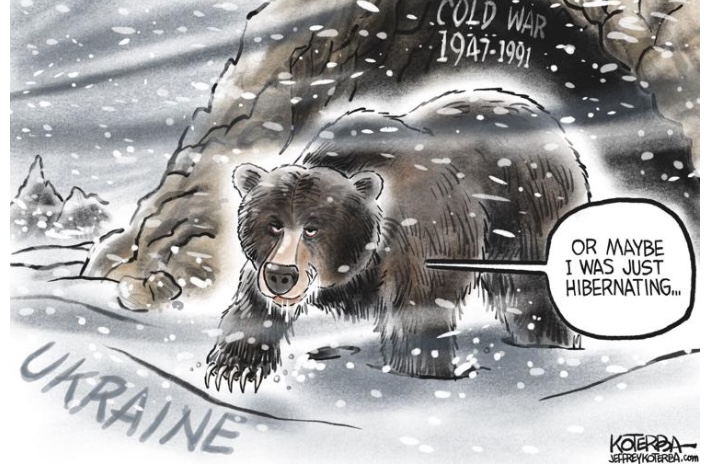
Putin rides a bear from which he dare not dismount

An uncomfortable ride

‘Dictators ride to and fro upon tigers from which they dare not dismount. Discuss’

From memory, 3 decades later, my Politics Honours General Paper (an exam prerequisite to pass to get my Honours degree but which did not cover a particular topic I had studied as an undergrad), was an open question very similar to the one I have listed above – the first sentence of which is a 1938 quote from a speech by Winston Churchill.

At that time, the Cold War being in the process of ending, the idea that Dictators were riding tigers was a very salient one. The one in Romania had faced a summary firing squad not too long before, and others were nervous about similar endings.

A tiger is not a domesticated animal. It is not bred to be trained to obey human commands, and, like all other species of cat, I doubt that it ever can. Does anyone ever think that it is safe to ride a tiger?

In the context of Churchill’s comments, tigers represent the untameable monster of political tyranny. It is both untameable and unaccountable. Whilst a tyrant can ride the beast for a while, if he is unsaddled, then someone else will ride it, or it will rage out of control. In either event, there is a strong chance that it will devour the former rider.

Right now, we have Putin, who has shaped post communist Russia into a dictatorship of his own making. Russia itself was never a domestic cat, or democracy. It always has been autocratic at the very least, as in the time of the czars. Perhaps like in the episode in War and Peace, where Pierre has a prank involving a bear cub, Russia has been the political equivalent of a bear cub, a creature which could grow into a monster, rather than a democracy tame to the will of the people.

Putin is riding the grown version of that bear cub. As dictator, he does not have the checks and balances of a functioning political system or rule of law to protect either his subjects from him, or him from his subjects (in the event that he gets overthrown).

This political rodeo is not a comfortable ride. He must be looking over his shoulder quite a lot.

But there is much that we cannot overlook. Russia has 5,500 nuclear warheads. This means that it cannot be dealt with like a non-nuclear power. It does not like the idea of a near neighbour which it used to rule recently joining alliances which are historically against it, such as NATO. It sees this as a major threat to its own security.

Whether or not you like the idea of Putin as a tyrant invading the Ukraine, Russians as a whole would be uneasy with its neighbour the Ukraine becoming a part of NATO, its adversary of the past 75 years. That would be as threatening to Russia as would the idea of Mexico or Canada becoming members of the Warsaw Pact.

The West needs to tread carefully here. Negotiating a withdrawal of Russia from the Ukraine would be in everyone’s best interests (the economic consequences alone are going to be very costly). Guaranteeing that the Ukraine does not ever join NATO or the EU is a small price to pay for this peace.

And what now is the purpose of NATO anyway? It was set up to counter the Soviet Union. Antagonising a non-communist Russia now, one which has inherited the nuclear arsenal of the USSR but not the ideological agenda, is fool hardy. Unless NATO was to expand in the way that was proposed in the Jack Ryan novels by Tom Clancy (ie to include Russia and face off against communist China), I see little point for it to do more than maintain its position in Western Europe.

The Return of History? Russia’s Invasion of the Ukraine

‘Do you think that the Faith has conquered the World

And that lions no longer need keepers?’

T.S. Eliot – Choruses From The Rock

It is a long time since I read any Fukuyama. His neo-Hegelian take on ‘The End of History’ was all in vogue in the early 1990s, when we in the free Western World breathed a sigh of relief as the Cold War ended with the fall of the Berlin Wall and the demise of the Soviet communist hegemony.

Fukuyama hoped that the types of ideologically driven struggles which Hegel and Marx saw as the engines of History had come to an end, and we were instead to enjoy the triumph of Liberal Democracy.

Well, how have the past 30 years worked out for you?

We are well used to American adventurism, which has existed since at least the 1840s, when the Americans seized half of the territory of their near neighbour, Mexico, and which has since seen the USA intervene in the affairs of many countries across Latin America at first, and then (particularly post-1945) increasingly elsewhere in the world.

Despite the pro-liberty rhetoric that the USA usually utilises to justify much of its adventurism, there are frequently cynical economic motives behind its actions, which show up an inherent hypocrisy in its claims to be making the world safe for democracy sharing close parallels to the Virginian slave owners writing and speaking about the rights and liberties of all men.

And it does make it hard for the USA and its western allies to then criticise the actions of truly despotic regimes acting aggressively against their weaker neighbours.

How much worse was the Soviet invasion of Afghanistan in 1979 than the US entanglement in Vietnam and the rest of Indochina? Many people (myself included) still think that Henry Kissinger probably has a case to answer for war crimes.

Post-Cold War, the first Gulf War and the US intervention to remove the Taliban Regime from Afghanistan were probably justifiable, although the latter activity has been proven by later events to have gone sadly awry.

But the US-led invasion of Iraq in 2003 has proven not only to be a very sad mistake, but very hard to justify in the eyes of global opinion. True, Saddam was a menace to his people, but so are a lot of other dictators, and it turns out that he was no longer a threat to his neighbours.

What it did do was to persuade a few other countries, such as Iran and North Korea, that the possession of solely conventional weapons was not going to be a guarantee against being invaded by a super power.

Which takes us to the Ukraine, which in 1994 voluntarily relinquished its share of the former Soviet Union’s nuclear arsenal, and who has now been invaded by its nuclear armed super power neighbour, post-communist Russia.

This is another message to those smaller nations that perhaps the nuclear disarmament and non-proliferation demands from the major powers should be balanced against their own security needs.

Whilst Russia has been aggressive to its former imperial vassal states since the end of the Soviet Union, the invasion of the Ukraine is the starkest and most extensive act of war that Russia has engaged in since it rolled its tanks into Afghanistan in 1979.

At that same time, Communist China attempted an invasion of Communist Vietnam.

Both events ended badly for the aggressors, particularly for the USSR as the Red Army carried so many thousands of its soldiers home in zinc coffins over the next decade.

But no one wins a war. Even superpowers lose strategically, even when they inflict a higher body count. I think we learned that from Robert McNamara’s mechanistic attempts to manage the Vietnam War with grisly Key Performance Indicators, let alone the failures of the Soviet Afghan conflict.

One of the problems with the USA’s strategic outlook is that it can never see how other powers feel about threats close to their own territory. Whilst Cuba was a dagger held to America’s throat in 1962, the USA has from time to time blundered into major conflicts failing to understand that other powers see their neighbours as buffer states or strategically vital to their own interests.

Take the tragedy of the Korean War. Whilst communist North Korea was clearly the aggressor, the USA and its allies refused to see that China saw the Korean peninsula as an invasion corridor into its territory, one which had been recently used as such by Japan. By continuing to pursue the communist North Koreans up to the Yalu River, the Americans blindly ensured that China would intervene in the war, prolonging it for another 3 years.

Take the Ukraine now. Russia has been subject to two major and traumatic invasions – that in the Napoleonic Wars, and that of the Second World War. It does not welcome the idea of having potential adversaries aligned with its neighbours. The motivation for Putin invading the Ukraine could have been significantly reduced if assurances had been given that NATO membership was off the table for the Ukraine.

It is great for the Western powers to express outrage. Russia is a nuclear armed superpower and the West cannot directly confront Russia within Russia’s perceived sphere of influence without risking nuclear war.

Rhetoric gives in to reality – the Ukraine needs to defend itself as best it can.

What happens next in the Ukraine is up to the people there. I do not pretend to be an expert on the countries and ethnicities of what was once the Russian Empire and then the USSR.

I just know that Finland, which had won its own independence from Russia as a result of the collapse of that Empire in the First World War, was invaded by the Soviet Union in 1940, and in the next few years fought and lost two wars against the USSR. They lost, and they suffered greatly, but the cost in casualties which they inflicted on the Soviet Union persuaded the USSR not to try and occupy Finland directly.

Similarly, the people of Afghanistan suffered greatly between 1979 and 1989 (and still do today, thanks to their tendency for waging Jihad on each other), but that steady northward flow of zinc coffins home to Moscow persuaded the USSR to withdraw.

If the Ukrainians put up sufficient of a fight, for long enough, they will suffer greatly. But they may inflict enough damage on the Russian forces that Russia will have to reevaluate whether it is worth the cost to try directly occupying a near neighbour.

The crisis could even catalyse the fall of Putin’s regime, much as the Afghan war contributed to the collapse of the USSR.

I do not hope for prolonged wars. I mentioned that this was the most aggressive act by Russia since 1979. I also mentioned that China tried some aggression coincidentally at the same time on the other side of the globe. China is far more belligerent in its rhetoric now than at any other time in the past 40 years, and it is eyeing Taiwan most provocatively. Both Russia and China are nuclear armed powers, and their targets are not. Escalation could be very frightening.

First World Problem…

It’s a first world problem when, for the first time in over two years, you need to wear a suit to a dinner at a posh club in the city and you look in your wardrobe and realise that all your suit jackets really need to visit the dry cleaners and then you discover that there is no longer a dry cleaning service operating within 5km of your home.

Sometimes you just have to laugh about it and be grateful you do not live in a country which has Russia as a neighbour.

Pot and Kettle and related Hypocrisies

We obviously have some reds under the beds at the moment.

Our Prime Minister has described the deputy opposition leader as a Manchurian candidate.

I assume that he expects that most people actually have seen that 1950s movie – personally I have not.

Let me put on record that (surprise surprise) I dislike Richard Marles. He is a posh git who went to Geelong Grammar or some similar school which makes him a stereotype for the odious bankers in the Alex Cartoon rather than somewhere relevant to the people who actually live in Labor held seats.

So… I believe that when he recites cliches about labor related rhetoric about the workers, he has trouble keeping a straight face. That does convince me that he is not going to be able to believe or recite any Maoist twaddle.

I try to be honest and earnest (sic) in this blog. Intellectual honesty is important to me, especially as I get older and I see how despicable and dishonest are people supposedly voting the same way that I do.

When we talk about Manchurian candidates, how about we look at some retired Liberal Ministers first:

Alexander Downer – a director of Huawai – a company which is now regarded as not suitable to be involved in Australian telecommunications due to national security issues.

Andrew Robb – who as a minister made the decision to sell the Port of Darwin to the communist Chinese company Landbridge and who then took up a $880,000 with Landbridge immediately after retiring from Parliament.

Santo Santoro – who as a lobbyist after he had retired as a minister successfully lobbied for the family of a billionaire regarded as a risk to national security to be granted citizenship.

These over-superannuated has-been politicians sicken me. I think that they sicken most Australians. If the current Prime Minister wants to start playing games about reds under the beds, he first needs to explain why these ex-ministers should not face charges for treason and the like.

I think that most of us will welcome the opportunity to see these overprivileged avaricious rent-seekers face justice.

RIP P.J. O’Rourke

American essayist and gonzo journalist P.J. O’Rourke has just passed away and I am a little sad.

From around 1989, when I discovered his collection of essays ‘Republican Party Reptile’, there was a period of about a decade when I would eagerly buy and devour his books as soon as they were released. He could be very funny.

Take this extract from his article ‘Myths Made Modern’ on page 21 of ‘Republican Party Reptile’:

‘Penelope was the wife of the war hero Ulysses, who had been an officer in Vietnam. He was overseas for a long time and Penelope felt like he was never coming back. So she had a lot of suitors. But Ulysses did come back, and when he did he killed all of Penelope’s men friends. And he would have gone to jail if the jury hadn’t decided that he was suffering from post-Vietnam Stress Syndrome and therefore had been temporarily insane.’

His car hoon essays republished in that collection, ‘Ferrari Refutes the Decline of the West’ and ‘How to Drive Fast on Drugs While Getting Your Wing-Wang Squeezed and Not Spill Your Drink’ are classics of gonzo journalism.

He did decline as a writer and a character. Old age does get to us, and after about 2001, his books became far less frequent and less funny, and less popular.

When he published a new collection of car related essays ‘Driving Like Crazy’ in 2009, he had to include ‘How to Drive Fast on Drugs While Getting Your Wing-Wang Squeezed and Not Spill Your Drink’ as it was probably his most famous essay.

However, in early old age by then and with a brace of teenage daughters himself who might read his pearls of wisdom and get the wrong idea, his writings from when he was in his mischievous prime about being high on drugs and picking up teenage girls in a fast car made him rather nervous, so he included a disclaimer that he had made it all up and that people should not take that essay as canonical.

And that disclaimer summed up the last 20 years of his writing career.

All the same, tonight I might pour myself a glass of Cinzano and soda and reread my favourite passages from ‘Republican Party Reptile’ for the first time in many years. Vale PJ.

Ageing 1970s Rockers Resist Attempts To Make Them Relevant In The 2020s

Perhaps ScoMo should try this next time?

Let’s face it, ScoMo’s ukulele solo on 60 Minutes last night was rather cringeworthy.

Besides which, he and his advisors might not have thought through the common associations most people have with the words ‘ukulele’ and ‘Hawaii’, as in ‘Hawaiian Holiday’, as in ‘Hawaiian Holiday during the January 2020 bushfires’, as in ‘Nero fiddles while Rome burns’.

It does not really matter what song he chose to inflict on his TV audience, although Dragon’s “April Sun in Cuba”, a 45 year old retro classic, might be much better than at least one other of Dragon’s songs (more on that in a moment).

The band Dragon have reached out, partly from beyond the grave, to express their dismay at the Prime Minister’s choice of music for his performance.

The indignation that Dragon have expressed (they were the singular Dragon then too, as well as now, when all of their members were alive, although right now being called Dragon in the singular is probably more apt) seems to be mostly around ScoMo falling to know most of the words to the chorus of the song. They gently remind us that if he had spent more time on that Hawaiian holiday, perhaps he would have learned that chorus properly.

But perhaps we should be grateful that ScoMo chose that song instead of others from the Dragon back catalogue.

The PM is accused of being tone-deaf, and not just in his musical talents. But it could be far worse.

You see, Dragon was, in its time, very into sex, drugs and rock n’roll, to a level that someone so Godly as our Prime Minister would feel uncomfortable about if he thought about it. The other really big song Dragon is known for is the hugely inappropriate 1978 hit “Are you old enough?”, which would, if the PM had played it, have put a lot of kerosene on the current fire Grace Tame is fanning around him.

Perhaps Dragon should be grateful that he did not choose that song, and remind people of the stage performances put on by lead singer Marc Hunter accompanying it. Late 1970s rockers could get away with a lot more than they could in 2022.

The Vaccine Policy Lottery

I like to play the lottery whenever there is a big draw. I know that the odds are microscopically small (over eight million to one in the case of Tattslotto and even less for the other two major lotteries), but it is unlikely that there will be any other channel through which I will acquire wealth far above my station as a member of the lower lower middle class.

Vaccines are another form of lottery. The odds of suffering a very serious side effect from a vaccine are very small, but still much greater than that of winning the lottery.

I am lucky in that regard. The only side effect I have had from my three Covid vaccinations is a sore arm. I do strongly encourage people to get vaccinated against Covid, as, when you look at the numbers, the odds of illness from vaccination are much lower than the odds of illness (or death from Covid).

But that is not to say that one size fits all is an appropriate position. Over a decade ago, a friend of mine was pressured by her employer to get the flu vaccination. The result for her was lasting and serious neurological illness due to her reaction to the vaccine. I am aware she has some work insurance claim, but that is theoretical and basically worthless. No lump sum and definitely no payment/reimbursement for physical treatment, which is standard and required for her injury.

Which is a way of opening a discussion on vaccine policy and what to do about the people who might suffer from an adverse vaccination event.

The Coalition, who are not regarded as champions of the workers, have actually taken steps to create a compensation scheme targeting vaccine hesitancy, which directs taxpayer money at those which might actually suffer adverse impacts from the Covid vaccination. Of course, this does not help my friend, however it does help people who have a covid  vaccine now.

The position of the Opposition, and the union movement in general, has been much less nuanced and responsible. The ALP has offered a suggestion of $300 per person who gets vaccinated – a blanket spend of taxpayer money which will go to all those who get vaccinated, whether or not they are going to suffer an adverse impact. This position pretends that adverse vaccination events do not occur, or that if they do, they are so rare (or irrelevant) as to not warrant a policy response.

This is despite the union movement (and by extension the Labor Party) knowing full well that serious adverse impacts to vaccination do occur, and have done so in the past. This is because, in its role of advocating for workplace safety, the union movement hears from union members seeking assistance when they suffer adverse health impacts from a vaccination.

In doing this, turning a blind eye to the suffering of this small cohort of industrial injuries (ie workers who have had a vaccination due to work requirements and then been permanently harmed by their bodies’ reaction), the union movement has failed in its duty of care to those people. It has abandoned workers and left them to suffer alone.

Does this surprise me? The union movement, and its parliamentary representatives, is increasingly removed from the ‘shop floor’ of the workplace. The days of decent men rising from the shop floor to the leadership of unions is gone. It is more likely that people like the infamous Kathy Jackson will move into full time employment in a union office, after an elite private school education followed by a few years at university, with no time working in the occupations represented by their union.

The Maribyrnong Explosives Factory Site

I have lived in Avondale Heights about 19 years now. I like it – and whilst I am not particularly Italian, I feel comfortable living in the most Italian suburb in Australia (20% of people here claim Italian descent – compared to 3% in Australia and 4% in Victoria overall).

Just over the Canning Street bridge to the east is the Maribyrnong Explosives Factory site. This is a 124 hectare location which takes up a very large part of the suburb of Maribyrnong. Until 30 years ago, Maribyrnong and surrounds hosted three major Defence factories – the Footscray Ammunition Factory which is now Edgewater, the Maribyrnong Ordnance Factory which is is the weirdly named Waterford Green, and the Explosives Factory.

The Explosives Factory has been closed for a very long time, and I was reading in the Herald Sun early last week about the lack of progress on developing the site. As it turns out, the Federal Government starting talking about redeveloping it as a new residential suburb around 19 years ago, when I moved here (FYI, I used to live in an upper level flat opposite that site on the eastern side in Maribyrnong).

After 19 years of prevarication where are we? It will be at least another 2 years before that site’s fate is decided and development may start.

One of the big problems is that it is hugely contaminated by all sorts of heavy metals and chemicals from decades of explosives production. Cleaning that up is not going to be easy.

There are also a lot of annoying heritage overlays over the site. Apparently run down factories which have been abandoned for decades have important value as part of our industrial history, rather than being easy targets for a bulldozer.

During the time that I have watched and waited for the development of the site, the number of residences on it has increased considerably – they are now talking about 3,300 residences and 6,600 people – which is double what they were talking about originally.

Given that I hate congestion and crowding, especially on the buses and trams that I take which may come to gain many more passengers on the Cordite Avenue stops than they do now, I am happy for the development to be delayed much much longer, say, another 19 years?

But I doubt that will happen. Wests Road, which runs south from that site, is now bookended by two high rise apartment towers. I expect that the warehouses along Raleigh Road south of the factory site will also turn into high rise towers in the coming years, extending Maribyrnong’s skyline.

If decontaminating the explosives site is too expensive and takes too long, I fully expect that instead of low rise housing, we will see much taller high rise apartment towers built on that site (hopefully leaving most of the mature trees extant).

The Wokeness of Brown Bread

I used to think, as a child, that Norman Gunston was real. Not even his parody song Kiss Army in 1980 at the height of Kissmania disabused me of this illusion.

It was only much later that I discovered that Norman Gunston was a fictional character, just like some others nurtured by the ABC, such as the other classic 1970s comedic creation Aunty Jack.

I find it reassuring that the ABC has not abandoned its sense of humour, nor its desire to nurture comedic talent in Australia. This was revealed this week when, on its show The Drum, the ABC introduced us to the fictional comedic character ‘Professor Noreen Young’, an excessively woke individual to the point of hilarity, whose back story includes a close friendship with our loveable and (until recently) cuddly Opposition Leader, Anthony Albanese, and who makes broad declamations of an ersatz Marxist variety.

On the recent admission by the Prime Minister that he eats white bread rather than sourdough or multigrain, our new comedic genius ‘Professor Noreen Young’ told viewers the follow pearls of wisdom:

“I think the comment about white bread was really interesting. Who eats white bread in this country? Anglo men. I come from a working class background.

“We had brown bread because we were healthy. I think it shows a deep lack of understanding about who works in this country.

“I think that there’s a deep intersection of race and class… I do think that there are some politicians who understand what the working class looks like. It’s not white anglo men.”

I look forward to more utterances from this great new comedic creation.

I am certain that she is a fictional creation because she claims to be close friends with Anthony Albanese. Until his recent weight loss, it was quite clear that Mr Albanese was excessively fond of eating white bread, yet Mr Albanese is Italo-Celtic in origin, not Anglo at all. Yet much as she is so clever about nutrition, she is not claiming credit for the loveable Albo losing so many kilos lately. A real person, rather than a fictional character, would be talking about that quite proudly.

Otherwise, the thought processes behind a real person dividing bread into the woke (ie brown) and not woke (ie white), does descend from the risable into the seriously disturbing.

And not for the cultural appropriation of what it means to be working class, something which Professor Young can no longer claim to represent.

Do you know what a Kulak was? They were independent peasant wheat farmers in the Russian Empire prior to the Russian Revolution. At the time of the Russian Revolution, the new regime twisted the term to mean people who withheld their grain from the new regime. Lenin and Stalin came to denounce and persecute them.

As many as six million were murdered by the Soviet regime, and millions others imprisoned or deported to Siberia.

All for the crime of growing wheat for making bread.

Bread, and the grain we used to make it, is a matter of life and death – of plenty, or starvation. To talk flippantly of class hatred, and smugly of whether a bread fits a politically correct line, whether of race or class, is to ignore the historical lessons of the past, where matters of race and class have led to the withholding of bread, or the killing of those who make it.

And so it is for that reason that I hope that Professor Noreen Young is a fictional character, not a real human being. For if this Professor Noreen Young really exists, with her ignorance of history and her clear hatefulness towards those different to herself, then it truly marks that we still have those walking amongst us with the zealotry to inflict the sorts of horrors seen in the workers’ paradise of the Soviet Union.