I’m not really retired yet, but I have 12 and a half months of extended leave to get used to the idea, and I am not going back to work.
I started my leave at lunchtime yesterday, marked with a very large farewell drinks at my Club with about a hundred colleagues and friends. The bar bill was sufficiently big that I will not be heading off on any holiday before my upcoming trip to Italy mid September. But hey, you only retire once, and I think Aristotle wrote something in the Nicomachean Ethics about Magnificence (or Munificence – they are much the same thing) being a virtue.
So what do I do now?
As the t-shirt says: I do what I want, when I want, where I want.
For today, that involved a nice long afternoon nap on the couch, followed by reading a few chapters of the latest Lindsey Davis murder mystery. Afternoon naps are going to be a large part of my lifestyle going forward.
I have a lot of binge watching in front of me. Now that Warrior Nun has been renewed for a third season, I feel justified in investing the time to watch season 2, and I need to make the time to finish watching revenge drama The Glory.
My lawn does need a lot of attention, and I think I will need to mow it sometime this week. Plus prune the fruit trees.
Already, several well worn business shirts have gone into a charity collection bag, and my white t-shirts for work days are going to be converted into cleaning rags. I also am going to get rid of most of my ties – not that I have worn them very much in recent years.
Life is good when you can retire at an age where you are still young enough to enjoy it. Right now, I count myself very lucky.
There is a very memorable passage in AB Facey’s beloved memoir A Fortunate Life where an unnamed senior British officer visits the front line at Gallipoli. When he suggests a highly risky and pointless action and is told that they do not want to lose more men needlessly, his callous reply is: “What is a few men?”.
In 1989, the Australian band Hunters and Collectors named their album “What’s a few men?” in tribute to this mention. I immediately got the reference.
Facey went on to comment that he and his comrades then would refer to that visiting officer as Lord Kitchener, probably with the awareness that the Field Marshall would have been equally as callous as (if not even more than) his fellow officer.
Kitchener, who made his name as the anti-hero of the Boer War, before becoming the poster boy of the British Army in the First World War, would have at least have been extremely callous, if not indifferent, to the lives of friend and foe alike. It was, after all, in the Boer War where the concentration camp was invented, as a way of controlling the enemy civilian population.
With the lens of 120 years perspective, it is difficult not to see the civilian deaths from disease in those camps as a crime against humanity, or that Kitchener, if he were alive today, would not be facing prosecution under the Rome Statute.
Whether Kitchener himself was guilty of ordering war crimes, such as those which Breaker Morant then committed, and for which Morant was rightly punished, is debatable.
This has come to the fore again this week, where people in Adelaide are petitioning for the inclusion of Breaker Morant’s name on a Boer War Memorial, just shows how little we have learned.
Let us get this straight: Breaker Morant was a murderer and a war criminal. He killed several unarmed people, including civilians. It is possible that he was following unofficial orders from the British command structure, but this would not exonerate him of his actions.
In recent years, various elderly Germans who, as teenagers, served in some minor capacity in concentration camps, have faced justice for their complicity in crimes against humanity. Why is it that those people are facing justice, whilst on the other side of the world we are still considering Morant as a hero and a martyr?
Following immoral orders does not exonerate the guilty of their crimes.
Which segues into the other current matter. The Australian Federal Police have had to abandon their initial war crimes investigation into Corporal Ben Roberts-Smith VC due to the possible inadmissibility of some of the evidence they have, whilst a senior barrister has raised the opinion that quite possibly, his infamy means that Roberts-Smith cannot be fairly prosecuted.
I do hope that these issues are resolved, and that due process of the law can be followed properly, either to exonerate Roberts-Smith, or to convict him.
In the case of Roberts-Smith, unlike those of Morant, there are no suspected orders from the command structure to commit war crimes. These are the product of a toxic warrior culture, of which Roberts-Smith was a progenitor rather than a product. The command failures which led to this culture flourishing do not exonerate the officers involved from failure as leaders, but they do not make them complicit in war crimes, the way that Kitchener may well have been.
Whilst we await the prosecution of one suspected war criminal, we should not be celebrating a convicted war criminal as a hero. Nor should the carefully curated display devoted to Ben Robert-Smith’s military career continue to be on show at the Australian War Memorial.
We need to remove any lingering doubt about what we as a nation expect from our soldiers. There is no glory, nor heroism, in war crimes.
American historian SLA Marshall is best known for his study Men Against Fire: The Problem of Battle Command.
In this book, he asserted that, in most US Army units in the Second World War, only one in five men actually fired their weapons. In elite units, the ratio was one in four.
Of those who did, he claimed that many were traumatised by the experience, such is the psychological reluctance to take human life, even in situations like war, where it is considered acceptable by most people, rather than murder.
Many of the non-traumatised shooters were, according to Marshall, suffering from psychopathic disorders.
This does go some way to explaining why the Waffen SS were so effective at fighting, even when greatly outnumbered. The reluctance to kill was probably missing in most of the members of that force.
[NB – the data behind Marshall’s study has been discredited, but academics have found that the underlying premise holds regardless.]
The recent civil court findings against Corporal Ben Roberts-Smith VC in his defamation case have me thinking about Marshall and his findings. The court found, on the balance of probabilities, that he is guilty of war crimes and murder on the battlefield, particularly the execution of unarmed prisoners – and of compelling other soldiers to participate in such killings.
The findings were so significant that whilst the court did not find that there was sufficient evidence of other matters (such as domestic violence), there was no defamation of his character in those unproven allegations, because of the severity of the proven accusations.
This matter is not over. A civil court finds on balance of probabilities. No criminal charges have been laid, and if criminal charges are laid, the standard of proof is higher – beyond reasonable doubt.
When considering the human taboo against taking life, it does worry me about what sort of people we are lionising for their heroics. Killing in war is a necessary evil, but it is not something which is glorious or something to celebrate. It is no coincidence that our greatest war heroes are Simpson the stretcher bearer and Weary Dunlop, the army doctor – men who saved lives rather than took them. They are the ones to whom we have erected statues, and rightly so.
The finding of the civil court is extremely serious. The most high profile and feted war hero from Australia’s recent and fruitless involvement in Afghanistan has been found not to be a war hero, but to be a war criminal. This was not surprising – the Brereton Report was released in November 2020 and indicated that war crimes had been committed and covered up by 25 members of the ADF.
At the time of that report, I wrote in this blog about the ‘ghost’ of Breaker Morant. For too long we have considered Breaker Morant a martyr and a scapegoat, rather than what he truly was – a war criminal who was rightly executed.
It is time that we exorcise the ghost of Breaker Morant.
Firstly, we need to make it clear that there is no place in the Australian Defence Forces for war crimes, and that there is no glory or profit or matyrdom to be gained from such conduct. This hang over from the case of Breaker Morant in the Boer War, that he was a martyr, needs to be finally dealt with – we need to accept the truth instead of mythologising such people.
Secondly, we do need to prosecute any of these alleged war criminals, including Corporal Roberts-Smith, with the full force of the law. Holding the Victoria Cross should not be seen as giving someone immunity from being held to account.
Thirdly, the Australian Army’s leadership needs to be held to account. It was commissioned officers who had the oversight of our forces in Afghanistan, who turned a blind eye and a deaf ear to the conduct of those NCOs who committed such crimes. This failure of leadership has never adequately been addressed – many of the officers involved have progressed further up the chain of command, medals intact, and are now generals, their careers embellished rather than sullied by their command experience in such situations.
I would say that until this is resolved, the most senior positions in the ADF beyond Chief of Army (ie the sole four star position and various of the inter-service three star positions) should be held exclusively by senior RAAF and RAN figures.
Fourthly, there are many medals and citations still to revoke. This includes not just that held by Corporal Roberts-Smith, but those of those officers and current generals who failed as leaders.
This is what we need, as a civilised community and democracy where our defence forces are accountable to our elected leaders, both to maintain our security and our democracy through a professional and ethical defence force. It is also what both our allies need from us, and our potential enemies. How we treat our enemies is a mark not only of how we then should expect them to treat us, but how we should behave as a decent society, one which should be reluctant to resort to warfare.
To mark the King’s Birthday weekend, hipster clothing store Dangerfield has put up various posters in their store windows with ‘Not My King’ emblazoned across the face of King Charles III.
Such frivolous and ignorant posters trivialise the importance of maintaining both civil debate on constitutional matters and careful consideration of the underpinning protections afforded to Australians under the constitutional traditions dating back to Magna Carta.
Our democratic institutions, constitution and our civil society all deserve more careful consideration than such irresponsible, destructive and superficial coverage.
I will not be shopping at Dangerfield and I urge any thinking adults to follow suit.
Some misguided people believe that Christopher Marlowe faked his death to avoid arrest by the Elizabethan authorities on blasphemy charges and went into hiding, becoming the actual author of the plays attributed to Shakespeare.
I doubt that anyone who has actually read Marlowe would see that as halfway plausible, given the much darker and more pessimistic world view expressed by Marlowe.
I have long had a possibly unhealthy preoccupation with the nature of the Devil, and hence I am very familiar with many of the depictions of the Devil in literature. The Faust legend, about a man who sells his soul to the Devil, is depicted very differently by those who have written about him. Goethe’s Faust starts off as a relatively good man who becomes increasingly corrupted after his deal, but who, at the very end, is still not damned despite the Devil’s efforts to claim his soul.
Two centuries earlier, when Marlowe wrote Doctor Faustus, the story is much the inverse. Faustus, after making his deal, spends most of the play regretting his decision and repenting of his sins. Yet, despite this, he is dragged off to Hell at the very end. A deal is a deal, after all.
I suppose Marlowe’s blackly pessimistic Faustus was representative of the times. The Reformation had started 70 years earlier, and the theology of the new Protestant faith was darker and less forgiving than would be allowed for by Catholicism. The road to Hell is far easier to tread and has far fewer exits after Luther and Calvin remade Christian theology. Marlowe, the cynical and probably atheistic maverick, could not have escaped those influences at University despite his skepticism.
Despite my own intense skepticism, I am, if I am honest with myself, still hard wired as a Roman Catholic, and therefore I do believe in repentance and redemption, that very few people are truly irredeemable.
Last year after the conclusion of Season 2 of Ted Lasso, I wrote that perhaps it was transforming into a Shakespearean tragedy, with the fall from grace of Nate the assistant coach, tempted by hubris and the Devil (in the form of former AFC Richmond owner Rupert).
After just watching the ending of Season 3, I must say that I was wrong. Nate repented very early on in the piece, resigned from coaching West Ham, and returned to Richmond to do his penance as an assistant kit boy. He was redeemed and forgiven, although I assume his penance was much softened by the acquisition of a very hot girlfriend.
The real villain of the story is Rupert Mannion, the former owner of AFC Richmond and ex-husband of Rebecca, the current owner. With his flowing black coat, he is not just a villain, but possibly represents The Devil (as he is listed on Rebecca’s phone list). Constantly philandering and morally corrosive, there is even a moment towards the end of the season, where he listens to Rebecca’s pleas against creation of a super league and refuses to join it, where even he might be worthy of redemption.
But that passes, and his ruthless competitiveness and lack of a sense of fair play result in his ultimate downfall, when he storms off the field in the final match of the season, with the Richmond fans chanting WANKER at him (the nickname, if you recall, Richmond fans used to reserve for Ted Lasso at the start of the series).
As a lifelong supporter of the Footscray Football Club (and recent fan of the Cleveland Browns), I have great affinity with and affection for underdog teams. I suppose that having AFC Richmond end up finishing second in the Premier League is the right ending, as winning would be too much the cliched sort of predictable outcome Hollywood gives us in sporting stories. But I still am disappointed for the fictional Richmond fans. Why could they not have their fairytale ending, just as myself and my fellow Bulldogs fans had in 2016?
But winning on the field is not the message from Ted Lasso. It is the moral journey of all the characters, where they all grow into much better and happier people by the end of the story. They might not all find love (I still think Roy and Keeley should still be together), but they do find happiness, and friendship.
Except for Rupert. He ultimately proved himself to be unrepentant and therefore irredeemable and loses his third wife and his new football club. He then slinks off alone into obscurity, which probably is in itself a form of Hell.
As a child, I think that the first ‘chapter books’ I read were Ruth Park’s Muddle Headed Wombat series. She was quite prolific and there were over a dozen of them in my primary school library. Close to a decade later, I also read her rather tragic adult novel, The Harp in the South, which seemed very far removed from the adventures of an anthropomorphic Wombat and his friends.
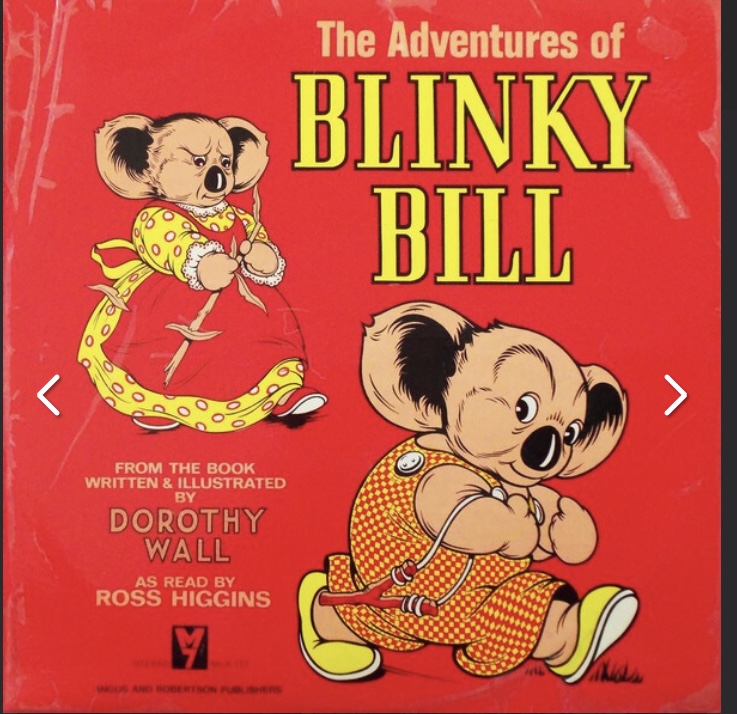
But for all the reading proficiency I gained from reading about the Muddle Headed Wombat, I had far more affection for Blinky Bill, the mischievous koala, even though his author, Dorothy Wall, was far less prolific.
After all, we all love koalas, don’t we?
The original Brisbane team, introduced in 1987 along with the first Perth team (the West Coast Eagles), was, despite being called the Brisbane Bears, more inclined to use the image of a koala bear who rather resembled our childhood friend Blinky Bill as their mascot.
Below are the relevant koalas for your perusal.
Of course, the Brisbane mascot seemed a little closer to a Drop Bear than to our loveable friend Blinky Bill.
The long march to a national football competition started in 1982 when the South Melbourne Football Club was persuaded to move north and become the Sydney Swans. It was then followed by the introduction of Brisbane and West Coast in 1987.
The VFL renamed itself the AFL for the start of the 1990 season, after having first tried unsuccessfully to force a merger between Footscray and Fitzroy Football Clubs, which was blocked by a grassroots revolt by Footscray supporters, led by Peter Gordon.
The competition became more legitimately a national one in 1991, when the AFL was able to use somewhat sneaky negotiations with Port Adelaide to leverage the SANFL, who had been holdouts, into entering an Adelaide team into the competition.
1991 also saw West Coast make the Grand Final for the first time, with them taking the premiership in 1992 and 1994.
1994 also saw Fremantle join as the second WA team
The current Brisbane Lions were formed from a merger with Fitzroy at the end of 1996 which saw that foundation VFL club effectively die. This opened the way for Port Adelaide to finally join as the second SA club.
There then followed a golden decade or so for interstate clubs, consolidating the AFL as a genuinely national football competition. This started with Sydney making the grand final in 1996, followed by Adelaide winning back to back premierships in 1997-98, and Brisbane Lions then winning three in a row in 2001-02-03.
2004 saw the first time in history when there was no Victorian team in the AFL grand final, when Port Adelaide defeated Brisbane. This was followed by Sydney defeating West Coast in 2005 and West Coast doing likewise to Sydney in 2006.
2011 saw the inclusion of the ill starred Gold Coast Suns, followed by the Greater Western Sydney Giants in 2012.
These two teams have not been very successful. After the 2019 grand final, a meme did the rounds that Tom Boyd (Western Bulldogs hero and former GWS recruit) and GWS had both kicked three goals in a grand final.
I consider the Pandemic to have been very good for the AFL. It lifeboated the competition to Brisbane in 2020, playing the AFL grand final at the Gabba, and proving that it could survive outside the Australian Rules Football cradle of Victoria. It then followed that up in 2021 with many games in Tasmania, and a grand final in Perth.
And now we are waiting for the newly announced Tasmanian 19th team to join the completion in 2028.
So, where do we go from here? Each state will have at least one AFL team? NSW, QLD, WA and SA each have two, and Victoria has ten (nine in Melbourne). The asymmetry of having 19 teams screams out for a 20th team to enter the competition, but from where?
Let’s eliminate some unlikely contenders first.
Canberra is not big enough to add to the TV market. Most people there are expats from other cities, and have their allegiance to their original football codes and teams. The best they can hope for, at least for the next decade or two, is that GWS plays more games there (and that GWS actually starts winning games generally).
One big sentimental favourite idea for me is to have a team based north of the Tropic of Capricorn, taking in the WA town of Broome, the NT capital Darwin, and the FNQ cities of Cairns, Townsville, Mackay and Rockhampton. It could be called The Northern Terror, with a crocodile as the emblem, and focus predominantly on recruiting and developing the local indigenous talent.
Sadly, much as I love that idea, I do not think that it is viable at all just yet, even if (something I do not support), a lot of taxpayer money from the federal, territory and QLD state government went into subsidising it.
So let’s look back around the population centres which might support a team.
Queensland is still mostly a rugby zone (both league and union), and the Gold Coast Suns are going the way of most professional sporting teams of any code (ie they are sinking rather than swimming). The AFL will persevere there, as it does see much potential growth in the TV market in Queensland.
Similarly, we have NSW. The Sydney Swans have been very successful on field, and very successful off it in attracting sponsors and a middle class supporter base. GWS is the key to attracting a very different demographic of supporters, and so far this has not worked out. But the TV market there is potentially extremely lucrative, and so the GWS experiment will continue.
And this leaves the two most populous cities outside of Melbourne where Australian Rules is the dominant football code: Adelaide and Perth.
I am firmly of the view we need to have a 20th AFL team, and that it should be a 3rd team from either Perth or Adelaide.
There are pros and cons to both.
Let’s look at Perth first. A big pro is that there is a larger population (2.1 million as compared to the 1.4 million of Adelaide). It also has a very good stadium, which holds 60,000. And let us not forget the mineral wealth which makes the potential sponsorship of a third team very lucrative.
But, and this is a big BUT, I do not think that there is any particularly strong club in the state competition which would stand out as to draw support away from West Coast as to command an independent presence.
Then there is Adelaide. The population is smaller, and the state is not as wealthy as WA. Nor does it have a stadium quite as good.
But it does have two things going for it which are quite important. Approximately 8.7 % of the population currently are members of one of their two AFL teams (as compared to 7.7% of the population of Perth, and 13.6% of the population of Melbourne). This is indicative of a slightly more intense sporting culture in Adelaide, which is more likely to commit to another team. The recent success of the inaugural ‘Gather Round’, which will see this hosted by Adelaide for the next three years, is indicative of this.
And the other thing that it has is a much stronger local competition, the SANFL, than in Western Australia. Norwood, in particular, is a long standing and extremely successful club which has a strong supporter base, second only to Port Adelaide, which was able to successfully move into the AFL.
My personal view is that the AFL should start to look at transitioning Norwood into being the 20th AFL club.
But the other thing that the AFL does need to do in the meantime as we await the debut of Tasmania in 2028 is to look at building the supporter base north of the Barassi line. GWS should play most of its games, including away games, either at home or in Canberra, or in other cities like Newcastle and Wollongong. Similarly, Gold Coast should play most of its away games in Darwin or FNQ.
And when the time comes for another Gather Round city to be selected, it should be Sydney, so as to rebuild interest in the competition there.
Given the title of this post, I had better address the Thylacine in the room first up. We do have many unkind jokes about Tasmanians, the nicest being that the small population results in limited genetic diversity and therefore leads to them all being two headed and red haired.
That is now out of the way (spoiler alert: it is not out of the way and I will make witty digs about our southern cousins all through this posting), and I can start to get more serious about the recent announcement of a new Tasmanian AFL team, which will bring the total to 19 teams.
I have always been skeptical about the need for an AFL team in Tasmania. I have three reasons for that. The first is that I do not think, one or two headed (yes I still cannot resist), that the population of Tasmania (approx half a million according to the Census) is large enough to sustain one team. The second is that the AFL is, these days, all about growing the TV audience. As Tasmania is already hopelessly devoted to Australian Rules Football, I do not see that it is going to grow the TV market by any noticeable amount.
And the third reason is that there is a serious and somewhat toxic rivalry between the north and south parts of the Island, such that I have my doubts that they will all unite behind a state based team.
This latter reason has already manifested itself, with the resignation of two northern Tasmanian state MPs from the Liberal Party in protest at the announcement of the construction of a very expensive new stadium in Hobart (in the south of Tassie, for those of you unfamiliar with the geography).
I am not going to cite exact figures, but the Tasmanian government is funding about two thirds of the cost of this new stadium, and the Federal government is chipping in the other third. Many Tasmaniacs (I could not resist), particularly of the Greens and State Labor (not Federal mind you) persuasion, are quite concerned that the money could be better spent on relieving poverty and homelessness.
Having been to Hobart four times, and Launceston for one day of work meetings (it rained constantly), I do not envy those who would find themselves homeless down there. It is very cold and wet. I do not think regular displays of the Aurora Australis at night will compensate for the cold.
But this is all about Sport as a nation building tool. I love my Australian Rules Football, and my AFL team, very much. But as I would have written in this blog at various times, I am very skeptical about Sport being used in Australia for nationalistic purposes. We do this more here than anywhere in the world other than totalitarian regimes (places who really need something to distract from the constant spying, human rights abuses and shortages of the bare necessities of life).
Because Sport is seen as such a necessary nation building tool by our politicians, federal governments are quite happy to write large cheques to subsidise sporting competitions and large stadia, in exchange for a degree of control unhealthy for civil society. That an outlier to the Federation like Tasmania, which does feel very much like a poor half sister to the secessionistic and wealthy Western Australia, does not have an AFL team, is to nationalists an affront, regardless of the economic and demographic realities (ie that Tasmania cannot sustain a viable AFL team).
It also is a causus bellum for state politicians. Parochialism is always alive and well in sport – indeed it is the foundation of the supporter base for most clubs (just look at my own allegiance to the Western Bulldogs). And the Tasmanian government was quite happy to gamble on the popularity of forcing the creation of an AFL team, even if it costs the state a lot of money, instead of something boring like spending the money on public housing.
The AFL was quite happy to ignore the economic and demographic realities of sustaining a Tasmanian team for a very simple reason. It is not going to cost the AFL anything. All the cost is going to be borne by the state and federal governments. And the AFL knew that if it did not cooperate, it would suffer the downstream and implacable hostility from the Tasmanian government, and also lose the bipartisan goodwill it enjoys in Canberra. So it was all win-win for the AFL in making this choice, as opposed to lose-lose if it did not cooperate.
After all, the AFL has been successfully surfing the nationalist sentiment (and related political interest) behind the ideology of Sport As Nation Builder better than anyone other than the Olympic movement for the past 30 years. It does not want to fall off the board.
So let’s all enjoy our new AFL team. Hopefully it is able to do better than GWS and the Gold Coast have since our last big expansion.
Give or take a day or two, it is now one year since ASX listed craft brewer Broo (ASX Code BEE) entered a trading suspension on the Australian Securities Exchange.
I don’t think that I can say ‘Happy Anniversary’ on this momentous occasion.
I have kept a close eye on Broo in that time, or as close as the holder of 120 shares worth less than my current pocket change can be motivated to keep. I have noticed that various directors have come and gone since Groges the founder was ousted in a shareholder putsch last March or April, and that most of those who have been interested enough in the company to have pushed him out or to have sought to participate in the running of the business since then seem to have lost interest.
In terms of assets, the company has divested itself of its Ballarat land, its brew pub in Mildura, and its various other physical assets. I do not think it now exists outside of its suspended listing, its bank accounts, and its intellectual property.
I now am very confident in saying that I do not think that Broo is going to trade again on the ASX in its current form. The most likely outcome is that its listing is used as a vehicle for some other company to list on the ASX sans IPO.
Now, more than ever, I am glad that as a pre-existing shareholder, I did not participate in the IPO in 2016, where I could have bought many more shares at 20 cents each. I had a feeling then that this was a huge premium to the actual value of the business, and events since then have proved me right.


 Lost For Words!