Qatar’s Clumsy Attempts At Both Sportswashing and Skywashing

This week has seen a bit of a blow up in the purported controversy about Qatar Airways being denied the opportunity to have more flights to and from Australia. The revelations that Qantas has been treating its customers in what can be charitably described as a kleptomaniacal manner has raised rage at the protection that Qantas gets from the Federal Government.

It appears to many commentators now that the Federal Government’s decision to deny Qatar more flights was significantly influenced by the horror and anger felt by many members of the community at the treatment of more than a dozen Australian women who were taken off a Qatar Airways flight at gunpoint and subjected to invasive examinations in what is commonly referred to as the Doha Airport Incident in October 2020.

I fully endorse the decision by the Federal Government to deny Qatar Airways more access to Australian skies. I do think that the Government has made a major miscalculation in that they were not prepared to be transparent about the reasons for their decision. They should have proudly announced why they were standing up against the appalling behaviour of Qatari government officials in relation to our fellow citizens and owned the decision.

There would have been applause.

Instead, they prevaricated about explaining why they did what I consider to be the right thing, and now there are accusations that they are unfairly protecting Qantas at the expense of Australian consumers. This is an unnecessary storm, and one which has been fanned by the general unpopularity of retiring Qantas CEO Alan Joyce who has presided over recent mega profits, fanned partly by government payments during covid and by price gouging the travel starved public. This has all blown up in the past week, and it unfortunately detracts from the appalling Doha Airport Incident, which has never been adequately addressed by our government.

Whilst Qatar Airways denies any liability on the basis that it was the Qatari police who undertook the actions in the Doha Airport Incident, as recently as last month, it is important for us to consider that the airline itself is owned by the same government which controls the police. The actions of one agency of that government should not be considered as absolving an associated agency of that same government of their liabilities, particularly given the commercial benefits which accrue to the owner, as well as potential prestige.

Qatar is controlled by an autocratic royal family. The assets of the government are, to all intents and purposes, the property and investments of that family. The values and conduct of the agents of the government are very much based on the tone set by their leadership.

In recent years, the term sports washing has been used usually to describe the way that various oil rich middle eastern petro-states (although other regimes also do it) try to deflect attention from their legion of human rights abuses and buy prestige in the Western World through investing in sports. This includes buying sporting teams (particularly in the English Premier League), setting up sporting competitions (such as Saudi Arabia’s LIV golf competition), sponsoring sporting teams, and buying the naming rights for prominent stadia or competitions (here in Melbourne I can name the Emirates Melbourne Cup and Etihad Stadium as prime examples).

Qatar’s biggest and clumsiest attempt at sports washing was to use a campaign of blatant bribery to buy the hosting rights for the 2022 Soccer World Cup. This succeeded. The 2022 World Cup was held in Qatar. However, the process by which they were able to bribe their way to success was so visible that it resulted in serious outrage. Also, by having the unvarnished vanity to go and hold a competition on their home sand, they drew the scrutiny of the world to the labour practices by which the much needed white elephant stadia were to be built, and the repressive nature of the society which soccer fans were about to enter.

Sports washing is not all. I have, in one of my more clever moments, coined the term ‘sky washing’. This is the use of heavily subsided government owned national flag airlines to raise the prestige of that nation, usually to project the false image of progressiveness and tolerance where the reality is that of a harsh human rights abusing regime. I would say that Emirates and Etihad Airlines, owned by two of the major royal families in the UAE, are prime examples of successful sky washing.

Qatar on the other hand, has suffered severe reputational damage due to the Doha Airport Incident. Instead of discussions about the quality of the business class service offer, and the relatively low airfares available, when people talk about Qatar Airways, they talk about how the Qatari police, who are merely another arm of the same government as Qatar Airways, forced a dozen Australian women off a Qatar Airways plane at gunpoint for an invasive search.

This one incident has destroyed billions of dollars of sky washing endeavours, as it is a matter which has revealed the Qatari government to be the appallingly autocratic and misogynistic regime that it truly is. That wipes out all the potential prestige.

So I mark Qatar a fail overall for both sports washing and sky washing.

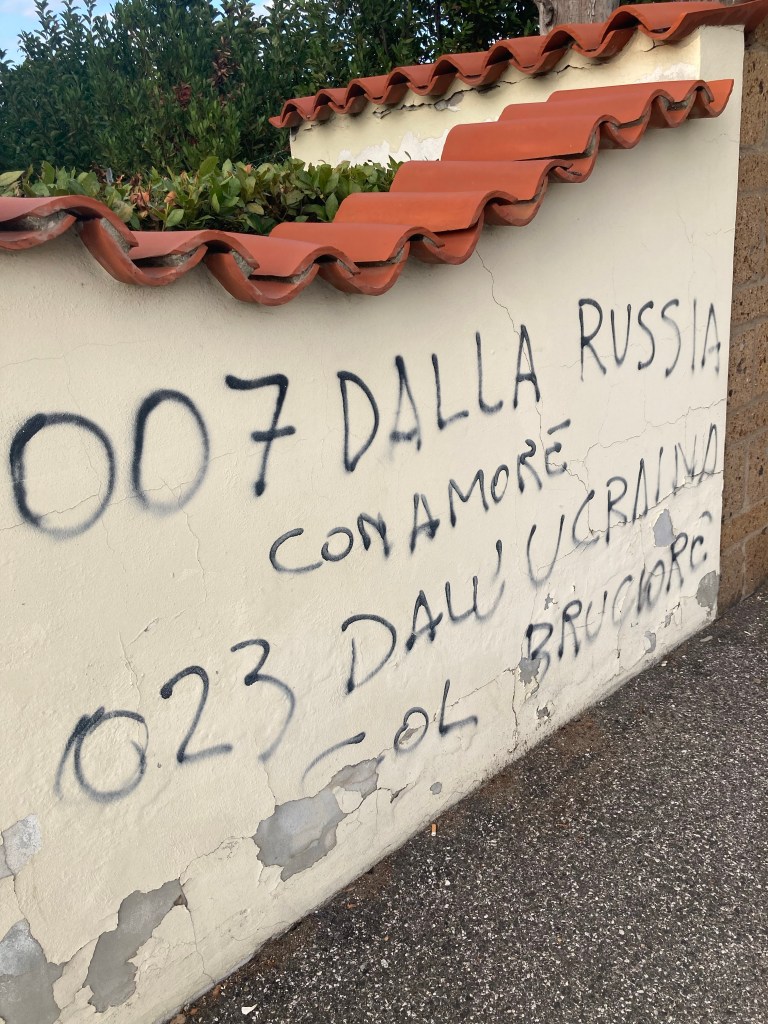
Don’t you miss the days when graffiti had something to say?

I like this sentiment

During and since the Covid lockdowns, much of Melbourne has been covered in graffiti. Most of it is indecipherable tags, where the only message is comprehensible to the purported artists and like minded morons of their subculture. [I make no apologies for my views on these vandals.]

As a result, given that our Premier is too busy pork barrelling and breaking his word, and local councils are too busy being useless, there has been no effort to clean up this graffiti and it makes our metropolis look like something out of a post apocalyptic film.

But there are some instances where someone has something to say. Recently, some person with very strange ideas spray painted the slogan ‘The Goddess Artemis is a Whore’ in at least two locations in Footscray. I found this extremely intriguing.

Then today, when walking near Fairfield Station after having a vegetarian burger smothered in smashed avo (Fairfield is definitely where to go for such things), I saw the above slogan painted on the floor of an underpass. ‘Selfish Cyclists’ is just the sort of message I would paint if I were not such a rigorously law abiding chap as I am.

Which makes me a tad nostalgic for the days when graffiti artists actually had something to say, whether it was political or just obscurely self indulgent.

In the 1980s and early 1990s, we still had graffiti primarily used as a tool of political protest. I recall, when I was in primary school, the slogan ‘Thompson Shears Education’ was painted on a brick factory wall over the street from the back of my school. It was painted, as I later discovered, elsewhere around the inner western suburbs, and related to Dr Shears, the unpopular director-general of education, and Lindsay Thompson, the Minister for Education (and an all round decent fellow if you really want to talk about him). Witty and to the point.

And there were so many brick and concrete walls which served as blank canvases for when lefties wanted to advertise a protest march for a time and place (I support the right to protest, even where I do not agree with the protesters). They had something to say, and their use of the walls was almost legitimate. I respect it.

Then you had the rather obscure. Ronald Reagan’s full name was Ronald Wilson Reagan, and some people in the potentially apocalyptic 1980s saw the six digits of each of his names as a sign of the Anti-Christ, 666. Hence, on the wall of the former Footscray Masonic Temple in Leeds Street, someone started to write:

“The Phoenix has risen from the ashes, Ronald Wilson Rea’…

Well, they were interrupted before they could finish. I hope they were able to get away.

On the retaining wall on the city bound side of North Melbourne railway station from at least 1984 onward, there was the slogan ‘USA The Whore Is Doomed – Rev 17’ which fitted in very much with the potentially apocalyptic times that were the 1980s.

My favourite from that era was on the wall of the Burnley railway station: ‘Blinky Bill Shall Rise’.

And I hope that their words come true.

Facebook’s AI is not ready to take over the World – yet

It’s been one week since I made the dubious decision to finally join Facebook – a decision which immediately caused me to have my account ‘temporarily suspended’ presumably by an AI.

Despite this suspension, I have been able to log into that account via the mobile phone through which I set up the account. It is simply that I cannot access it via my desktop or tablet which currently is the source of annoyance.

And so, in the past week I have been adding various friends, kinfolk, and former colleagues as Facebook friends. I have also been reading or watching various Facebook information videos, sources of great fascination such as timelines for the mostly spoken languages since 1900 on a real time basis, or who has won the most World Cups on a real time basis, deaths in the Second World War by country by year, or countries with the most Miss World Winners (my favourite of those, obviously).

These sorts of information graphics are obviously created by AI. It would take a computer genius with OCD over statistics many months to create the sorts of dynamic graphics on something like language use or war casualties.

But there are some other clues. Where such videos have voices, the voice seems to be artificially generated, and frequently mispronounces fairly easy words. There are some odd terms used. In a video listing overrated people from history, Che Gueverra is described as having been appointed the ‘Pastor’ for economic affairs in Cuba, and Malcolm X is compared unfavourably to Martin Luther ‘Ruler’.

It is obvious that only an AI could substitute ‘pastor’ for ‘minister’ and ‘Ruler’ for ‘King’. A human intelligence is nimble enough to discern context.

So, just like in Blade Runner, the replicants are not yet quite ready to walk amongst us undistinguishable from us.

The Imminent and Indirect Remutualisation of IOOF

After the Banking Royal Commission made its report in the not so distant past, I read several of the books published by finance journalists with morbid curiosity.

The way that major banks and leading financial institutions had behaved, particularly to honest business loan holders and to trusting mum & dad investors, showed a degree of unnecessary ruthlessness and lack of compassion (not to mention sharp practices more than bordering on the unlawful) that will leave a long stain on the reputations of the big four banks.

That Macquarie Bank, a ruthless investment banking machine which has become known for its sharp practices in finance (take the Brisbane Connections float for example), came out of it looking ethical in comparison says something about how bad the retail banks had been behaving.

AMP and IOOF, long standing wealth management companies, came out of it looking even worse than the banks. That AMP’s board had arranged for a supposedly independent review by a law firm of some of its conduct to rewrite its report several times in a self-serving manner regardless of the facts was a serious smoking gun which caused several senior heads to roll. The damage to AMP’s reputation has been almost fatal, and I do not see AMP surviving long term.

Soon after the Royal Commission, legal action was started against several senior managers in IOOF due to their involvement in some supposed illegality with their administration of the superannuation funds under management did not do IOOF the same degree of reputational damage. This is only because one would need both an accounting degree and a law degree specialising in commercial law to understand what they had done wrong, and the rest of us go a little cross eyed trying to follow the accusations.

Reading the Financial Review this morning, I noted a prominent story about how a significant number of superannuation funds administered by AMP and Insignia Financial (IOOF’s recently adopted new name) have significantly underperformed in the past year, triggering mandatory letters to policy holders suggesting that they look elsewhere to invest their super. There was some commentary that the underperformance may be partly caused by the administration fees charged on those funds.

This does not suggest that AMP or IOOF have learned the bitter lessons from the Banking Royal Commission and similar scrutiny of a few years ago.

What is sad is that not all that long ago, AMP and IOOF were both mutual societies, rather than listed companies. They were owned by the policy holders rather than by shareholders. AMP demutualised in 1996 and IOOF in 2002, giving their existing policy holders shares in exchange for the change in governance.

I have been following IOOF closely, because my mother invested my late father’s superannuation in IOOF insurance bonds in 1986. We had been advised that IOOF was good for widows and orphans, and it might well have been then, when it was a ‘friendly society’ trying to do the best for their policy holders rather than being run to benefit its share holders. I have not done a deep dive into their performance since that time, but I do hope and trust that when it was a mutual, it did the best by its members.

Performance since the demutualisation in 2002 has not exactly been overwhelming. The shares were valued at $3.15 when they demutualised, and they are currently trading at about $2.65, meaning that they have been about as good for people like my mother as Telstra shares have been (not that my mother has any interest in share ownership beyond the shares she was given at demutualisation).

In late July this year, Insignia Financial announced that they were planning to sell the IOOF Insurance Bond business to Australian Unity. I made some unsuccessful attempts at that time to get more information from Insignia about this, and I note that Insignia has neither published any further information on its website about this matter, nor written to insurance bond holders like my mother to notify them of this move and what it all means.

The lack of information on this matter just goes to show how far Insignia Financial has evolved from the mutual ‘friendly society’ who was there to look after widows and orphans.

Given all that I have observed about the corporate entity now known as Insignia Financial in the 21 years since demutualisation, I strongly welcome the sale of the IOOF Insurance Bond business to Australian Unity. Australian Unity is the largest surviving mutual society in Australia, being a merger in the 1990s of Manchester Unity (who built that neo-gothic skyscraper on the north west corner of Swanston and Collins Streets) and the Australian Natives Association (which was rather inappropriately named, given it was intended to benefit white men born in the colonies).

That Australian Unity remains a mutual society means that it is going to work primarily for the interests of its policy holders rather than its share holders. That probably means that IOOF insurance bond holders like my mother are going to be members of a mutual society again, and I think that, given the track record of Insignia in the past couple of decades since demutualisation, that is a very good thing.

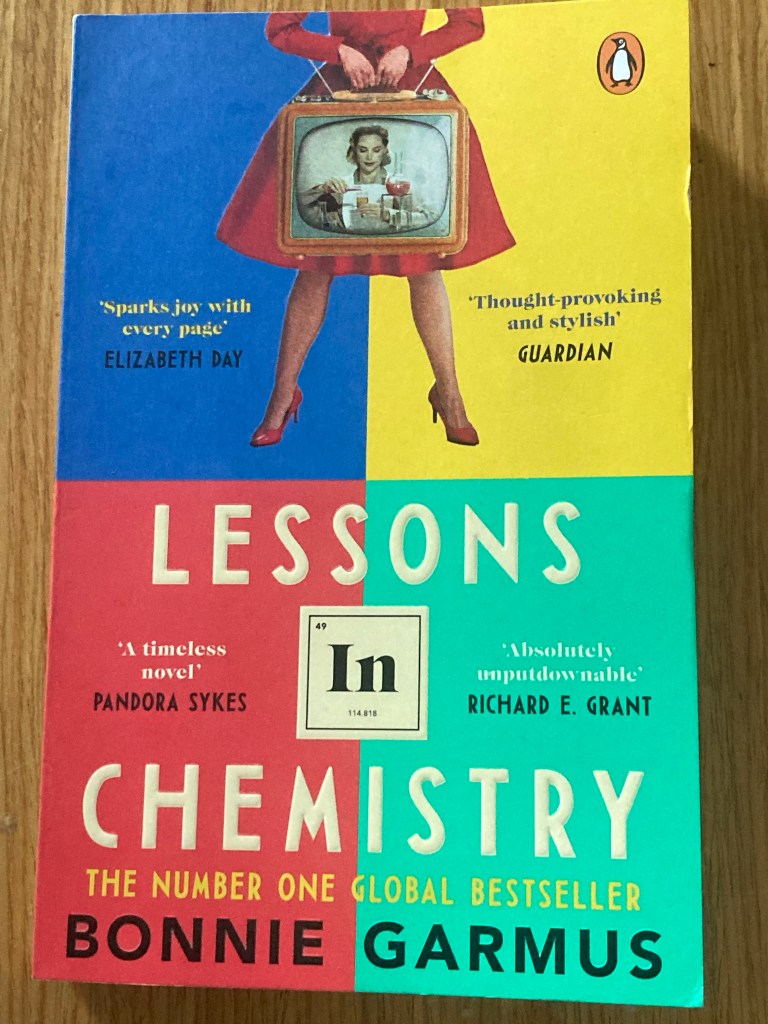
Sometimes, you do need to be Italian to really ‘get’ Italian literature

My god daughter is having her 8th birthday this weekend, and so I am loading her up with chapter books so she can become more proficient at reading.

I doubt that the Muddle Headed Wombat I ordered will arrive in time, and I realised when I re-read Paddington Bear a few years ago that the sentence structure requires an adult to concentrate, so I will leave Paddington til next year.

So I bought a few anthologies of Enid Blyton books (as you do – or at least, as someone as non-PC as me will do).

I also have bought a nice hard back copy of Pinocchio, which really is a dark comedy for children, although I have my doubts that most people are familiar with the novel.

People will not be surprised that whilst I have read the novel, I am not all that familiar with the Disney animated feature. I happily admit that I don’t think that I have seen any of the classic Disney animated features, except for Fantasia.

I will say that the novel is far darker than the movie.

Let’s take the main supporting character in the movie, Jiminy Cricket, an anthropomorphised insect who dresses like some sort of Victorian era London spiv complete with top hat.

He has a much smaller role in the book, and lacks a name, and only occupies the space of chapter 4, which is 3 pages long. There is no possibility for the cricket to spend more page time in the novel because Pinoccio throws a hammer at him and flattens him.

See… much darker than the movie. But skimming my paperback copy of the novel right now, the energy and dark humour leaps off the page at me in a way which the eight or nine year old version of me might not have appreciated.

But to truly appreciate the sometimes dark humour in Italian literature, you need to have some sort of lived experience as an Italian, particularly as an Italian peasant. The struggle for survival is one which Italians find blackly, or bleakly, funny, as is the host of resentments and causes for envy amongst neighbours. As an ethnic Italian born in Australia from peasant ancestors, I am close enough to that mindset to ‘get’ it.

Aside Pinocchio, another example is Italo Calvino’s hero Marcovaldo, an uprooted peasant struggling to support his family in post war Rome. There is a scene where he finds a free feed (mushrooms if I recall), and he then ends up sick all night from it. It might not be funny to Marcovaldo, but to Calvino and his readers, it is indeed – the bleak humour that comes from understanding the struggle for survival.

Moravia perhaps is a little too sophisticated and bourgeois for peasant humour, but he too sometimes can be very funny in a way which an Italian perhaps would exclusively understand. HIs book of short stories, Il Paradiso, which consists of ten stories of a sexual nature narrated in the first person by female protagonists, is well worth appreciating. It is one of the few books of Italian literature which I have read in the original language, given my spoken Italian is better than my reading ability.

Joining Facebook – An Inauspicious Start

Readers of this blog who scroll far enough into the deep recesses four years ago when I set it up will know that I have no fondness for Facebook and that this blog was originally set up as an alternative way for me to share my travel adventures from my 2019 trip to Italy.

That I did not need to set up a blog in 2016 on my previous trip to Italy was due to the existence of Google+, the social media experiment which Google discontinued in early 2019, and of which I had been a member for over 5 years.

On Tuesday I very reluctantly set up a Facebook account. I did so primarily because there are certain distant relatives in Calabria whom I wish to meet on my imminent trip, and that they are more easily contactable via Facebook than other means.

Soon after setting it up on my smartphone, I tried to log on via my desktop and was informed that my account had been temporarily suspended due to suspected breaches of conditions – mostly I presume because I had immediately sent an abundance of friend requests to various friends, former colleagues, and relatives whom Facebook suggested to me.

That has not stopped me logging out and logging back in via my smartphone, but it does prevent me accessing Facebook on this desktop or on my tablet.

So this is a great start to my relationship with Facebook, and confirms a whole lot of the reservations I had about joining it in the first place.

I will see how it continues, but I am sorely tempted, after my trip to Italy is over, to cancel the Facebook account.

So take that Zuckerberg!

The Embassy Taxi Cafe

Unchanged since 1962

I first visited the Embassy Taxi Cafe in Spencer Street in May 1989, either before or after the Metallica concert at Festival Hall.

They made, and still make, some of the best fish and chip shop burgers in Melbourne. I was reminded of this last Friday when I popped in for the first time in ages.

It is a place where the thing which appears to have changed in the past thirty plus years is the price of the food. It’s a time capsule to a much earlier time.

I’m too young to know if there were other taxi cafes around Melbourne back in the day, although I have heard rumours that there were. But it’s the only one now – open 24/7 and regularly frequented by taxi drivers of all companies (Embassy was taken over years ago).

In terms of the best old school burgers in Melbourne, I would list four:

. The good old Embassy Taxi Cafe

. Andrew’s burgers in Albert Park

. Danny’s Diner in North Fitzroy

. The Ascot Vale Fish and Chippery

The first three on my list have been operating for over 60 years each.

Why The Matildas 2023 Dream Run Is Just Like Winning The Americas Cup In 1983

Over a decade and a half ago, a friend told me that he had just ordered a new dinner suit as he had joined a yacht club and they regularly held formal dinners he needed to attend.

There was no talk of him actually going out in a yacht of course – it was all about the formal feeds onshore.

As I discovered a couple of years later, my friend had told me a rather egregious fib – he had not actually joined a yacht club, but rather, a masonic lodge which met on the premises of that yacht club, and he had been sponsored into the Freemasons by a trustafarian who happened to run a yachting supply store.

I believe that the lodge was rather pretentiously named ‘Hearts of Oak’ or something equally silly, and that any yachting enthusiasm by either most of its members or my (now long former) friend was at best fleeting and superficial.

This was a bit like my friend’s sudden enthusiasm, a couple of years before that, for the newly launched A-League, Australia’s new national soccer competition. He had fallen in with bad company, the sort of people who wanted to attend Melbourne Victory games regularly, and he desperately wanted to fit in, just like he did when he joined the Freemasons.

My friend’s passing enthusiasms for niche sports represent something which is more than a mere weak attention span (he has been bundled out of the masons and I doubt he can afford to attend A-League games anymore), it is symbolic of Australia’s own infatuations with certain sports.

As the Matildas progressed through the Women’s Soccer World Cup tournament in recent weeks, there was talk of calling for a public holiday if they won. This was in recognition of the national significance of such a victory, similar to the jubilation which erupted when the yacht Australia 2 defeated an American defender to claim the America’s Cup in 1983. At that time, whilst no public holiday was declared, then Prime Minister Bob Hawke gave his moral endorsement to people to unofficially take the day off and celebrate.

I was only 14 at that time, but I was a bit skeptical even then about the significance of winning the America’s Cup. Yachting is a very elitist sport for the rich, and it consumes much money to undertake successfully. Alan Bond, who was the principal sponsor for the Australian challenger, was a ruthless nouveau riche businessman who sought to use yachting as a way to propel his social standing upward to match his self made wealth.

It did not escape me at the time that he had, weeks before the yachting contest in Long Island Sound, closed down the Waltons department store chain in Victoria and put hundreds of people out of work.

Only a few short years later, this former painter and burglar was found to be extremely crooked as well as ruthless in his business dealings. However Perth is probably the one place in Australia where social standing is less nuanced and more meritocratic, and I doubt that his fall from grace was as harsh as it would have been on the eastern seaboard.

So what happened after we won the America’s Cup? Fremantle was to host the defence in 1987, and was all transformed for this event, possibly in a way which ruined its previous charm (I am not sure as I first visited in 1991). Then we lost the race and with it, any collective interest in yacht racing as a source of national pride.

And so it will be with soccer. Our national women’s team did much better than the men’s team has ever done, and did so hosting on home ground. There has been great interest shown both by the live TV audiences and in the packed stadia.

But it is over. There is no fairy tale history making win, and no public holiday – official or otherwise – to celebrate.

We will now sleep off our hangovers and forget it, just like my former friend with his faux yacht club masonic lodge and his deluded enthusiasm for Melbourne Victory.