That Qatar Airlines calls the decision not to grant more access to Australia surprising and unfair is quite ironic.
Tell it to the women who were strip searched at Doha airport. Now THAT was surprising and definitely unfair.
I'm old enough to know that I don't have any answers, but that won't stop me talking
That Qatar Airlines calls the decision not to grant more access to Australia surprising and unfair is quite ironic.
Tell it to the women who were strip searched at Doha airport. Now THAT was surprising and definitely unfair.
I’m mostly over my jet lag now, having hit the pillow in my hotel room in Rome at 4pm last night after a duty bound walk to the Collosseum followed by a late lunch at a cheap and cheerful restaurant just off the Via Cavour.
I must say that breaking up the trip with a stay in Singapore did not really help. True, one night of decent sleep was good, but as the second flight out was at 3am the following night, could not exactly cause me to board the flight with a few extra hours of sleep.
What sort of helped a little was the extra room and reclinement in Premium Economy. I am not one of those lucky people who can sleep sitting upright, so long haul flights hurt. But at least I was able to doze fitfully during the 12 hour flight from Singapore to Rome.
That does not mean that long haul does not suck, and I am not in premium economy on the way home so I’m dreading that long haul.
You remember the Gideon Society? They are the people who hand out copies of the Gospel in the street and who used to make sure that motel rooms each had a Bible in a drawer.
Hunter S Thompson was very grateful to them for those Bibles as when he was sitting in his motel room drunk or stoned and needing inspiration for his writing, he was grab the Gideon edition and read the Book of Revelation.
What I appreciate about the Gideons is that they are so moved by the Bible that they want to give copies away to people.
I used to feel that way, to some limited degree, about Joseph Conrad’s novella Heart Of Darkness and Mikail Bulgakov’s black comedy The Master And Margarita.
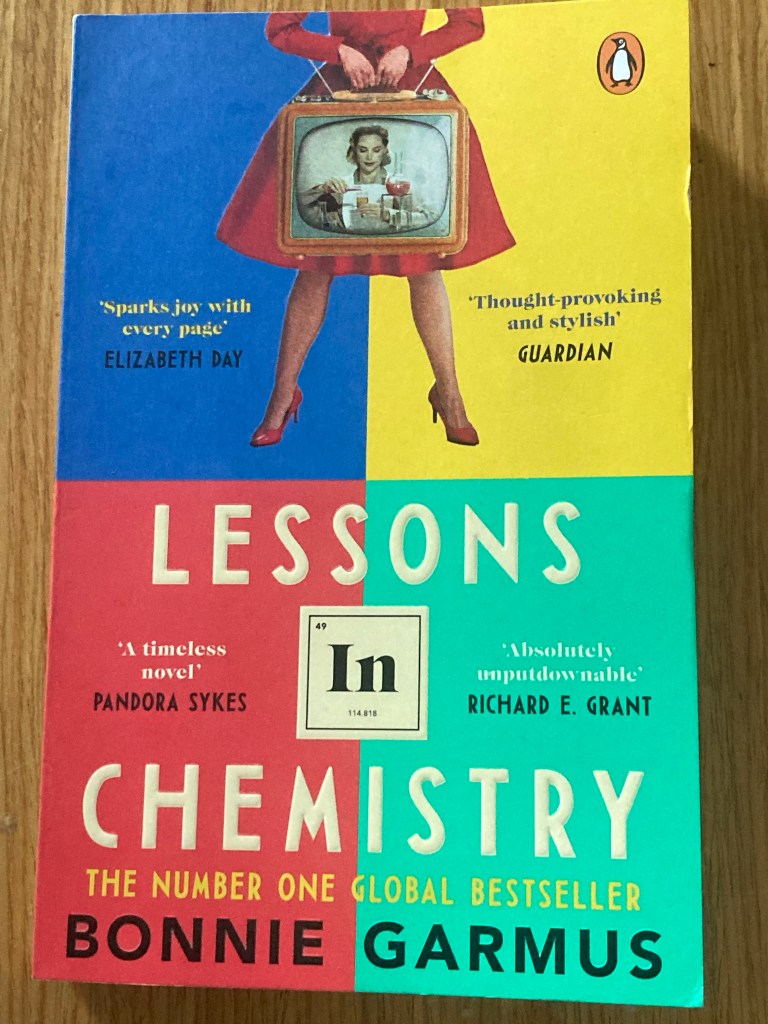
I now have another book I feel that way about: Lessons In Chemistry. I started reading it at Tullamarine airport yesterday whilst waiting for baggage drop off to open. A passing woman paused to tell me it’s one of her favourite books. I kept reading it in the departure terminal and then for the first part of my flight to Singapore.
I’m typing this on my phone so I will leave you to google the plot. Suffice that this book is sad, funny, moving and ultimately triumphant.
I will be buying lots of copies and giving them to my friends.
Several years ago, I was in the lift on the way back from lunch at AFL finals time and happened to make some Collingwood jokes.
By the time I had reached my desk, my phone was ringing. It was one of the HR Managers.
He said: “Ernest, what were you saying in the lift?”
I said: “Some Collingwood jokes.”
“Some effing idiot has just complained about you to HR.”
Happily, making jokes about a football team and its supporters is still the sort of thing which you can get away with at work, although I would not dare to try such a stunt in any pub north of Victoria Parade and east of Smith Street.
Which is a good way to segue into the fact that it is now footy finals time. Collingwood are through to the preliminary finals and Carlton are into a semi. If both teams win through over the next fortnight, they will face off in the Grand Final for the first time since 1981.
I find this the stuff of nightmares.
One of the major joys of the modern AFL era of football has been to witness the regular suffering of Collingwood and Carlton supporters. Given that my team, the Western Bulldogs, has enjoyed very little success (2016 has given me a warm inner glow which will last the rest of my life), the suffering of the supporters of the very successful AFL teams like Carlton, Collingwood, and Essendon, brings joy and malicious glee to my heart.
That this year looks like being a Collingwood premiership makes me a little sad.
Mind you, I would be very petty and churlish if I were not to be happy for Collingwood captain Darcy Moore. He is the son of former captain and Brownlow medalist Peter Moore. He seems to be a very sensible and likeable chap, and I do think that if he were to be a premiership captain, going one better than his dad, I would be happy for him.
Of course, with my team out of the running, I am more interested in the Brownlow medal, and hoping that Bulldogs captain Marcus Bontempelli wins. That would be, along with his 2016 premiership, a crowning achievement on his great career and cement him as one of the Footscray Football Club’s all time greats.
I did lunch last week at the Great Northern Hotel in North Carlton with a friend who is a very senior barrister. Given that I am about to hop on a plane to Italy in a few days’ time, we talked a fair bit about travel, and particularly about the scandals which are currently plaguing Qantas.
Probably because my friend is a very competent barrister, with the intellectual discipline which that entails, he is very reserved in his words, even in private. He does not make sweeping generalisations, nor give opinions which are not based strictly on fact, nor leap to conclusions unless he has evidence to back them.
Hence I was rather surprised when the first words he uttered in relation to the disclosure that Qantas had intentionally continued to sell tickets on 8000 flights after they had cancelled those flights were: “It’s fraud. It’s theft.”
I concur of course.
Intentionally seeking to gain a benefit by deceiving someone out of their property is fraud. That Qantas did it on an industrial scale is a matter of serious concern, which is now being addressed by the ACCC in commencing a prosecution of the airline.
This is the latest in a long string of outrages involving Qantas under the leadership of its deceptively woke CEO Alan Joyce.
I will list a few of them.
During the covid lockdown crisis, Qantas obtained at least $2 billion in subsidies from state and federal governments. This was significantly more than any of its smaller competitors.
After several years of covid related losses, Qantas recently announced a $1.7 billion profit. It has not signalled any intention of returning any of those subsidies. Nor has it shied away from paying extremely large salaries and bonuses to its senior executives.
When the covid occurred, Qantas stood down thousands of employees without pay. One of those was, up until that point, on extended sick leave during to cancer. Whilst it was legally entitled to stand that employee down, doing so exhibited, on the part of Qantas management, an extreme degree of callousness which is abhorrent to the Australian community.
Prior to this, Qantas has, in order to maximise its profits, outsourced thousands of jobs, causing a decline in customer service and staff morale. Whilst this does not appear to have decreased safety standards, this is the sort of calculated risk which usually only becomes apparent when there is an air disaster.
Until this past month, the ability to claim and use flight credits, such as those from those cancelled flights which had been fraudulently sold to customers, was difficult. Last year, for example, you could only use those credits for flights that cost the same or more than the credits you held. This link to Choice gives some detail on this:
https://www.choice.com.au/travel/on-holidays/airlines/articles/qantas-flight-credits-failure
Industrial relations negotiations run by the supposedly woke Mr Joyce in the past have been particularly ruthless, including shutting down the airline at one stage. Indeed, much as I am a rather right wing person, Alan Joyce makes me look like a socialist in comparison.
All up, Qantas is now a very toxic brand. You do not treat staff, customers, and the taxpayer in the way that they have without commercial repercussions. It is sad that the toxicity of Qantas is being used by some as an issue to try and reopen the issue of allowing more flights by the even more toxic Qatar Airways.
This week has seen a bit of a blow up in the purported controversy about Qatar Airways being denied the opportunity to have more flights to and from Australia. The revelations that Qantas has been treating its customers in what can be charitably described as a kleptomaniacal manner has raised rage at the protection that Qantas gets from the Federal Government.
It appears to many commentators now that the Federal Government’s decision to deny Qatar more flights was significantly influenced by the horror and anger felt by many members of the community at the treatment of more than a dozen Australian women who were taken off a Qatar Airways flight at gunpoint and subjected to invasive examinations in what is commonly referred to as the Doha Airport Incident in October 2020.
I fully endorse the decision by the Federal Government to deny Qatar Airways more access to Australian skies. I do think that the Government has made a major miscalculation in that they were not prepared to be transparent about the reasons for their decision. They should have proudly announced why they were standing up against the appalling behaviour of Qatari government officials in relation to our fellow citizens and owned the decision.
There would have been applause.
Instead, they prevaricated about explaining why they did what I consider to be the right thing, and now there are accusations that they are unfairly protecting Qantas at the expense of Australian consumers. This is an unnecessary storm, and one which has been fanned by the general unpopularity of retiring Qantas CEO Alan Joyce who has presided over recent mega profits, fanned partly by government payments during covid and by price gouging the travel starved public. This has all blown up in the past week, and it unfortunately detracts from the appalling Doha Airport Incident, which has never been adequately addressed by our government.
Whilst Qatar Airways denies any liability on the basis that it was the Qatari police who undertook the actions in the Doha Airport Incident, as recently as last month, it is important for us to consider that the airline itself is owned by the same government which controls the police. The actions of one agency of that government should not be considered as absolving an associated agency of that same government of their liabilities, particularly given the commercial benefits which accrue to the owner, as well as potential prestige.
Qatar is controlled by an autocratic royal family. The assets of the government are, to all intents and purposes, the property and investments of that family. The values and conduct of the agents of the government are very much based on the tone set by their leadership.
In recent years, the term sports washing has been used usually to describe the way that various oil rich middle eastern petro-states (although other regimes also do it) try to deflect attention from their legion of human rights abuses and buy prestige in the Western World through investing in sports. This includes buying sporting teams (particularly in the English Premier League), setting up sporting competitions (such as Saudi Arabia’s LIV golf competition), sponsoring sporting teams, and buying the naming rights for prominent stadia or competitions (here in Melbourne I can name the Emirates Melbourne Cup and Etihad Stadium as prime examples).
Qatar’s biggest and clumsiest attempt at sports washing was to use a campaign of blatant bribery to buy the hosting rights for the 2022 Soccer World Cup. This succeeded. The 2022 World Cup was held in Qatar. However, the process by which they were able to bribe their way to success was so visible that it resulted in serious outrage. Also, by having the unvarnished vanity to go and hold a competition on their home sand, they drew the scrutiny of the world to the labour practices by which the much needed white elephant stadia were to be built, and the repressive nature of the society which soccer fans were about to enter.
Sports washing is not all. I have, in one of my more clever moments, coined the term ‘sky washing’. This is the use of heavily subsided government owned national flag airlines to raise the prestige of that nation, usually to project the false image of progressiveness and tolerance where the reality is that of a harsh human rights abusing regime. I would say that Emirates and Etihad Airlines, owned by two of the major royal families in the UAE, are prime examples of successful sky washing.
Qatar on the other hand, has suffered severe reputational damage due to the Doha Airport Incident. Instead of discussions about the quality of the business class service offer, and the relatively low airfares available, when people talk about Qatar Airways, they talk about how the Qatari police, who are merely another arm of the same government as Qatar Airways, forced a dozen Australian women off a Qatar Airways plane at gunpoint for an invasive search.
This one incident has destroyed billions of dollars of sky washing endeavours, as it is a matter which has revealed the Qatari government to be the appallingly autocratic and misogynistic regime that it truly is. That wipes out all the potential prestige.
So I mark Qatar a fail overall for both sports washing and sky washing.
Just discovered this last night. It’s from a TV drama The Newsroom, and features the way underrated Jeff Daniels.
It really hits the nail on the head about America.
We Australians need to think about what it might mean about us too.
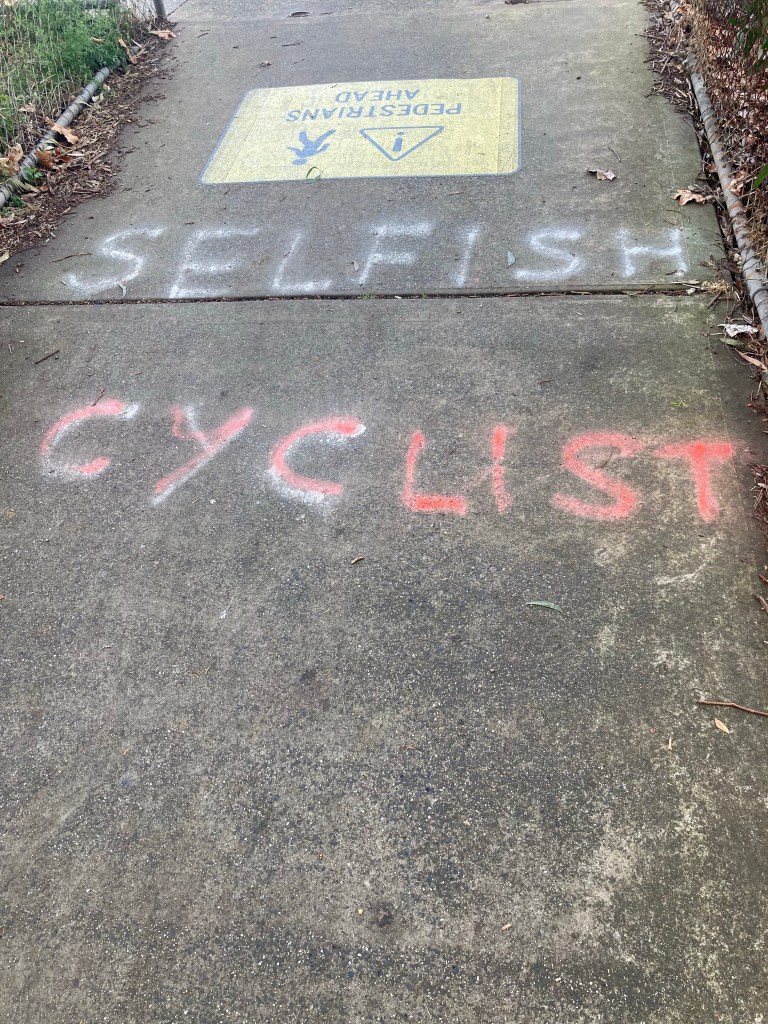
During and since the Covid lockdowns, much of Melbourne has been covered in graffiti. Most of it is indecipherable tags, where the only message is comprehensible to the purported artists and like minded morons of their subculture. [I make no apologies for my views on these vandals.]
As a result, given that our Premier is too busy pork barrelling and breaking his word, and local councils are too busy being useless, there has been no effort to clean up this graffiti and it makes our metropolis look like something out of a post apocalyptic film.
But there are some instances where someone has something to say. Recently, some person with very strange ideas spray painted the slogan ‘The Goddess Artemis is a Whore’ in at least two locations in Footscray. I found this extremely intriguing.
Then today, when walking near Fairfield Station after having a vegetarian burger smothered in smashed avo (Fairfield is definitely where to go for such things), I saw the above slogan painted on the floor of an underpass. ‘Selfish Cyclists’ is just the sort of message I would paint if I were not such a rigorously law abiding chap as I am.
Which makes me a tad nostalgic for the days when graffiti artists actually had something to say, whether it was political or just obscurely self indulgent.
In the 1980s and early 1990s, we still had graffiti primarily used as a tool of political protest. I recall, when I was in primary school, the slogan ‘Thompson Shears Education’ was painted on a brick factory wall over the street from the back of my school. It was painted, as I later discovered, elsewhere around the inner western suburbs, and related to Dr Shears, the unpopular director-general of education, and Lindsay Thompson, the Minister for Education (and an all round decent fellow if you really want to talk about him). Witty and to the point.
And there were so many brick and concrete walls which served as blank canvases for when lefties wanted to advertise a protest march for a time and place (I support the right to protest, even where I do not agree with the protesters). They had something to say, and their use of the walls was almost legitimate. I respect it.
Then you had the rather obscure. Ronald Reagan’s full name was Ronald Wilson Reagan, and some people in the potentially apocalyptic 1980s saw the six digits of each of his names as a sign of the Anti-Christ, 666. Hence, on the wall of the former Footscray Masonic Temple in Leeds Street, someone started to write:
“The Phoenix has risen from the ashes, Ronald Wilson Rea’…
Well, they were interrupted before they could finish. I hope they were able to get away.
On the retaining wall on the city bound side of North Melbourne railway station from at least 1984 onward, there was the slogan ‘USA The Whore Is Doomed – Rev 17’ which fitted in very much with the potentially apocalyptic times that were the 1980s.
My favourite from that era was on the wall of the Burnley railway station: ‘Blinky Bill Shall Rise’.
And I hope that their words come true.
It’s been one week since I made the dubious decision to finally join Facebook – a decision which immediately caused me to have my account ‘temporarily suspended’ presumably by an AI.
Despite this suspension, I have been able to log into that account via the mobile phone through which I set up the account. It is simply that I cannot access it via my desktop or tablet which currently is the source of annoyance.
And so, in the past week I have been adding various friends, kinfolk, and former colleagues as Facebook friends. I have also been reading or watching various Facebook information videos, sources of great fascination such as timelines for the mostly spoken languages since 1900 on a real time basis, or who has won the most World Cups on a real time basis, deaths in the Second World War by country by year, or countries with the most Miss World Winners (my favourite of those, obviously).
These sorts of information graphics are obviously created by AI. It would take a computer genius with OCD over statistics many months to create the sorts of dynamic graphics on something like language use or war casualties.
But there are some other clues. Where such videos have voices, the voice seems to be artificially generated, and frequently mispronounces fairly easy words. There are some odd terms used. In a video listing overrated people from history, Che Gueverra is described as having been appointed the ‘Pastor’ for economic affairs in Cuba, and Malcolm X is compared unfavourably to Martin Luther ‘Ruler’.
It is obvious that only an AI could substitute ‘pastor’ for ‘minister’ and ‘Ruler’ for ‘King’. A human intelligence is nimble enough to discern context.
So, just like in Blade Runner, the replicants are not yet quite ready to walk amongst us undistinguishable from us.
After the Banking Royal Commission made its report in the not so distant past, I read several of the books published by finance journalists with morbid curiosity.
The way that major banks and leading financial institutions had behaved, particularly to honest business loan holders and to trusting mum & dad investors, showed a degree of unnecessary ruthlessness and lack of compassion (not to mention sharp practices more than bordering on the unlawful) that will leave a long stain on the reputations of the big four banks.
That Macquarie Bank, a ruthless investment banking machine which has become known for its sharp practices in finance (take the Brisbane Connections float for example), came out of it looking ethical in comparison says something about how bad the retail banks had been behaving.
AMP and IOOF, long standing wealth management companies, came out of it looking even worse than the banks. That AMP’s board had arranged for a supposedly independent review by a law firm of some of its conduct to rewrite its report several times in a self-serving manner regardless of the facts was a serious smoking gun which caused several senior heads to roll. The damage to AMP’s reputation has been almost fatal, and I do not see AMP surviving long term.
Soon after the Royal Commission, legal action was started against several senior managers in IOOF due to their involvement in some supposed illegality with their administration of the superannuation funds under management did not do IOOF the same degree of reputational damage. This is only because one would need both an accounting degree and a law degree specialising in commercial law to understand what they had done wrong, and the rest of us go a little cross eyed trying to follow the accusations.
Reading the Financial Review this morning, I noted a prominent story about how a significant number of superannuation funds administered by AMP and Insignia Financial (IOOF’s recently adopted new name) have significantly underperformed in the past year, triggering mandatory letters to policy holders suggesting that they look elsewhere to invest their super. There was some commentary that the underperformance may be partly caused by the administration fees charged on those funds.
This does not suggest that AMP or IOOF have learned the bitter lessons from the Banking Royal Commission and similar scrutiny of a few years ago.
What is sad is that not all that long ago, AMP and IOOF were both mutual societies, rather than listed companies. They were owned by the policy holders rather than by shareholders. AMP demutualised in 1996 and IOOF in 2002, giving their existing policy holders shares in exchange for the change in governance.
I have been following IOOF closely, because my mother invested my late father’s superannuation in IOOF insurance bonds in 1986. We had been advised that IOOF was good for widows and orphans, and it might well have been then, when it was a ‘friendly society’ trying to do the best for their policy holders rather than being run to benefit its share holders. I have not done a deep dive into their performance since that time, but I do hope and trust that when it was a mutual, it did the best by its members.
Performance since the demutualisation in 2002 has not exactly been overwhelming. The shares were valued at $3.15 when they demutualised, and they are currently trading at about $2.65, meaning that they have been about as good for people like my mother as Telstra shares have been (not that my mother has any interest in share ownership beyond the shares she was given at demutualisation).
In late July this year, Insignia Financial announced that they were planning to sell the IOOF Insurance Bond business to Australian Unity. I made some unsuccessful attempts at that time to get more information from Insignia about this, and I note that Insignia has neither published any further information on its website about this matter, nor written to insurance bond holders like my mother to notify them of this move and what it all means.
The lack of information on this matter just goes to show how far Insignia Financial has evolved from the mutual ‘friendly society’ who was there to look after widows and orphans.
Given all that I have observed about the corporate entity now known as Insignia Financial in the 21 years since demutualisation, I strongly welcome the sale of the IOOF Insurance Bond business to Australian Unity. Australian Unity is the largest surviving mutual society in Australia, being a merger in the 1990s of Manchester Unity (who built that neo-gothic skyscraper on the north west corner of Swanston and Collins Streets) and the Australian Natives Association (which was rather inappropriately named, given it was intended to benefit white men born in the colonies).
That Australian Unity remains a mutual society means that it is going to work primarily for the interests of its policy holders rather than its share holders. That probably means that IOOF insurance bond holders like my mother are going to be members of a mutual society again, and I think that, given the track record of Insignia in the past couple of decades since demutualisation, that is a very good thing.

 Lost For Words!