For the past 30 years, for initial reasons more than half forgotten, I have rented a post office box at Highpoint West. The post office address is Highpoint City, not the original Highpoint West, nor the current simple Highpoint, reflecting the name of the shopping centre post 1986 expansion, which the post office has never bothered updating.
Thirty years is a long time. The Highpoint Post Office has moved location once, and the post office boxes have been moved twice, most recently twelve years ago to the barely accessible basement car park. I myself have moved home twice, dropped out of my masters degree, had three promotions at work, and recently retired from work.
It sometimes is hard to remember the person I was 30 years ago.
Through that time, I have, possibly due to pretentiousness, maintained my post office box, which now costs about $150 per year, and which has a constantly decreasing amount of traffic delivered to it.
Two weeks ago I received a notice in my box that whilst the PO Boxes will remain, the actual Highpoint Post Office which services them will close in late May.
It’s not the only one. Braybrook is about to close, as are Glenroy and Essendon.
I’m surprised about Highpoint PO. On some days, when it opens, there are huge queues to get served.
Closure of post offices is going to have an impact on the community. Many newsagents do not sell postage stamps (and barely sell newspapers anymore for that matter), as there is no profit to it, only nuisance. I recall the existence of primitive stamp vending machines about 30 years plus ago separate from post offices, but have not seen any such since, except in the Melbourne GPO.
The inability to buy postage stamps easily is going to impact further on the physical mail traffic, as it will be harder for those more likely to rely on snail mail to actually send it.
Post Offices, being government owned, also have a community service obligation. Where this en masse closure is occurring, it is difficult for both Australia Post and the Federal Government to assert that those community service obligations are being met.
As for me… I just spent over an hour ensuring that my residential address has become my postal address for all my banking, investment, tax, medicare, electoral enrolment etc records. All I need to do now is update my insurance policies (all paid up til next March) to my home address.
After that, I will not be renewing my PO Box next year. I will save that money. I wonder where I should return the PO Box key.
Now that I am retired (well, not officially til July, but I am not planning to ever go back to the office), I do not think that I will ever have cause to visit Canberra again. Much as Blue Poles is now a part of Australian cultural history due to the initial controversy followed by the gradual acceptance, I do not see the National Gallery of Australia as particularly appealing, and I have been there, the National Portrait Gallery, the National Museum (with its restored FJ Holden) and the Museum of Australian Democracy (ie Old Parliament House) several times. The only appeal about the bunker which is the current Parliament House is the copy of Magna Carta on display, although there are a lot of notable artworks there. Nor do I think that Floriade is enough of an event to draw me. The reality of Canberra to me is subzero winters in Belconnen, and I have done my fair share of those over the years.
The one thing which might inspire me to visit the nation’s capital again is the Australian War Memorial, and in particular, the Hall of Memory. In there, the solemn stained glass windows and mosaics not only remind us of the sacrifices made to keep Australia free from foreign invasion and tyranny, but they are breathtaking artworks.
Their creator, Mervyn Napier Waller, was quite a talented artist, more so because he lost an arm in the First World War and all of his great works were created in the ensuing half century.
Melbourne is lucky in that, within walking distance of the National Gallery of Victoria, there are many of his works available to view.
And some which require a bit of effort.
But Melbourne really is an open plan gallery of Waller’s works.
Yesterday I did a guided tour of the Melbourne Town Hall, a building we all know by sight, but which few of us ever bother venturing within. There are many interesting things in there, and I daresay that it is a grander building than the Victorian Parliament less than half a mile away. What drew me there was the chance to see several of Napier Waller’s works held within. The main concert hall within the town hall has over a dozen panels on the upper walls, painted with faint friezes of classical scenes by Waller.
These are not his best works, by any stretch of the imagination, not if you have been to the Hall of Memory.
But these are only a sampling of what you can find in Melbourne.
Around the corner in Collins Street, on the south side between Swanston and Elizabeth Streets, all you need to do is look up slightly and you will see a mosaic with a scene from Midsummer Night’s Dream, encaptioned ‘I will put a girdle about the Earth’. Then hop on a tram down to William Street to the former State Electricity Commission HQ, where a spectacular mosaic of Prometheus, complete with a quote from Aeschylus, greets you in the foyer. Breathtaking.
Not far from there opposite Market Street is another of his works, but apparently concealed due to building modifications since Waller placed it there. Tragic.
Hop back on the tram and circle to the State Library, and there is another of his works on display, dedicated to peace after the First World War. Venture north to the University of Melbourne and you can do a scavenger hunt for his works. In the main art gallery there is a stained glass of his, salvaged from Old Wilson Hall after the fire. One of the libraries has another of his works, although I have never been able to make the time to find it. And a minor stained glass window of his is in one of the departments in the Science faculty (Botany if I recall correctly).
Then you might head back into the city to try accessing others. His stained glass is in Wesley Church (try to choose a day when they are doing an organ recital at lunchtime as they don’t always keep the church open). Another mural is in Florentino’s, which almost is enough to make me want to eat there (my tastes are not usually that fancy). And if you happen to go shopping in what is now the Versace store just down from the Athenaeum Club in Collins Street, you will be lucky enough to see another mural.
That is not all. Some of his works are in churches in the inner eastern suburbs.
Indeed, now that I am retired, I might go onto try looking for those out in the suburbs, not that I am a church going type. I doubt that there is any other artist in Australia who is so hidden in plain sight.
I usually think that certain novels or songs could only be created in the era that such genres thrived in. Jazz music is from the Jazz Age (ie the roaring 20s), and Disco is very 1970s. Regency novels are very, well, Regency. And can you imagine Dickens in any time and place but the Industrial Revolution grime of Victorian London?
There are exceptions. The late 1990s movie Velvet Goldmine, which was a tribute to the early 1970s era when David Bowie and Iggy Pop were at their best created new music which sounded like authentic Bowie.
How do you do this? I think you need to be entirely immersed in the sights and sounds and language and way of life of a particular place in time to be able to create art that is archetypical of that genre.
Time does not stop, even for the jilted Miss Haversham forever attired in her wedding dress.
To reach into the past and create a credible mimicry of a genre takes genius.
For a quick example, I should mention the semi-retired jazz/blues musician CW Stoneking. From what I gather, he was born to American parents somewhere in northern Australia and raised in an aboriginal settlement, remote from outside contact.
Exposed from an early age to a steady musical diet of jazz and blues, he has done far more than become a jazz guitarist. He has written several concept albums which feature music that sounds like it is from a particular era – whether it is the 1920s, the 1930s or the 1940s – but which is his own original music.
Jaw droppingly original talent, especially as it is as if he can reach us from 90 years in the past with new music from that time.
I have seen him live twice (most recently in a beer garden in Castlemaine), and he is bloody good. If he comes out of retirement again, he is well worth going and listening to perform.
So too is the novel I finished reading yesterday, ‘The Gentleman’ by Forrest Leo.
This novel is narrated in the first person present tense by Lionel Lupus Savage, a fopish and somewhat pretentious poet, one of the deadbeats of the Victorian Era Gentry whom many writers of that era (including but not exclusively Anthony Trollope and Oscar Wilde, and, a few decades later, Evelyn Waugh) would use for comic relief in their stories.
It is annotated by Savage’s cousin in law Hubert Lancaster Esq (who introduces us to the text with the passage: I have been charged with editing these pages and seeing them through to publication, but I do not like the task. I wish it on record that I think it better they had been burned.).
In short, our narrator Savage, having been profligate with his inheritance, has caused a young and wealthy aristocratic lady to fall in love with him so that he can continue to live the life of the idle rich. He is not in love with her, and when, at a party at their home, a ‘Gentleman’ appears who gives the impression that he is the Devil, he laments to this chap about his marriage and wishing his wife gone.
The next morning she is in fact nowhere to be seen, and Savage concludes (which obviously is the most simple and logical explanation) that his wife has been taken away to Hell by the Devil.
He comes to repent his indifference, and then, aided by his liberated sister, his aristocratic brother in law, and (of course) his butler, he starts to plan how to travel to Hell and win his wife back.
I won’t spoil the rest for you, except that there is a steam powered flying machine invented by a member of an exclusive inventor’s club located in the centre of London.
Reading through the rich and witty language, the story is one which has so many elements of the Jeeves and Wooster stories of PG Wodehouse (although Wooster was even more commitment phobic) and the Faustian tones of Oscar Wilde.
The author, Forrest Leo, has created a very original work which is extremely reminiscent of those English writers of a century or more before today. How has he done this?
What is most astonishing is that he is actually American.
Although this might explain it, as his biography reads: ‘Forrest Leo was born in 1990 on a homestead in remote Alaska, where he grew up without running water and took a dogsled to school.‘
Images of an isolated log cabin insulated in part at least with bookshelves filled with the writings of PG Wodehouse, Oliver Wilde, Evelyn Waugh, Hugh Hector Munro (aka ‘Saki’) and similarly witty ironic Englishmen come to mind. It is totally conceivable to me that someone living in the Alaskan wilderness could immerse themselves in the language and thinking of that time so as to give us a book which fits so well with what you would expect to have been published over a century ago.
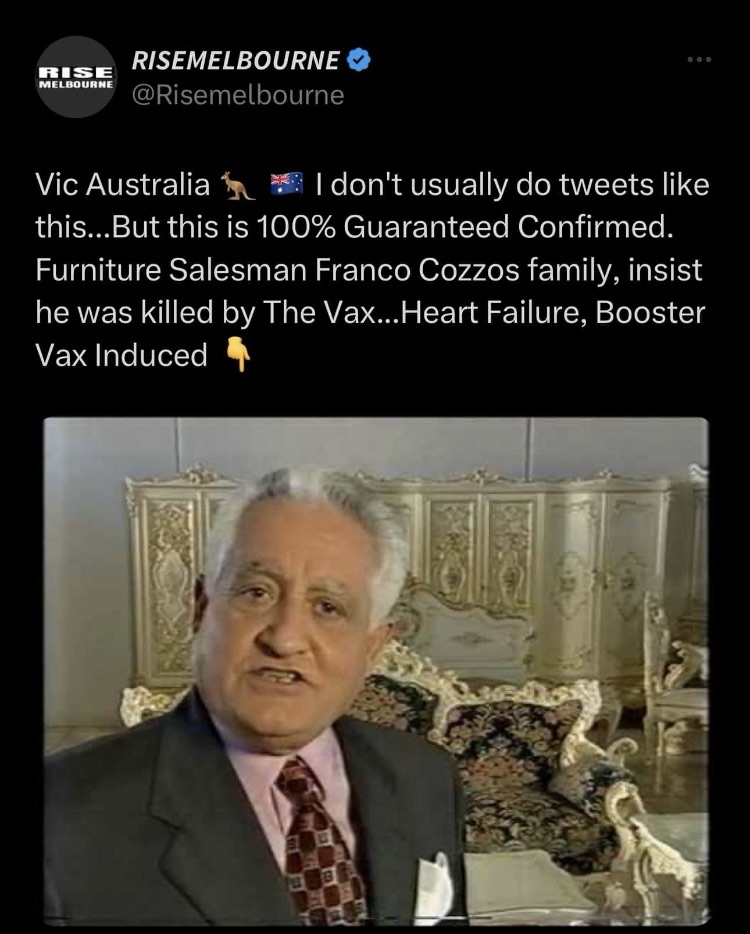
Furniture dealer Franco Cozzo died recently, at age 87. He is famous for the ads he used to run back in the 1980s on Channel Ten on Sunday mornings, when Ten would run such awful shows as Grecian Scene and Variety Italian Style.
Only crazy people believe he died of the vaccine but I think it’s funny to share this image
In a combination of Italian and deliberately broken English, Franco Cozzo would exhort viewers to buy furniture from his shops, initially in ‘Nord Melbourne and Footiscray’ and later on ‘Brunswick and Footscray’.
The stores are closed now, although so recently that the Brunswick store still had a lot of the furniture in the windows this week when I was in Sydney Road, and the ‘Footscray’ store has only recently put paper over the windows in preparation for its transformation into a craft beer hall.
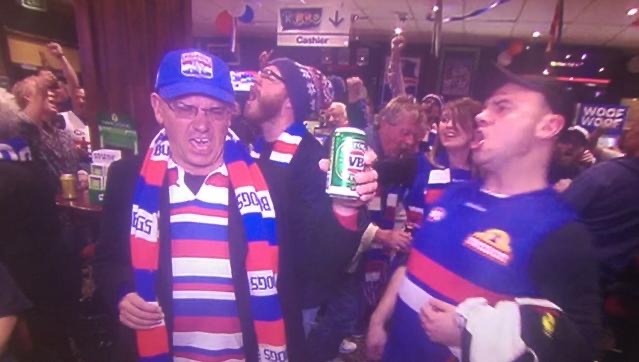
There were not too many other famous businesses or organisations based in Footscray. Jim Wong (my favourite Chinese restaurant) closed over 4 years ago, and the Footscray Football Club has traded as the Western Bulldogs for the past 27 years (a decision I understand and respect, but which I still do not love).
Travel guidebook company Lonely Planet had its world headquarters in Footscray for a long time, based somewhere in the original village, in an office building near the river. It gave me a bit of parochial pride as a local that Lonely Planet was based there.
That knowledge that Lonely Planet was, sort of, a local Footscray business did greatly influence my choice to purchase the most recent edition of the Lonely Planet guide to Italy before each of the three journeys I have made there in the past 8 years.
Sadly, Lonely Planet is not based in Footscray anymore. I discovered recently, to my great disappointment, that its current owners have moved the world headquarters to the USA. It has hence lost what made it unique and special to me.
As a result, when I next travel overseas, I will probably take a closer look at other travel guides before deciding which I will buy, and Lonely Planet has definitely lost what was it’s competitive edge as far as I am concerned.
I have frequently written about craft brewer Broo in my blog over the past couple of years as I find the boardroom intrigues fascinating, a bit like a slow moving tram wreck.
Yesterday I checked the company updates on Commsec and noted that the latest chairman has resigned after approximately 3 months as chair and that Broo are looking for a third board member.
I think this makes 9 directors gone and 4 chairmen since late 2021.
And this month is when they apparently launch a new beer on the market.
Just as well that I’m not counting on the ongoing success of Broo to fund my retirement.
In late 2021 I was in the midst of a very long and pleasant staycation. I visited a few pubs and wrote an entry in my blog which listed several of the better beer gardens of Melbourne.
Happily, I have been on a permanent staycation since mid 2023, and this means that I have visited quite a lot more pubs and beer gardens since that time.
Hence it is time to update my list of beer gardens.
Let me start by saying that I will disqualify those beer gardens which relate to bars which are not traditional pubs (eg Garden State). I am a traditionalist, and I cannot keep up with all the inner city bars which sprout up and then just as quickly disappear. Nor am I going to include rooftop bars, like what Young & Jacksons and The Imperial now have.
So, here is my list:
1. The Nottinghill Hotel
There was no bar on campus when I was an undergrad at Monash, which was probably a good thing, on sober reflection. Aside from not having the disposable income or the ability to hold copious quantities of beer or wine that I do now, I would occasionally wander north to the Nottinghill Hotel, affectionately known as The Nott to generations of Monash students.
A couple of years ago, visiting old haunts in a masochistic fit of nostalgia, I felt a bit the way F. Scott Fitzgerald did, when he wrote (perhaps with an ironic wink at his reader): ‘Once more the belt is tight and we summon up the proper expression of horror as we look back at our wasted youth.’
When, in my late teens and early twenties, I would visit the beer garden at the Nott, there used to be chickens roaming free range around the tables. I mentioned this to the barmaid as she poured me a pint of Little Creatures, but she had already heard this.
It was a very different time, almost worlds away really. 1987 is as far away in time from 2024 as 1950 is from 1987. Chickens in the beer garden was a charming quirk about the Nott, as was the publican, Kath, who had been there since the late 1930s as a newly wed not quite 20, and who remained the publican for about 70 years. [I did not know that then, as my visits to the Nott were an end of term thing, rather than an end of week thing, as they more than likely would be if I was to be transported back to that time now.]
Aside from the chickens and the record breaking publican being gone, the Nott is probably much the same as it was then, even if Nottinghill has changed much since the market gardens surrounding the pub when Kath first took up the license. The University Bar is currently referred to as the Steakhouse, and the food is probably better than when I did lunch there one rainy day in 1993. And the beer garden is still one of the best in Melbourne.
How can I not rank the Nott at the top of the list, given all I have already written about it? Aside from the character and history of the place, it has a beer garden which, even sans chooks, is spacious and shady and comfortable, running in a long oblong from the buildings of the pub down to the bottleshop out back.
2. The Standard Hotel
The Standard is located in a side street parallel to and immediately west of Brunswick Street Fitzroy. Surrounded by workers’ cottages, the beer garden occupies a spacious block L-shaped block immediately behind the pub, with many trees providing shade. I have spent many happy afternoons there, mostly at work related Christmas lunches.
3. The Retreat
There are two pubs with the name The Retreat in Melbourne. One is in Abbotsford just south of Johnson Street and is famous for where the pub scenes in The Sullivans were filmed. But it has no beer garden. There is another Retreat in Sydney Road Brunswick, and this is the one with the beer garden, which is well worth visiting.
RIP giant almond tree
I have had several very fun afternoons there on various December days over the years with some colleagues and friends.
What has made the Retreat particularly special in my mind is that its beer garden is dominated by an ancient almond tree which would have to be the largest specimen of the genus prunus I have ever seen.
Sadly since my original posting in late 2021, the almond tree has died. I popped in for a beer in November 2023 with a friend who lives in Brunswick and the dead trunk of the tree remained. They had consulted a tree surgeon last February and realised that the tree was no longer viable.
Hopefully in future, just like the Cussonia Tree in Cussonia Court at Melbourne Uni, they replace the old almond tree with a new one, which grows for many years to come.
4. The Anglers Tavern
The Anglers Tavern is located on the banks of the Maribyrnong River, just opposite where a sign in the 1990s used to welcome motorists to the City of Sunshine, with ‘Maribyrnong Township’ in slightly smaller lettering.
I used to live on the other side of the ‘township’ (I much prefer that to suburb), about 10 minutes’ walk through the side streets from my flat. As a result, I have visited the Anglers many times over the past 30 years and it has many fond memories.
For example, Sunday afternoons in the mid 1990s when Wendy Stapleton would sing covers of various other peoples’ songs with the aid of a backing tape and one guitarist (sadly, she never would play Reputation or any of the other songs from when she headed The Rockets in the early 80s).
As the beer garden is located on the banks of the river, it has a lot going for it. However, I think that putting up semi-permanent roofing over most of the beer garden has diminished it. I much prefer a beer garden which is mostly open to nature, with more trees, as it used to be.
The Anglers has frequently been victim to the floods which burst from the Maribyrnong River, and the record breaking flood in late 2022 was the most dramatic in the pub’s history (FYI, I believe it was the second biggest flood recorded in Maribyrnong). The pub and beer garden are still closed, some 15 months later, as repairs take place.
Hopefully it reopens in time for the next Spring Racing Carnival.
5. The Great Northern
The Great Northern is in Rathdowne Street in Carlton North, just before the street ends at the abandoned railway line. The pub itself seems to be a time capsule of early 1980s decor, and I find that charming.
I went to a close friend’s 40th in the beer garden there, some 15 years ago. Since then, the beer garden has upgraded with new wooden flooring and benches and tables and shading. As it is an inner city beer garden, just north of the Princess Hill precinct, it enjoys an almost pastoral setting.
6. The Keilor Hotel
I really am not sure about including the Keilor Hotel on a list of Melbourne pubs. Technically, Keilor village is a part of Melbourne, and suburbia these days extends well past it to the north and west, but Keilor has always felt to me like a small country town tucked away around a few bends in the river, with only the hum of the freeway and the roar of planes approaching or departing from the airport nearby to remind us of Greater Melbourne.
I also, being a non-driver (which is wise when you enjoy beer and wine on the scale I do), find it hard to get to the Keilor village as it is not exactly well served by public transport.
The pub itself has the charm of a giant old country pub. I think it dates to about 1850, and was a stop over during the gold rush for chancers heading out to Bendigo to try their luck. The current publican has been there since 1974, and is related to a local family which owned it since the 1860s.
The beer garden area is out the back of the pub, surrounded by ancient gum trees, and offers a very comfortable afternoon of beer drinking. I was there on Cup Day, and it was strangely deserted.
The Keilor Hotel is one of those hidden gems of Melbourne, and well worth a visit, if you can spare the time for such a remote trek.
7. The Flying Duck, Hawksburn
Aside from the location of railway stations, I tend to get a bit confused about where exactly the suburbs of South Yarra, Toorak, Prahran and Hawksburn are located vis-a-vis each other. In any event, it is on Bendigo Street on the Chapel Street end of Malvern Road, so you go figure which suburb precisely it sits within.
The quaintly named Flying Duck (it does have some flying ducks mounted on a wall, although I tend not to notice these things) is a charming tavern with open fireplaces. I used to visit it semi-regularly approximately 30 years ago.
Recently, I caught up with an old friend who is currently living in South Yarra for a few beers there. It was a rainy day, so beer garden was not an option, but I did notice for the first time (my visits in the 1990s were in the evening so I would not have noticed back then) that it does have quite a beautiful little beer garden out the back.
8. The Peacock Inn, Northcote
A few weeks ago, I did lunch with some friends who happen to live in the inner north eastern suburbs (I assume Thornbury is inner north eastern). Despite being Italian, I do not really know Thornbury or Preston particularly well (a rather grasping paesano of my father’s has always been the only member of my extended family who ever dwelled around there so no reason to ever head out that way).
As I have a blindspot in my knowledge of that wedge of greater Melbourne between Merri Creek and the Yarra River, I’ve only ever gone past the Peacock Inn rather than stopping in there for a drink.
Last month was the first time I went in there, for lunch. And whilst I was in the bistro rather than the beer garden, I was, for a better word, gobsmacked by the sheer beauty and size of the beer garden.
9. College Lawns Hotel, Prahran
Whilst I do frequently get confused about the demarcation of suburbs around South Yarra, I have no doubt that Greville Street is in Prahran, and so too is the College Lawns Hotel.
It is another of those pubs which I used to visit circa 1991, plus or minus a couple of years. I popped into there for the first time in ages recently, and did notice that it does have a beer garden which is spacious and comfortable.
10. Westwood, Footscray
The Westwood is the latest name for what was recently known as the Reverence, and before that under its traditional name The Exchange. The local bogans in Footscray used to nickname it The Gearbox, probably due to its proximity to the major truck route through inner Footscray towards the docks.
It recently reopened and it is making an effort to promote itself as a band venue. It is a bit of a rabbit warren, including a 1960s era extension on Napier Street and a much older out building on Whitehall Street which I suspect originally was a stable.
The beer garden itself is fairly large, and now well suited to many people sipping beer in good company on summer evenings.
11. The Station Hotel, Footscray
In the past two or three years, the Station has been one of my favourite pubs to visit. As I live in Avondale Heights, and two of my closest friends live, respectively, in Melton and Laverton, meeting in Footscray for a boozy lunch or dinner is a very easy option.
The Station Hotel, located just down the street from Footscray Station and just over the road from the Footscray Town Hall, is well known for its steakhouse bistro, which I greatly enjoy visiting.
It also has two beer gardens. One is the discreet smokers area near the toilets and the fumes of Napier Street. The other, set back further from the street, is much larger, and suited for a family dining environment, complete with the occasional petting zoo!
12. The Commercial Hotel, Yarraville
The Commercial Hotel, located in the deep south of Yarraville, was long a neglected pub, complete with the grungy mouldy armchairs found in some of the more bohemian inner suburban uni pubs.
Happily, it has undergone a respectable renovation recently, which has included opening up a large beer garden area and adopting as a nickname ‘The Mersh’.
13. The Victoria Hotel, Brunswick
There are many pubs around Melbourne named the Victoria. Off the top of my head, there is one near the Vic Market (which used to have an impressive red gum bar), the Victoria on Hyde in Yarraville and the Victoria (aka Hart’s) in Footscray where I celebrated the 2016 AFL Premiership with my brother.
The Victoria Hotel in Victoria Street Brunswick is a very friendly local pub, with a snug and well maintained beer garden out the back, hemmed in by a number of shrubs which make the vibe a little more relaxed than in some other places. There are many wooden tables and benches where you can sit with your friends and drink beer all afternoon long, as I happened to do a few days ago.
Honourable Mentions:
I will make a few honourable mentions here.
The Kingston Hotel – Richmond.
If I remember correctly (and I have only been there twice), about a decade ago this had an awesome beer garden. I finally revisited it recently post extensive renovations and was chagrined to find that most of the beer garden area has been turned into a covered bistro area, and the tall trees I remember in the beer garden are gone. This makes me sad
St Andrews’ Hotel (aka The Pumphouse).
Does an atrium area out the back count as a beer garden? Not sure.
There’s a few wooden tables on the street, and that does have a beer garden feel to it, even though it does not technically count as a beer garden
As an aside, a former owner of this pub some decades ago was rumoured to harbour a pet monkey upstairs.
Mitre Tavern
Heaps of tables are set up outside the Mitre Tavern in the dead end alley known as Mitre Lane. I am not really comfortable calling this a beer garden, even though we do need more of them in the city proper.
Bells Hotel
I have a distinct memory that this pub, somewhere just off Clarendon Street in South Melbourne, had a great beer garden when I first visited it in 1994.
I visited it again in recent months, and the entire pub had a vibe which was combination beer-barn / sports bar / pokies venue. There was a beer garden, but it did not really thrill me. I do think that it is salvageable, at least.
The Clyde
This place has been a haunt of Melbourne Uni students for a very long time, and is probably the only pub left in the area that still welcomes them (I feel that the vibe at Naughtons is no longer uni student focused).
It has a beer garden, but not in the same league as the ones listed above. But any beer garden which is not just the concrete space with a plastic table and an ashtray en route to the toilet (eg the Courthouse Hotel in Footscray) deserves some commendation.
The Plough
Located on a wedge between Victoria Street, Barkly Street and Geelong Road, the Plough was one of the first two gastro-pubs in Footscray, becoming such in the early 1990s when everything else in my home town was going down hill.
They closed off the drive through bottle shop area and created an outdoor drinking area. I think they need to get rid of some of the concrete and plant some trees and then it might make it as a decent beer garden.
Dishonourable Mentions:
As aluded to above, there are some pubs which occasional claim to have a beer garden, but this is actually just a dull concrete space doubling as the smoking area en route to the toilet. The worst of these are ones which have a plastic table and an ashtray.
The Courthouse
The worst such example is the blood house pokies and TAB venue The Courthouse Hotel in Footscray.
Other such venues, which might have a slightly better smoking area, but which do depress me include:
The Waterloo Cup
This place actually had a great beer garden in the early 1990s, but it got built over to put the pokies in. It does have a smoking area now, but most of the non-pokies areas of the pub have been closed since Covid, which is a shame as it used to be a fantastic pub.
The Derrimut Hotel
The Derrimut Hotel in Sunshine relies heavily on poker machines. When a friend lived in Sunshine, I used to drink there a lot. There is a large outdoor smoking area, and between the smokers and the problem gamblers, this place is rather depressing and disturbing.
The Footscray Hotel
Don’t get me wrong, I quite enjoy the Footscray Hotel. It has a certain rundown bogan cachet to it and I try to visit it whenever I have a spare half hour in Footscray, usually when en route to the Station Hotel.
It is rather rundown though, and the beer garden area out the back is more like a storage area for bits of outdoor furniture and other equipment. However, I would not want the Footscray to change too much, beyond getting seriously decluttered.
If anyone reads this post, please suggest some more beer gardens in the comments.
In the course of my adult life, I have haunted many pubs across inner Melbourne in particular, as well as having visited many more around greater Melbourne and out in the country.
I have never actually seen any ghosts or had any supernatural experiences, and in the bright light of mid afternoon as I write these words, I do feel a little regretful about that, even though I am quite skeptical about those things.
But, as Shakespeare put it in Hamlet: ‘There is more to heaven and earth, Horatio, than is dreamt of in your philosophy’.
Whilst I have never seen any ghosts, several people I know whom I respect as being rational and reliable people, including one pub manager, have had supernatural experiences, and I thought it might be fun to list some of the pubs which are reputed to be haunted.
1. Young and Jacksons
Young and Jacksons is the most famous pub in Melbourne, as just about all five million people living in our city would know. This comes from it being on the prominent corner of Flinders and Swanston, just over from the main railway station, and from the famous nude painting, Chloe, whose presence has graced the pub for over a hundred years.
Obviously a pub this famous and iconic in Australia needs to be haunted, and it is claimed that the ghost of a murdered prostitute can be heard screaming outside late at night.
To me, this is a very disappointing account, as you would hope that a pub this big and so long established would have a few more ghosts elsewhere on the licensed premises.
2. Mitre Tavern
The Mitre is possibly the oldest building in central Melbourne, and one of the only six pre-gold rush buildings left (the others being the Duke of Wellington, St Francis Church, Rutherglen House in Highlander Lane, the small shop on the corner of King and Latrobe, and that big shopping block which holds the Paperback on Bourke Street).
I have not really frequented the Mitre that much until recently, but it has become my favourite city pub in the past two years, with its old local pub charm and its upstairs steakhouse, and its rickety structure.
The Mitre makes a big deal of being haunted by Connie Waugh, whose portrait hangs in the stairway up to the steakhouse. Connie was the mistress of one of the early Clarke baronets (famous for hosting a party where the Ashes were created at their Rupertswood Manor in Sunbury) and who had a townhouse opposite the Mitre (now the Savage Club). She reputedly killed herself inside the Mitre and her ghost haunts it.
This might not be so. When chatting with one of the barmaids last year, I was informed that Connie actually killed herself in Adelaide. HOWEVER, there have been other untimely deaths, such as two brothers who fought a gunfight outside in the dead end (sic) alley that we now call Mitre Lane.
Some entity may indeed haunt the Mitre. That same barmaid told me that a vodka bottle had explicably dropped from above the bar (one spirit being jealous of being unloved compared to the other?), and that one night, a time lapse security camera had recorded that a glass had moved on a table without any persons being present.
3. The Imperial
Of all the pubs in the city, the Imperial is the one for which I would express the most love. I spent a lot of time there in the late 1990s and early 2000s as a regular, and even now that I am retired a month does not go past without me stopping in there at least once.
Back when I was a regular, I was very friendly with the pub management, and would ofttimes drink with them when they were off duty. One of those managers told me that the most famous ghost of Melbourne, the late opera singer Federicci, who is known for haunting the Princess Theatre a few doors up, also haunts the Imperial. It seems that Federicci, like me, had many happy memories of times drinking in the Imperial before his untimely demise, so he likes to visit it when he is not employed in haunting his former place of employment.
This manager told me that the publican in the mid 1990s who used to live upstairs had many unnerving experiences late at night, and that he himself had one odd experience. The manager was, at about 1pm one night, doing the paperwork in the upstairs office when the lid on a flip top bin started flipping violently. He wearily looked at it and said ‘Quit it Fred’ and it stopped.
Barmaids at the time (and the Imperial probably had the best looking barmaids in Melbourne back then) also claimed of feeling a presence when they were changing out of their street clothes upstairs. This would be very much in character with Federici’s reputation.
4. The Maori Chief
The Maori Chief is a very old school type pub in South Melbourne, which, alas is temporarily (I hope) closed for renovations.
I recall reading an article in street magazine The Big Issue back in the late 1990s where the publicans claimed that the pub was haunted by the Maori Chief. At that time, the pub would host strippers on Friday afternoons. Supposedly, the ghost of the Chief would get excited and his portrait would fall off the wall.
That won’t be happening anytime soon. Even if the Maori Chief reopens, we are in a different era and the only pub in the city which might entertain strippers these days is the Royal in Punt Road.
5. The Steam Packet
The Steam Packet is, as befits its name, a pub in Williamstown.
There is a story about an opera singer who was staying there and who lost his voice. As a result he killed himself and now haunts the hotel.
As I have friends who live in Williamstown and regularly dine in the Packet, I might investigate this story further myself sometime soon.
6. Rob Roy (now The Workers Club)
The Rob Roy is in Fitzroy and would be one of the older pubs in Melbourne. It is rumoured that a cleansing took place when it was converted into a Backpacker hostel several years ago to remove the ghosts.
It had a sinister atmosphere, where a bathroom mirror would often fall onto the floor and where a locked storage area was constantly messed up. My informant told me that a barmaid claimed that a dark cloud would float around the ceiling of the bar area late at night.
A medium supposedly communicated with the dead and found that there were many spirits there, but that they welcomed the company.
7. The Middle Hotel Ferntree Gully
Let me preface this bit with the admission that I get very confused about places like Ferntree Gully as it is far from my home in the western suburbs. There are several pubs, and I am not sure that the Ferntree Gully Hotel is the one which is sometimes known as the Middle Hotel.
In any event, there were offices in the upstairs at the Middle Hotel which were abandoned because of supernatural activity, and that something had scratched a woman who worked there.
8. The Palace Hotel
The Palace Hotel is in Burke Road Camberwell, and is currently one of those giant venues where many people frequent. About a decade ago, I would go there fairly regularly to hang out with a friend who was living in Ashburton.
I feel that all the people and poker machines etc would scare away any spirits which were not drinkable, but I might be wrong. My informant has told me that there was a locked office upstairs which was inexplicably trashed overnight.
9. Railway Hotel, Brunswick
Like most of the old pubs in Melbourne, the Railway doubled as a morgue in its early days. It has recently reopened after years of being derelict, and the new owners are making the most of promoting its chequered history, including all the characters who used to frequent it.
Unsurprisingly, it is being claimed as being haunted. People say that they have heard things moving when they are alone, and when they turn, they do not see anyone. Two former publicans died on the premise.
I’m not sure as to whether this is just positive publicity on the part of the owners, or whether there is depth to these rumours.
10. Prince of Wales, Seymour
The Prince of Wales in Seymour is reputed to be haunted, but I do not have more details.
11. The Royal Hotel, Seymour
The Royal in Seymour has an abundance of public information about being haunted. It was used as a morgue, back in the olden days, and the head of Mad Dan Morgan, one of the most vicious bushrangers, hung in the bar after he was finally hunted down.
Or so I learned this morning when browsing a book about haunted places in Australia in the QBD bookshop.
According to some casual searching on Google, there are ghost tours who visit it in the hope of experiencing ghosts.
12. Toolleen Hotel
The Toolleen Hotel has a creepy atmosphere at night and when my informant lived there, her dog refused to go inside. A baby died in there and that perhaps is the reputed ghost.
13. The Plough Hotel, Myrniong
The Plough is another pub reputed to be haunted, although I do not have details.
14. St Andrews Hotel
When I was told that the St Andrews Hotel was haunted, I had to double check, as I initially hoped that it was the pub in Fitzroy which was known as the Pumphouse for several decades, and which I visited several times each year.
Alas, it was not so – it is the pub in the town of St Andrews (which is most well known for suffering terribly during the Black Saturday bushfires) which has the ghosts. It was used as a morgue.
15. Blackwood Hotel
Back around 2007-8 I was a member of a pub crawl group (the Great Intercontinental Pub Crawl) which would take a bus out into the Macedon Ranges for the day. Hence I am pretty sure that I have visited the Blackwood Hotel.
The owners claim that it is the ‘best haunted pub’ in Blackwood although that is not why I visited. Apparently it has a rich history of ghost stories and paranormal investigators frequently visit with their gadgets to suss out supernatural activity.
16. The Kangaroo Hotel, Maldon
I did visit Maldon once, and I have been to the Kangaroo Hotel there, the only pub named after our national emblem. The pub was used as a morgue, which seems (from what I have read in researching this posting) a common reason as to why a pub will be haunted.
Aside from that, a stable fire in 1870 killed ten horses who haunt it, and in 1907 the publican threw himself down the well.
Nowadays, ghost tours like to visit it.
17. Argyle Hotel (Irish Murphy), Geelong West
The Irish Murphy in Geelong was nicknamed The Strangler’s Arms in the 1950s after a woman was killed there. Personally, I prefer that sort of nickname for a pub rather than transforming it into a Plastic Paddy.
News reports claim that glasses are hurled across rooms (without the prerequisite accompanying drunkards who usually perform such actions), urns get moved, doors slammed shut and terrifying voices hissing into the ears of staff and patrons. The poltergeist is affectionally named Mary.
18. The Coach and Horses Inn, Clarkefield
The Coach and Horses Inn was built by the Clarke family, whom I have already mentioned above in connection with the Mitre Tavern. It is claimed to be the most haunted pub in Australia, with at least three ghosts. Those are an autistic girl who was thrown down a well by her father, an Irish seaman who was robbed and killed, and a Chinese miner who was hanged in the stables.
I’m pretty sure that this was the pub which was mentioned in some paranormal special on TV in the mid 1980s. One of my year 12 maths teachers (I did double maths plus physics and chemistry for HSC) told us that he had been in there and the atmosphere was sinister.
19. Elephant Bridge Hotel
The delightfully named Elephant Bridge Hotel is the main attraction if you want to visit the village of Darlington in the west of Victoria. It has four ghosts, including a young woman, a man in his thirties, and a child who drowned there.
The fourth ghost is Adeline Eliza Satchwell, the longest serving publican, who died in 1943.
Reports of these ghosts make me rather curious about visiting this pub.
20. Craig’s Hotel, Ballarat
Walter Craig, the owner of the eponymous Craig’s Hotel, reportedly had a dream in 1870 that his horse was going to win the Melbourne Cup ridden by a jockey wearing a black armband.
He died soon after this dream of gout and pneumonia and his horse Nimblefoot did indeed win the Cup, ridden by a jockey (John Day) who wore a black armband in respect of the owner.
Apparently this story is a fabrication, but as the old saying goes, never let the truth get in the way of a good story, and it does make the rounds, lending some supernatural appeal to Craig’s Hotel.
21. Criterion Hotel, Rushworth
People have reported cold spots, strange noises and footsteps, and even worse, inexplicably warm beer at this pub.
Paranormal investigators have identified a ghost named Kevin in one room of the pub, although a businessman named Ted Read committed suicide in the pub in 1912 with the help of a shotgun and could also be a candidate for long term occupant.
Sadly, whilst there is a Kevin, there are no Karens haunting the pub. On second thought, this could be a good thing.
22. Cosmopolitan Hotel, Trentham
This pub has apparently been haunted by the ghost of a young girl with dark hair for over a century.
23. Nelson Hotel, Nelson
Not to be confused with the Lord Nelson in Sydney, which has its own rather famous ghost. The Nelson is in far south-western Victoria. It is believed to be haunted by the ghost of a young woman who had been kept locked in the pub’s cellar.
24. Dinner Plain Hotel, Dinner Plain
The person who informed me about the Dinner Plain Hotel advised that several people they knew have worked there and all heard voices of young women and presences within the pub. A few shadowy figures have been spotted, especially when heading upstairs.
25. Customs House Hotel, WIlliamstown
On a recent visit to Williamstown to watch a friend’s band play at the Customs House Hotel, I asked the bar staff if the pub had any stories about being haunted. They advised in the affirmative.
As the pub was opposite the old Customs House, there was a tunnel from the cellar to the Customs House. When ships docked in Williamstown, the bodies of people who had died in transit would be transferred through that tunnel to the pub cellar which served as a makeshift morgue (as indeed have many pubs in Greater Melbourne). Ghosts include that of a girl.
Concluding Comments
This blog post was not possible without a couple of weeks of casual research, including getting input from some people on an Australian Pubs page on Facebook.
I have excluded places like the Windsor Hotel because whilst it is claimed to be haunted it is a major hotel rather than a pub, and similarly I have excluded bars and night clubs. I have also excluded private clubs (like the Kelvin Club which I regularly frequent) because they are private clubs, not public houses, and I have yet to hear stories about ghosts in those.
I am really curious to collect more ghost stories about pubs, so would welcome much feedback and input.
Being of Italian peasant origins (aside from the recent discovery of a Count four generations back in the family tree) I like attempting to grow tomatoes every summer.
Aside from my first year in Avondale Heights, this has been with limited success.
Not to jinx it, but this year looks like giving me my best crop in 20 years. The first to be picked are some green zebras, a striped tomato which is a yellowish green when ripe and very delicious.
As far as film adaptations of Shakespeare’s plays go, Sir Kenneth Brannagh’s work over the past 35 years has given me particular enjoyment. Henry V in 1989 revived interest in Shakespeare, and his version of Hamlet was closest to the full written play (although proven by experts to be far too long to have been what actually was original performed at the Globe) than any other movie version. I found his version of Love’s Labour’s Lost (with such co-stars as Alicia Silverstone, the delectable Natasha McElhone, and the way underrated Matthew Lillard) to have great energy and fun.
I have only been disappointed with Brannagh with his performance in Othello (which he did not direct) as Iago, one of my two absolute favourite villains in the First Folio (the other, if you are curious, is Richard III).
But the most fun I have had in watching Brannagh’s ‘Shakespearances’ (I just made that word up – aren’t I clever?!?) is Much Ado About Nothing, which he directed and co-starred in about 30 years ago. The chemistry between himself as Benedick and his then wife Dame Emma Thompson as Beatrice was amazing. He had a great supporting line up, including Denzel Washington as Don Pedro, Keanu Reeves (always a fan favourite) as the villain Don John, and Michael Keaton in a bit role as Dogberry, the comic relief.
And more importantly, that film marked the screen debut of my absolute favourite actress, Kate Beckingsale, as Hero. Mind you, Hero is very much a passive character in that play and Kate’s performance was totally overshadowed by the chemistry between Sir Kenneth and Dame Emma in the lead roles.
As was everyone else, to be honest. [FYI, I did not really fall in love with Kate til I saw her amazing lead performance in Cold Comfort Farm two years later.]
Brannagh’s efforts, particularly after the initial success of Henry V, inspired other film adaptations of Shakespeare. Suddenly Mel Gibson wanted to play Hamlet, Sir Ian McKellen (a co-star in Cold Comfort Farm with Kate) gave us a mind blowingly awesome art deco adaption of Richard III in the mid 1990s, and Alan Hopkins’ portrayal of Titus Andronicus in the film version was aptly cannibalistic.
Baz Lehrman did Romeo + Juliet with Leonardo Di Caprio and Claire Daines in the title roles, a version which, I felt at the time had editing inspired by Pepsi Max commercials, but which has grown on me the more I have come to overlook his youthful brattiness and appreciate Di Caprio’s talent as an actor.
Stanley Tucci as Puck in the 1999 production of A Midsummer Night’s Dream stole the show, as did Sir Ben Kingsley as the fool in Twelfth Night in that same golden decade of Shakespearances (see – I have found a use for my new word).
I do think though that the Melbourne gangland inspired production of Macbeth in 2005 missed the point as making all the characters gangsters means that everyone is a villain, which is not what Macbeth is about.
We also had an abundance of film adaptions which were based on Shakespeare, but which did not quite follow the script. Ones which come to mind are O, which was Othello in a high school basketball team with Josh Barnett as ‘Hugo’, the Iago villain, and Ten Things I Hate About You, which introduced American audiences to a teenage Heath Ledger in a high school rom-com version of The Taming of the Shrew. Julia Stiles was the female lead in the latter, and probably (although I am not too certain and can’t be bothered looking it up) in the former.
Boxing Day saw another loose adaptation of Shakespeare hit the cinemas, the rom-com Anyone But You, starring current ‘It Girl’ Sydney Sweeney as ‘Bea’ opposite a romantic lead named ‘Ben’ in a clash of wits during a destination wedding set on Sydney Harbour.
I like the escapism of cinema, as well as seeing beautiful women in bikinis, and so I went to see this film. I did not actually pick up on the abundant hints that this was loosely based on Much Ado About Nothing until about half an hour into the film when the supporting characters start to try and manipulate the leads into thinking that each is secretly in love with the other.
The bits where they dig out phrases and ham acting from the play to obviously talk in a way as to be both overheard by Bea and Ben, and to be understood by the audience as to the motives, come across to me as rather charming, rather than awkward. If this was a standard rom-com, this would not work, but when you are clearly basing something on the Bard, it adds greater value to the entire endeavour, a bit like the absence of horses in Monty Python’s Holy Grail.
I also found the almost cringe-worthily stereotypical Aussie surfer comic relief with his broad Australian accent and vocabulary to be very amusing, rather than offensive, and spent quite some time wondering how the script writers had been able to come up with his dialogue. Did they get a linguistics professor to advise them?
At least one of my friends deplores my taste in film and TV, which is quite low brow (I did see Baywatch and Wonder Woman on the same day after all) in comparison to my taste in literature. But I like what I like, and if I see a rom-com which is made somewhat cleverer by being spiced by Shakespeare, then I can reach a happy medium between the two extremes.
When I was nine years old, I became aware of the extent of the Roman Empire, in which Italy, my ancestral homeland, was the dominant part. I felt rather indignant (being ethnically Italian) that Rome did not still rule all shores and hinterlands of the Mediterranean.
Without knowing it at the time, I was an Italian Irredentist, a believer in the political fiction that a modern state has a right to reclaim (with or without consent of its inhabitants) territory formerly ruled by a predecessor state.
A nine year old can be excused for being an Irredentist. It is, after all, an ideology extremely appealing to the immature, and who can be more immature than a nine year old?
Irredentism is a fairly new addition to both my vocabulary and my working knowledge of political philosophy. It came into my consciousness mostly thanks to the recent manifestation of Russian Irredentism through Putin’s aggression towards the Ukraine.
But it is very much Italian in origin. The term comes from the slogan Italia Irredenta (Unredeemed Italy) relating to the late 19th century desire by Italian nationalists to reclaim various areas occupied by other adjacent states to the newly reunited Italian nation.
[As an aside, there is another similar nationalist ideology, Revanchism (from the French word Revanche – for Revenge), which relates to wanting to recapture territory lost in a recent war and which arose around the same time.]
When I was in Genoa during my recent trip to Italy, I found myself highly disturbed by a particular public square, in which there stands a war memorial dedicated to all the Italian soldiers lost during the First World War. This square is surrounded by buildings, which, from their architectural style, were clearly built during the Fascist era.
I saw the entire square as a tragic but unconscious memorial to Italian Irredentism, which prompted me to want to write this post.
For me, it is a highly personal matter. Both my grandfathers served on the Italian front in the First World War. My namesake grandfather, a corporal-major in the infantry, suffered capture and was a prisoner of war in Hungary for several years. The other grandfather was a machine gunner throughout the war, a macabre and violent duty that would have haunted him the rest of his life.
Looking at the maps of the front, I am well aware that my paternal ancestral village was as far from the front line as my mother’s home in Maribyrnong is from Solomon’s Ford, the river crossing near my home. That puts the war in sobering context, right on my family’s doorstep.
Then, with the debacle that was Italy’s participation in the Second World War, there was fighting around both my parents’ villages, at either ends of the country. They were children at the time, and they both vividly recounted their memories of that period.
Members of the extended family were killed in both wars. And for what?
In, as a mature adult, denouncing the highly immature and irresponsible idea of Irredentism, I see that there were two types of Irredentism at play in the Italian state, driving Italy unnecessarily into two costly and devastating wars.
The first form of Irredentism is bourgeois in nature. This is what we have to thank for plunging Italy into the First World War. A desire to claim territory occupied partly by Italian speakers which was within the Austro-Hungarian empire drove the Italian bourgeois to force the government to declare war.
The government of the time had little ability to control this groundswell of idiocy. Austria-Hungary, already beset with its own commitments through having started an ill-considered war, was anxious not to have to open a new front on the Italian border. It was willing to make territorial concessions and let Italy have much of what it wanted without a fight.
However, the irredentists felt that land gained without the shedding of blood was unearned. War was seen as necessary. [If you want to read more for yourself on this mindset, I suggest the biography of Gabriele D’Annunzio by Lucy Hughes-Hallet: The Pike, London 2013, pp 352-369.]
The direct result of that war was 351,000 dead Italian men – few of whom were professional soldiers, and the suffering of many others forced to participate in this needless war.
Another result of that war was the disaffection of millions of Italians, particularly in the less politically empowered lower classes, with the Italian state, who had bankrupted the nation and failed to deliver the promised territorial gains. Call them peasants, or proletarians, or plebeians, or what you will, there were millions of men who had not had much of a say in the decision to go to war, but had suffered the brunt of it, both at the front and in the bread basket.
Which lit another form of Irredentism, a proletarian form (if you pardon my decision to use Marxist terminology for convenience’s sake). Suddenly, Irredentism became a mass movement of the disempowered and disaffected, people willing to follow the lead of Mussolini, the most bombastic arch-irredentist.
This then led to the Second World War. There were fewer deaths in this one in Italy, 457,000 (of which a third were civilian), but the entire country was devastated by the fighting and by German occupation of much of its territory. This was then followed by the loss of most of the territorial gains from the First World War.
So, when I look at monuments erected a century ago, and the public buildings of that era which surround them, I think of the sad losses which immaturity and stupidity amongst political leaders and their followers caused through their belligerent decisions.
Whilst Irredentism can be excused in children, it cannot be excused in adults. Adults hold political power, both through their individual vote and through holding office. Making decisions based on ideologies based in deep and childish immaturity and petulance is dangerous and inexcusable. For that, Irredentism is, despite the origin of its name, Irredeemable.