Where’s my lollipop?

I was not at Highpoint last Thursday night, but I pretty much could have been. The risk of catching Covid would have been low but having to isolate would have been very disruptive.

That spurred me on to get my first dose of Astra Zeneca yesterday. I was a walk in at the vaccination centre at the Royal Melbourne Exhibition Building.

The 50 minute wait was not too bad, given I had my smart phone to amuse me. And the needle did not sting too much.

And despite all the hype about side effects, all that has happened is that my arm is sore, which is normal for many vaccines.

I did joke about the microchip in the vaccine causing me to have an urge to walk like a robot and that I was hearing instructions from Bill Gates. But really, it’s important to get vaccinated and I should not joke about it.

Of course, I was so happy and relieved to get the dose so easily that I forgot to ask for a lollipop.

HaHa is even less funny

www.abc.net.au/news/2021-05-26/asio-reconsiders-huifeng-liu-s-national-security-risk-status/100168336

Having libertarian convictions means that usually I am a bit skeptical about ASIO and the security apparatus.

However, when you look at the way our democracy is bring subverted from within by rich donors to political parties who happen to have close links to communist China, I am totally on board with ASIO’s efforts to protect Australia.

Bubble, Bubble, Toil and Trouble

Like most men, I suppose, I have a puerile streak. It partly manifests itself through a love of James Bond movies.

I do think that Bond Super Villains are amongst the most interesting characters in cinema, and direct descendants of the classic Shakespearean villains from the golden age of Elizabethan Theatre.

Twenty five or so years ago, in Tomorrow Never Dies, Terence Stamp played a super villain who controlled both a software empire and a media empire. It does not take much insight to realise that Bill Gates and Rupert Murdoch were being used for the inspiration for that Bond Super Villain.

With Elon Musk’s recent activities on twitter, both building up and then knocking down cryptocurrency, I think a lot of Bitcoin enthusiasts are currently seeing him as a Bond level super villain right now. And I suppose that the Eon company might slyly look at scripting a villain in a future Bond film based on him.

I somehow doubt that Elon Musk would mind terribly much.

But as more and more people around me talk about getting onto the cryptocurrency band wagon, I have been revisiting the generally available commentary on asset bubbles.

The Wikipedia page on economic bubbles cites the economist Charles P. Kindleberger as dividing the stages of a bubble into 5 phases:

  1. Substitution: increase in the value of an asset

2. Takeoff: speculative purchases (buy now to sell in the future at a higher price and obtain a profit)

3. Exuberance: a state of unsustainable euphoria.

4. Critical stage: begin to shorten the buyers, some begin to sell.

5. Pop (crash): prices plummet

Of course, we are still mostly in the third stage, Exuberance, where some people are saying that Bitcoin is going to replace gold as the preferred store of value.

Yes, go ahead and keep on believing that.

But I really think we are, like when a roller coaster reaches the height of the track, about to reach stage four, when people start selling.

That same Wikipedia article I have quoted from also talks about a concept known as moral hazard:

Moral hazard is the prospect that a party insulated from risk may behave differently from the way it would behave if it were fully exposed to the risk. A person’s belief that they are responsible for the consequences of their own actions is an essential aspect of rational behavior. An investor must balance the possibility of making a return on their investment with the risk of making a loss – the risk-return relationship. A moral hazard can occur when this relationship is interfered with, often via government policy.

A recent example is the Troubled Asset Relief Program (TARP), signed into law by U.S. President George W. Bush on 3 October 2008 to provide a Government bailout for many financial and non-financial institutions who speculated in high-risk financial instruments during the housing boom condemned by a 2005 story in The Economist titled “The worldwide rise in house prices is the biggest bubble in history”.[26] A historical example was intervention by the Dutch Parliament during the great Tulip Mania of 1637.

Other causes of perceived insulation from risk may derive from a given entity’s predominance in a market relative to other players, and not from state intervention or market regulation. A firm – or several large firms acting in concert (see carteloligopoly and collusion) – with very large holdings and capital reserves could instigate a market bubble by investing heavily in a given asset, creating a relative scarcity which drives up that asset’s price. Because of the signaling power of the large firm or group of colluding firms, the firm’s smaller competitors will follow suit, similarly investing in the asset due to its price gains.

However, in relation to the party instigating the bubble, these smaller competitors are insufficiently leveraged to withstand a similarly rapid decline in the asset’s price. When the large firm, cartel or de facto collusive body perceives a maximal peak has been reached in the traded asset’s price, it can then proceed to rapidly sell or “dump” its holdings of this asset on the market, precipitating a price decline that forces its competitors into insolvency, bankruptcy or foreclosure.

The large firm or cartel – which has intentionally leveraged itself to withstand the price decline it engineered – can then acquire the capital of its failing or devalued competitors at a low price as well as capture a greater market share (e.g., via a merger or acquisition which expands the dominant firm’s distribution chain). If the bubble-instigating party is itself a lending institution, it can combine its knowledge of its borrowers’ leveraging positions with publicly available information on their stock holdings, and strategically shield or expose them to default.

When you look at the last three of the above paragraphs, you can perhaps see some parallels with what Elon Musk has been doing. He tweeted that he was going to allow people to use Bitcoin to pay for Tesla cars. This caused the Bitcoin price to go up considerably, at little actual risk to himself and his business. He has now suddenly discovered (I am being ironic here) that Bitcoin is bad for the environment and therefore has decided to not allow Bitcoin as a currency for purchasing Teslas. That has caused Bitcoin to go down considerably in price.

I think, if someone was to look at the relation between his and Tesla’s investment in, and potential divestment, in Bitcoin, and his tweets on the same subject, you could map the Bitcoin price fluctuations in direct proportion to those tweets.

And remember that whilst Elon Musk runs a rocket company these days, he is not a rocket scientist – he is a financial services guru, one of the creators of PayPal. He did not get to be so rich and successful without being extremely smart about money, and understanding better than all but a few thousand people on the planet how the financial system works. And he understands people and the way they behave in crowds very very well.

He can play social media in a very hip way, and everyone will follow his tweets and react to them (do I dare call them ‘sheeple’?). But he is the only one who can actually act, as he is the only one who knows what he is going to tweet.

So go ahead and pump your hard earned savings into Bitcoin, or Dogecoin, or Poseidon Nickel NL shares (no, you can’t do that as that bubble was 52 years ago), or tulips. At least with tulips you will have something pretty to admire.

Liz Cambage reminds us of the irrelevance of Basketball in Australia

Margaret Thatcher is quoted, probably Apocryphally, as saying in 1990 when discussing with Kenneth Clarke the England team’s defeat against Germany in the semi-final of the Association Football (aka soccer) World Cup:

‘They might have beaten us at our national sport, but we managed to beat them at their national sport twice in the 20th century.’

She might not have actually said this, but English fans love to chant, when they are playing against Germany: ‘Two World Wars and one World Cup!’

Which does put the place of sport somewhat into the proper context, much as we prefer it overwhelmingly over the prospect of War.

Of course, I would be naive if I were not to mention the warlike win at all costs attitude which fascist, communist, and nationalistic regimes have placed on success in sport over the years, right back to Berlin in 1936 and right throughout the Cold War, continuing now with the obsession Communist China has with Olympic success.

Australia has, as part of its foundation mythology, a reliance on both the courage and nobility of our citizen soldiers in wartime (we are never the aggressor), and the excellence of our sports people in international competition.

At the moment, some aspects of the behaviour of our soldiers in in our most recent conflict are falling into serious question. But at the same time, the commitment of Australia to triumph in sport remains paramount.

I think this comes from the gold rush, and the wealth that filled Victoria, creating one of the first serious sporting cultures in the world, at a time where humanity was first rising above absolute poverty. Melbourne’s famous horse races are amongst the oldest in the world. Test cricket was born here. And the most ancient of the AFL clubs are older than English Premier League teams.

We have been interested in sport, and have been able to afford to invest in it, and in pursuing global success in sport, for far longer than just about anyone else.

Harken back to 1983 – where a shonky Perth businessman closed down a chain of department stores not too long before a yacht he was bank rolling, as part of his endeavours to rise above his Cockney low rent origins into what passes for genteel respectability amongst the sand gropers, happened to win a series of races against an American yacht.

We all remember Australia 2 defeating the Stars and Stripes to break the longest winning streak in sporting history. It was a very big national celebration – spontaneously declared as an unofficial public holiday by the newly elected prime minister. But who remembers the Waltons department stores which Alan Bond closed down at that time?

But the existentialist crisis in Australian international sports came a few years earlier, in 1976. This was the Olympics where Australia failed to win any gold medals. There was national dismay.

And whilst democracies do not see the same ideological need to win gold medals as totalitarian regimes do, our politicians do like to be seen as doing something to promote sporting victory, so that they can bask in the afterglow of the success of our athletes. And the success of national sporting teams promotes nationalistic fervour (NB – I consider myself to be a patriotic Australian, but not a nationalist, as I believe we should place limits on the nation-state).

Hence the federal government sprung into action, establishing the Australian Institute of Sport, and pumping increasing amounts of money over the ensuing years into ensuring that never again would we suffer the national disgrace of failing to win gold medals at the Olympics.

Winning gold medals is a serious monetary investment, something which I personally see as about as productive a pursuit as bitcoin mining. But our sporting bureaucrats have success targets and business plans, seeking to leave nothing to chance. The number of medals which our athletes are expected to win as a return for the taxpayer investment is subject to careful predictions. The amount of money poured into each sport and its competitors is in a precise formula involving a combination of probable success and of inclusiveness (a politically correct way of describing the long shot punts on obscure sports like speed skating where we might enjoy a fluke victory – after all, we are a nation of punters).

As some fictional Olympic official says in the Simpsons episode where the Olympics are almost held in Springfield (until Bart insults the entire IOC):

‘The Olympics are about handing out medals of beautiful gold, so-so silver, and shameful bronze.’

That does sum up pretty accurately the Australian public’s appetite for success at the Olympics.

Which brings us to Basketball, a sport which is fun to play socially, but extremely tedious to watch as a spectator. Liz Cambage, one of the stalwarts of the Australian Women’s Basketball Team, has come out and criticised the Olympic organisers for not being inclusive in the sorts of athletes who appear in the official photos promoting the Olympic team.

She has now threatened to boycott the Olympics.

Let’s look at the performance of the Australian Women’s Basketball Team at past Olympics. The Opals, as they are call, won silver in 2000, 2004, and 2008. They won bronze in 1996, and in 2012.

Shameful bronze.

I will not bother looking at the record of the Australian Men’s Basketball Team, because, let’s face it, basketball is boring and men’s basketball is even more boring than women’s basketball.

But, what I am getting at is that Australia is interested in winners, not losers. We love the swim team most of all, as they rarely let us down and give us GOLD GOLD GOLD. We are fond of our rowers and equestrians and shooters and some track & field athletes and cyclists, because they often give us the endorphins we need as a nation from winning gold medals for us. And we reward them accordingly for this by funding them and giving them their faces on postage stamps and the Order of Australia Medal in the next Australia Day Honours list.

But what do our Basketballers do for us? Forever disappointing us.

Lately, not even shameful bronze.

And who really cares about Basketball anyway? It is mostly a big thing in the USA. And what are some of the other things that they love in the USA which we are not so keen on here:

. Dr Pepper

. supersized junk food

. unrestricted gun ownership

. fundamentalist Christianity (the de facto state religion)

. the death penalty

. imprisonment rates approaching a one in ten chance in a lifetime of ending up in gaol.

Americans are welcome to keep all those things, and they are welcome to keep their basketball as well.

As far as I am concerned, not only is Liz Cambage welcome to boycott the Olympics and continue to play her lucrative career out in the WNBA in the USA, but the Opals as a whole are welcome to stay away from the Olympics too.

Basketball is essentially irrelevant in Australia, and I think the organisers of both Netball Australia and the AFLW are probably today rubbing their hands with glee at Liz Cambage’s gestures of defiance against Olympic and Basketball officials alike.

For those who came in late… why the Phantom continues to appeal

I am on leave this week from work, a combination of routine medical appointments for my elderly mother in between days of annual leave to rest and undertake life admin.

For example, late last week I arranged for repairs to my iPhone (I cracked the screen recently). On Monday, I mowed the lawn and dug up the veggie patch and planted lots of kale, lettuce, broadbean and beetroot seeds.

And decluttering my home, carport, and garage is more than a few years overdue (I last summoned the hard rubbish removalists three years ago when an old couch needed to disappear and I do constantly accumulate stuff).

Hence I have booked in a hard rubbish collection for tomorrow, to get rid of all sorts of unwanted sticks of furniture which have accumulated at my home over the years (several people have either stored or gifted or abandoned furniture with me, most of which is of limited utility to me).

When walking down the street this morning, I ran into a neighbour who has recently restarted collecting scrap metal. He was more than happy to take the spare fridge from the garage and a lot of no longer useful bits of metal cluttering my car port.

That is a win-win situation. Tomorrow’s hard rubbish collection charges by the square metre, and I think that I will save a bit through that stroke of luck.

Which then caused me to think about getting rid of a pile of comic books and magazines which I happen to have hoarded in recent years, particularly Phantom comics.

For those who came in late…

I do not consider myself a collector of comic books, but I do still enjoy them, as I have since the age of seven. I usually read them and give them away, which is what I did today. The newly reopened book exchange at the Highpoint bus stop is all the richer for a nice big pile of Phantom comics which none of my friends seemed interested in taking off my hands.

The Phantom definitely is my favourite comic book, and by far my favourite super hero (FYI, otherwise I do not read any superhero comic books). Created by Lee Falk (who also created Mandrake the Magician) in the late 1930s, the Phantom is that rare superhero who both does not belong to either the Marvel or DC universe, and who does not have any superpowers (unless moral certainty and supreme determination are superpowers).

The back story to the Phantom is enthralling, at least to someone with my conservative and unapologetically pro-Western Civilisation inclinations.

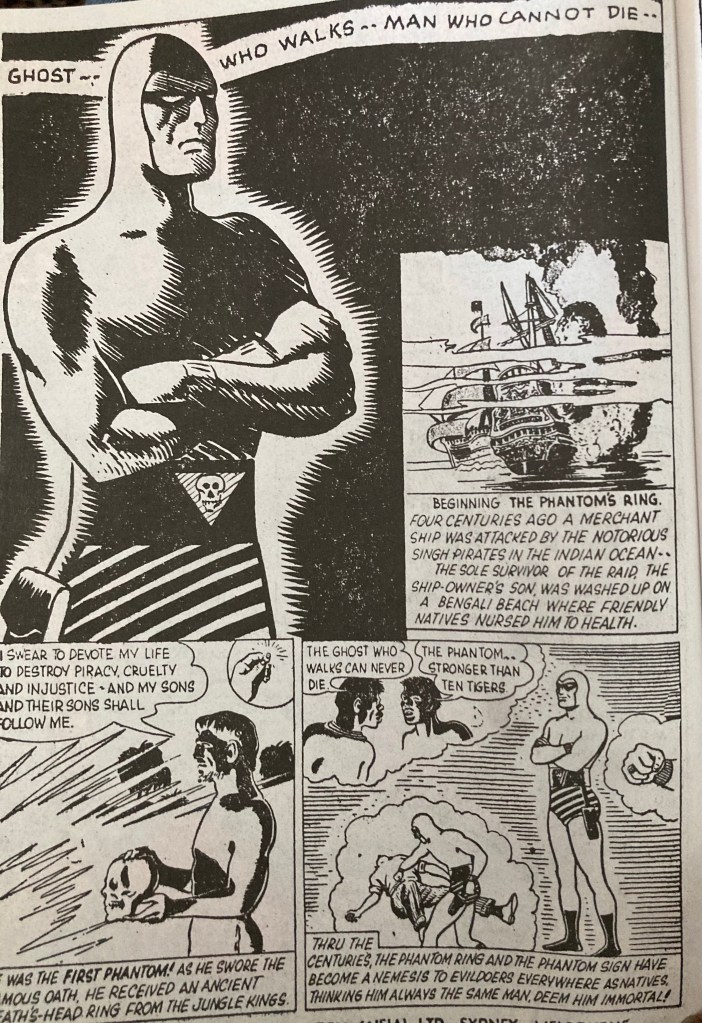
As many of the comic book stories start, ‘for those who came in late’, the sole survivor of a ship attacked by pirates 400 years ago is washed ashore on a remote coast. He is nursed back to health by friendly pygmies, and then swears an oath on the skull of his father’s murderer to devote his life to fighting piracy and crime, and his sons and their sons will follow him. Over the centuries, he becomes myth, The Ghost Who Walks, Man Who Cannot Die, Guardian of the Eastern Dark, nemesis to evil doers everywhere, believed to be immortal.

Frew Publications has been printing Phantom stories in Australia since the late 1940s. Originally a partnership of four men to print various different comics, The Phantom survives as their sole current publication, and involves reprinting Scandavian stories (mostly set back in the time of previous Phantoms), recent Daily and Sunday newspaper strips, new stories which are still being produced from time to time, and an abundance of old strips from the archives.

What makes the Phantom so special is his moral certainty, and his willingness to constantly risk his life in the pursuit of justice and the protection of the weak. He rarely doubts his mission, and he is constantly able to put aside his fears and face danger. Evil doers everywhere have reason to fear him, even though he does not kill (except in the early WW2 era story The Phantom Goes to War, where he leads his pygmies and the other local natives in defence of their home land against the Japanese army), and he always triumphs, against all the odds.

There is great humanity and humour in the Phantom, even though we rarely see any particular outside interests he might have outside of fighting piracy and crime, apart from his family life. One rare exception to this is a story set in Vegas, where the Phantom is chasing some crooks through a casino. One panel sees him running into a room with a sign ‘Elvis Impersonation Contest’ and the next shows him exiting and discarding the ‘first prize’ trophy. We do not get to see him impersonate Elvis, but we are left with the impression that he must be very good at it.

The most famous superhero without any superpowers is Batman. In one of those recent DC franchise films, Aquaman asks Batman what exactly is his superpower, to which Batman retorts ‘I’m rich.’ Banal and materialistic, but halfway convincing in the DC Universe.

The universe in which the Phantom is set is almost identical to our own. There are no super powers, super heroes, nor super villains. The only monsters are other people, who choose to do evil, either on a minor or on a mega scale. The Phantom’s power is that he chooses to do good, and that he does not hesitate to face human monsters of any size. I suppose we wish that there really were more people like that, and that is why so many of us still buy Phantom comics.

Stalin’s Wine Cellar

The Tang Dynasty in Kingston, Canberra, was one of the classiest Chinese restaurants in Canberra. It’s long gone now – I believe it closed in 2005, and I do mourn it a little still. For it had one of the best and most reasonably priced wine lists I have ever encountered.

It was a Shanghai style restaurant, decorated to look somewhat Art Deco, as Shanghai did in its 1920s heyday, before world wars and communist revolutions ruined it.

I have a very fond memory of a dinner I had there one Saturday night in late August 1999, just before I moved back to Melbourne after working in Canberra for seven months. I had become friends with two of my colleagues (we are still close friends now, over two decades later), and we were having dinner to mark my imminent departure.

On looking at the wine list, I saw that the Henschke Hill of Grace Shiraz 1977 vintage was available for $148 (there were a lot of other bottles on that wine list at relatively hefty but still, even then, reasonable prices given the quality and bottle age).

As a result, mindful that I was about to get my rental deposit refunded, I announced to the table that I was buying the first bottle and it would be the Hill of Grace. The response was that I would not, after that gesture, need to spend a further cent on drinks for the rest of the evening. (I suspect, given the subsequent amount we drank before I called time at 2am and grabbed a taxi from a night club, that the $148 I spent was much less than a third of our alcohol expenses for the night, so it was a shrewd move.)

Still now, 22 years later, I think that the 1977 Hill of Grace is the best wine I have ever drank. And I have (in company of course – fine wine is not to be drank alone) bought and drank several other quality premium wines, such as several vintages of Penfolds Grange (1971, 1985, 1994, 1995), Elderton Command Shiraz, Langmeils ‘The Freedom’ Shiraz, Wolf Blass Black Label, Mount Mary Quintet….

But beyond the extravagance of paying $300 for a bottle or three of the 1994 Grange (one still sits in what passes for my wine cellar), I do not think it sensible to spend more than about $70 normally on a special bottle of wine. And being lower middle class means that whilst comfortable, I am not wealthy enough to go all out in the extravagance stakes.

Nor have I gotten particularly curious about French wine or other foreign wines, even though there are many amazing wines to try from beyond Australian shores.

As for wines which are hugely expensive and collectible, they are best left to super-rich people, like royalty, dictators, and oligarchs.

Which gets me to the book I read this week, Stalin’s Wine Cellar, about a wine collection whose ownership passed from Czar Nicholas II to Joseph Stalin and probably now to some oligarchs or other kleptocratic types in the former Soviet Union.

The main author and narrator of this book, John Baker, was an upmarket Sydney wineshop owner who was approached in the late 1990s about a wine collection in the former Soviet Republic of Georgia, which might be for sale. This sees him embark on an adventure where he visits Georgia, meets various shady characters, and inspects a giant wine cellar holding tens of thousands of bottles of wine.

Some thousand of those wines were from the Czar’s personal cellar and were imported from France in the 19th century. Others were Stalin’s personal favourites.

The story is an engaging one, and I finished the book almost in one sitting, which these days is rare for me. But it does illustrate to me that whilst I do know a lot more about wine than the average person, and probably drink a lot more of it and spend more on good quality stuff, there is still a whole lot that I do not know, and will never know. And that even if I wanted to know more, I would need an unlikely event like a lottery win or a major Poseidon sized share market windfall to make accessing and drinking such wines feasible.

Love and Death and an American Songwriter

I’m part of the Countdown Generation. That comprises the callow youth growing up in Australia in the second half of the 1970s and the first half of the 1980s, when Countdown was the ABC’s most popular show, probably the only thing the ABC had which could compete with the commercial networks in terms of ratings.

We got our colour TV with the superior reception which made it possible to get the ABC and start watching Countdown in early 1981, and I was just about to start high school. That’s when Jim Steinman’s solo album Bad For Good came out, to great fanfare. Rock and Roll Dreams Come Through remains one of my favourite rock songs, although I eventually came to the conclusion that Meatloaf’s 1993 cover of it, on Bat Out Of Hell II, was a better version.

But despite Steinman’s comparatively weak vocalisations, the Wagnerian Rock Composer’s lone solo album, Bad For Good, had so much good stuff on it that it is the only record I have ever owned in all three formats of vinyl, cassette, and CD.

So learning yesterday that he has passed away, aged 73 (he was 33, way younger than I am now, when he did that solo album), does make me a little sad.

His best work was what he did for other artists, who could sing better than him. Obviously, Meatloaf would not be the success he is now (AFL Grand Final fiasco aside) if it were not for the Wagnerian Rock Steinman composed. But the work he did boosted a lot of other singers, such as Bonnie Tyler’s 1980s revival, and even Barbara Streisand.

Wagnerian Rock could be cliqued to a high degree. When I first heard Barbara Streisand sing Left in the Dark on the radio, I suspected before the DJ said anything that it was a Steinman song.

However, there is one spoken piece on Bad For Good which does not require singing talent, and which I indeed recited (in part) from memory in the office yesterday after some colleagues had sung part of Total Eclipse of the Heart as we mourned Steinman. And that one piece is Love and Death and an American Guitar (which was inexplicably renamed Wasted Youth and covered by Meatloaf when they reunited in 1993):

I remember everything!
I remember every little thing as if it happened only yesterday
I was barely seventeen, and I once killed a boy with a Fender guitar
I don’t remember if it was a telecaster or a stratocaster
But I do remember that it had a heart of chrome and a voice like a horny angel
I don’t remember if it was a telecaster or a stratocaster
But I do remember that it wasn’t at all easy
It required the perfect combination of the right power chords
And the precise angle from which to strike
The guitar bled for about a week afterward
And the blood was ugh dark and rich, like wild berries
The blood of the guitar was Chuck Berry red
The guitar bled for about a week afterward, but it rung out beautifully
And I was able to play notes that I had never even heard before
So I took my guitar, and I smashed it against the wall
I smashed it against the floor
I smashed it against the body of a varsity cheerleader
Smashed it against the hood of a car
Smashed it against a 1981 Harley Davidson
The Harley howled in pain, the guitar howled in heat
And I ran up the stairs to my parents’ bedroom
Mummy and daddy were sleeping in the moonlight
Slowly I opened the door, creeping in the shadows
Right upto the foot of their bed
I raised the guitar high above my head
And just as I was about to bring the guitar crashing down
upon the centre of the bed, my father woke up, screaming “Stop!”
“Wait a minute! Stop it boy! What do ya think you’re doin’?
That’s no way to treat an expensive musical instrument!”
And I said: “God dammit daddy!
You know I love you, but you got a hell of a lot to learn about rock an’ roll”

Jim Steinman created Wagnerian Rock. It dies with him. We are a little poorer for its loss.

A Great Start to the AFL Season, but I stay cautious

The Western Bulldogs (aka the Footscray Football Club) are sitting on top of the AFL ladder after round 5, undefeated and with a huge percentage (thanks to recent matches against current easy beat teams like North Melbourne and the Gold Coast).

Commentators are saying that this is the best start to a season the Bulldogs have had since 1946.

This piqued my curiosity, so I looked up the 1946 VFL season (NB for any non-Australians who might read my blog, the VFL did not become the AFL til 1990), particularly as our first premiership did not occur til 1954.

For the record, in 1946 the Footscray Football Club won the first 9 matches in a 19 round season, and then another 4 out of the remaining 10 to finish third on the ladder with 13 wins. They then lost the semi final to Melbourne and ended the season fourth.

So, whilst it is amazing to see my team make the sort of start to the season which I have not seen in my entire lifetime (I think our best start was 1985, and that is still the only year where we beat each team in the league at least once), I am more interested in the spirit of 2016 (our amazing 4 finals in a row march to premiership glory) than the spirit of 1946.

But so far, we are looking good, and whilst I am not pencilling in what I am doing on Grand Final day yet (I probably would just watch it at a pub this time and let some other supporter go to the match instead), I am quietly hopeful that this might again be our year.

That is what Footscray supporters do – we quietly hope.