Beer Gardens of Melbourne

There was no bar on campus when I was an undergrad at Monash, which was probably a good thing, on sober reflection. Aside from not having the disposable income or the ability to hold copious quantities of beer or wine that I do now, I would occasionally wander north to the Nottinghill Hotel, affectionately known as The Nott to generations of Monash students.

Yesterday, visiting old haunts in a masochistic fit of nostalgia, I felt a bit the way F. Scott Fitzgerald did, when he wrote (perhaps with an ironic wink at his reader): ‘Once more the belt is tight and we summon up the proper expression of horror as we look back at our wasted youth.’

When, in my late teens and early twenties, I would visit the beer garden at the Nott, there used to be chickens roaming free range around the tables. I mentioned this to the barmaid as she poured me a pint of Little Creatures, but she had already heard this.

It was a very different time, almost worlds away really. 1987 is as far away in time from 2021 as 1953 is from 1987. Chickens in the beer garden was a charming quirk about the Nott, as was the publican, Kath, who had been there since the late 1930s as a newly wed not quite 20, and who remained the publican for about 70 years. [I did not know that then, as my visits to the Nott were an end of term thing, rather than an end of week thing, as they more than likely would be if I was to be transported back to that time now.]

Aside from the chickens and the record breaking publican being gone, the Nott is probably much the same as it was then, even if Nottinghill has changed much since the market gardens surrounding the pub when Kath first took up the license. The University Bar is currently referred to as the Steakhouse, and the food is probably better than when I did lunch there one rainy day in 1993. And the beer garden is still one of the best in Melbourne.

Which got me thinking, as I sometimes do, particularly as summer approaches, as to what are the best beer gardens in Melbourne.

Let me start by saying that I will disqualify those beer gardens which relate to bars which are not traditional pubs. I am a traditionalist, and I cannot keep up with all the inner city bars which sprout up and then just as quickly disappear. Nor am I going to include rooftop bars, like what Young & Jacksons and The Imperial now have.

So, here is my list:

  1. The Nottinghill Hotel

How can I not rank the Nott at the top of the list, given all I have already written about it above? Aside from the character and history of the place, it has a beer garden which, even sans chooks, is spacious and shady and comfortable, running in a long oblong from the buildings of the pub down to the bottleshop out back.

2. The Standard Hotel

The Standard is located in a side street parallel to and immediately west of Brunswick Street Fitzroy. Surrounded by workers’ cottages, it occupies a spacious block immediately behind the pub, with many trees providing space. I have spent many happy afternoons there, mostly at work related Christmas lunches.

3. The Retreat

There are two pubs with the name The Retreat in Melbourne. One is in Abbotsford just south of Johnson Street and is famous for where the pub scenes in The Sullivans were filmed. But it has no beer garden. There is another Retreat in Sydney Road Brunswick, and this is the one with the beer garden, which is well worth visiting.

I had a very fun afternoon there last December with some colleagues, and the December before that with some other friends. What makes the Retreat particularly special in my mind is that its beer garden is dominated by an ancient (but still marginally alive) almond tree which would have to be the largest specimen of the genus prunus I have ever seen.

4. The Anglers Tavern

The Anglers Tavern is located on the banks of the Maribyrnong River, just opposite where a sign in the 1990s used to welcome motorists to the City of Sunshine, with ‘Maribyrnong Township’ in slightly smaller lettering.

I used to live on the other side of the ‘township’ (I much prefer that to suburb), about 10 minutes’ walk through the side streets from my flat. As a result, I have visited the Anglers many times over the past 30 years and it has many fond memories.

For example, Sunday afternoons in the mid 1990s when Wendy Stapleton would sing covers of various other peoples’ songs with the aid of a backing tape and one guitarist (sadly, she never would play Reputation or any of the other songs from when she headed The Rockets in the early 80s).

As the beer garden is located on the banks of the river, it has a lot going for it. However, I think that putting up semi-permanent roofing over most of the beer garden has diminished it. I much prefer a beer garden which is mostly open to nature, with more trees, as it used to be.

5. The Great Northern

The Great Northern is in Rathdowne Street in Carlton North, just before the street ends at the abandoned railway line. The pub itself seems to be a time capsule of early 1980s decor, and I find that charming. I have been there quite a number of times, most notably at an old friend’s 40th birthday drinks there, over a decade ago.

6. The Keilor Hotel

I really am not sure about including the Keilor Hotel on a list of Melbourne pubs. Technically, Keilor village is a part of Melbourne, and suburbia these days extends well past it to the north and west, but Keilor has always felt to me like a small country town tucked away around a few bends in the river, with only the hum of the freeway and the roar of planes approaching or departing from the airport nearby to remind us of Greater Melbourne.

The pub itself has the charm of a giant old country pub. I think it dates to about 1850, and was a stop over during the gold rush for chancers heading out to Bendigo to try their luck. The current publican has been there since 1974, and is related to a local family which owned it since the 1860s.

The beer garden area is out the back of the pub, surrounded by ancient gum trees, and offers a very comfortable afternoon of beer drinking. I was there on Cup Day, and it was strangely deserted.

The Keilor Hotel is one of those hidden gems of Melbourne, and well worth a visit, if you can spare the time for such a remote trek.

Honourable Mentions:

Given that I am on a staycation of 13 weeks duration, I will have sufficient time to visit more than a few pubs in coming weeks. From memory, there are a few which I do need to reevaluate.

The Kingston Hotel – Richmond. If I remember correctly ( and I have only been there twice), this has an awesome beer garden. I will have to investigate.

St Andrews’ Hotel (aka The Pumphouse). Does an atrium area out the back count as a beer garden? Not sure. As an aside, a former owner of this pub some decades ago was rumoured to harbour a pet monkey upstairs.

Bells Hotel. I have not been here in a very long time, so I am not sure that this pub, somewhere just off Clarendon Street in South Melbourne still exists, but I am pretty sure that it had a great beer garden. Maybe I need to try and find out again.

The Clyde. This place has been a haunt of Melbourne Uni students for a very long time, and is probably the only pub left in the area that still welcomes them (I think that Naughtons is not called that anymore, assuming that it is open at the moment). It has a beer garden, but not in the same league as the ones listed above. But any beer garden which is not just the concrete space with a plastic table and an ashtray en route to the toilet (eg the Courthouse Hotel in Footscray) deserves some commendation.

If anyone reads this post, please suggest some more beer gardens in the comments.

How Australia Should Deal With the Qatar Airport Incident

I love a good demonstration!

I was reminded this morning of the October 2020 incident at Qatar Airport where a number of Australian women were taken off a Qatar Airways plane and involuntarily subjected to invasive gynaecological searches when a newborn baby was found in the toilets at the airport terminal.

The sorry story, if you need reminding, is here:

https://www.news.com.au/travel/travel-updates/incidents/australian-women-threaten-to-sue-over-airport-incident-in-qatar/news-story/0e10ed3299ca2cb8286f4da8cc254c93

It appears both that neither the Australian government, aside from the initial noises of outrage at this incident, and Qatar Airways, who were responsible for the safety of those passengers at the time, are taking this matter particularly seriously.

No one has been punished (beyond a metaphorical slap on the wrist for one official) and no one has been compensated, with Qatar Airways apparently dismissive of the claims of those passengers as ‘lacking merit’.

I do feel that this is wrong, and that Australia, both through its government, and its broader community, need to take steps to make the displeasure felt at this violation of a number of Australian women by Qatari officials more widely known to the authorities in Qatar.

There are three measures that I think should be taken.

The first is for Qatar Airways to be banned from Australian airports until they take steps to adequately compensate the women involved and issue a sincere apology. In the olden days, this could be done by the various airport related unions (eg the time Frank Sinatra was pressured into apologising – he didn’t – to Australian female journalists in 1974 by having unions place bans on flights carrying him out of the country). But these days, unions are rather toothless, and it would be up to the Australian government to show some backbone and impose such a sanction.

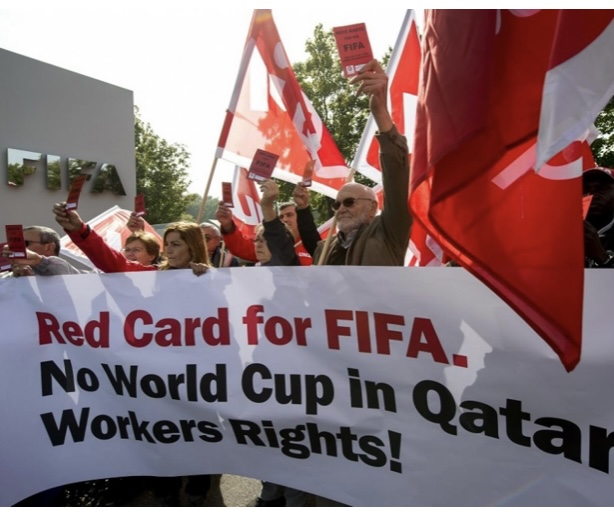
The second relates to the 2022 Soccer World Cup, which is widely believed to have been awarded to Qatar in circumstances involving (to be more tactful than I am known for) somewhat questionable probity. Assuming the Socceroos qualify for the World Cup (and as I loathe soccer, I fervently hope they do not), it would be good for soccer’s governing body in Australia to make a stand on principle against both the bribery which resulted in Qatar getting the hosting rights, and the 2020 Qatar Airport incident, by announcing a boycott of the Qatar World Cup and keeping the team home. That would also show that Australian soccer is no longer a soft touch for sports washing.

The third measure is up to the board of the Sydney Swans. Qatar Airways is one of their major sponsors (as is not surprising when we examine the practise of sports washing). The Swans are also a team which has worked hard to become female friendly, having a large female supporter base, as befits a team which has fitted into a boutique middle class niche market in Sydney:

https://www.sydneyswans.com.au/news/875541/celebrating-the-women-of-the-sydney-swans

I think the Sydney Swans need to man up and make a statement against the misogynistic behaviour of their major sponsor, especially as they have a responsibility to their female supporters. The 2020 Qatar Airport Incident cannot be easily excused. Qatar Airways needs to offer meaningful compensation to its victims.

The Problem With Crony Capitalism

Back in the 1980s, there were some committed communists in the UK who loyally voted for Maggie Thatcher’s Conservatives because they believed that her policies would cause the proletariat to achieve class consciousness and start a workers’ revolution.

Perhaps they were ideologically pure in their faith in Marx (Commo, not Groucho), or perhaps they had been banging their heads too hard when listening to the Sex Pistols.

However, as someone with Libertarian (much as I dislike that word) inclinations, I occasionally fear that my somewhat cautious trust in Free Market Capitalism is not too dissimilar from those Marxists on the other side of the spectrum, who argue that communism has never really been tried (such as the ones who instead of moving to the USSR or PRC, chose to stay in the UK and support Maggie Thatcher).

I particularly felt that way last night, after I finally got around to reading ‘Game of Mates’, a self-published 2017 expose of how those with wealth and influence in Australia are able to manipulate the political system and bureaucracy in order to get greater advantage and profit than the vast majority of the population, helping to extend the gap between the richest and the poorest (and those shrinking numbers of us in the middle).

‘Game of Mates’, whilst written by academics, is not an academic publication. It is better described as a pamphlet, written in plain language and with the arguments simplified for easy consumption by the general public.

Most people will have never heard of it, nor will read it. This is because it is only available online, rather than through bookstores (still my preferred way of buying books).

There are flaws in this pamphlet, and not just in the simplified, almost Zoroastrian clash between ‘James’ (the person with the power and influence to change policy) and ‘Bruce’ (the average mug punter who is deprived of what they otherwise would benefit of through James’ gaming of the system in different ways) which makes up the narrative running throughout the book.

The book takes for granted that any ideological position which questions the extent to which government power exists and is exercised is legitimate, or the purpose of taxation (such as Classic Liberal or Libertarian philosophy), is ‘myth making’. No it is not myth making (even if it comes from the Institute of Public Affairs, who are drawn up as an oversimplified straw man for half a page), questioning the power of government is a very valid part of political philosophy going back to the time of Plato (to say nothing of Locke and the other doctors of the Scottish Enlightenment who have helped to shape our own modern political thinking), which itself is a subset of Ethics, one of the four classical branches of the discipline of Philosophy (the others being Logic, Aesthetics, and Metaphysics).

Another, probably more serious flaw, is that the book, whilst almost anecdotal in its narrative of instances where the elites are gaming the system at the expense of the Hoi Polloi, does not really apply any rigorous theoretical structure to its argument, or at least not to do so sufficiently as to strengthen the argument and give it more impact.

Specifically, it does not talk about concepts such as ‘Crony Capitalism’, which is far more insidious and prevalent than the pure and possibly idealistic ‘Free Market Capitalism’ which I believe in.

To quote from Wikipedia:

Crony capitalism, sometimes called Cronyism, is an economic system in which businesses thrive not as a result of free enterprise, but rather as a return on money amassed through collusion between a business class and the political class. This is often achieved by the manipulation of relationships with state power by business interests rather than unfettered competition in obtaining permits, government grants, tax breaks, or other forms of state intervention[1][2] over resources where business interests exercise undue influence over the state’s deployment of public goods, for example, mining concessions for primary commodities or contracts for public works. Money is then made not merely by making a profit in the market, but through profiteering by rent seeking using this monopoly or oligopolyEntrepreneurship and innovative practices which seek to reward risk are stifled since the value-added is little by crony businesses, as hardly anything of significant value is created by them, with transactions taking the form of trading. Crony capitalism spills over into the government, the politics, and the media,[3] when this nexus distorts the economy and affects society to an extent it corrupts public-serving economic, political, and social ideals.

Essentially, without saying so in so many words, ‘Game of Mates’ is a book which criticises Crony Capitalism in Australia. By not distinguishing it from Free Market Capitalism, and being dismissive of the philosophical underpinnings of Capitalism and Liberalism more generally, the argument is diminished in its impact.

Having said that, there are significant issues raised in the book, in its anecdotal way, which are of concern.

As a first example, the capture of state planning authorities and political decision making at a higher level of planning decisions by property developers, in a manner as to cause disadvantage to the general public and the consumer and great profit to those said developers, is a matter of considerable concern.

To me, this is best illustrated by the fact that local council elections are more fiercely contested than state or federal elections (I live in a very safe Labor area, where the other parties do not really bother in the latter two), due to the value which a council seat will hold if a candidate sympathetic to property development interests wins.

The analysis of how the rise of the superannuation industry has caused both the corporatisation of the union movement (such that it is now run almost exclusively by professional apparatchiks rather than by those who have worked in those industries) and the legal channelling of large (and mostly unjustifiable) amounts of money through various fees into the pockets of fund administrators and trustees to the detriment of the super balances of the average worker is also disturbing. [And there I was, naively thinking that the industry super funds were slightly less dodgy than those run by the banks and other financial institutions.]

The mining industry and farmers also are examined in detail, for the privileges they are able to extract from our political leaders which are frequently at our own expense as taxpayers. Examples cited include railways and ports which will exclusively serve those mining companies, but which are frequently subsidised by the taxpayer, and the way that farmers are indemnified by the taxpayer from loss in the lean years, but keep all their profits in the good years.

But perhaps the area of most concern is the use of ‘Public Private Partnerships’ (aka PPP) in the building of infrastructure over the past three decades. In many, if not all, instances, it appears very clear from the research undertaken by the authors of this pamphlet that the taxpayers in those states where PPP have been undertaken would have been better off if the roads had been built by more traditional finance (such as the government raising the loans directly) than by such partnerships.

I do not see that private ownership of freeways is a bad thing. What I see as a bad thing is that the terms under which such agreements are made are excessively skewed to the benefit of those corporations, to the detriment of the taxpayers and consumers in those jurisdictions.

In all cases, the problem is a bipartisan one. The major political parties, whenever either of them holds power, is very willing to acquiesce to the wishes of the vested interests and their lobbyists, rather than consider the broader interests of the public generally, and to make decisions which frequently enrich those interests at public expense.

How do we fix cronyism? The authors of the book make it very clear that this is a matter of human nature, it always emerges over time. Perhaps this sociological insight needs to be explored further, but at the very least, we need to keep cronyism under the spotlight, as it does thrive in darkness.

The Perils Of Democracy In A Two Party System

Yesterday, I received my fortnightly edition of Newsweekly, and I found an ad in it by the DLP which caused me to pay even more attention than to the article written by a friend who regularly writes for them. Here is a link to the concerns raised by the DLP which caused them to draw on their cousins in Newsweekly whom they do not always align with:

Personally, I find minor parties both annoying and helpful.

When I want a protest vote, whether in the upper house (as I usually do), or in the lower house (as I have only done twice in my adult life), I like the idea of being able to give my vote to a party whose values most align with my own, and whose integrity may be greater than that of the major party for whom I would otherwise vote.

I find minor parties annoying when they either misrepresent their values, or cause the election of persons blatantly unsuited to more sophisticated participation in the political process. As a disturbing example, I will call out the misnamed Reason Party, which was set up as lobbyists for the pornography industry (nothing wrong with that), who claim to be libertarian (they are actually only libertines at best) but who (shame on you Fiona Patten, you smug timeserving hypocrite) slavishly give the state government extensions of authoritarian powers with very limited parliamentary oversight in the current plague situation.

But much as I, as a private citizen, might find minor parties annoying or helpful, their existence does fill a valuable role in the competitive market of ideas which should underline our democracy.

Rules, such as those which have been recently passed by the Federal Parliament by a consensus of the Coalition and the Opposition, are designed to impede minor parties, with the intention of limiting their ability to compete on any semblance of a level playing field with the major parties.

That the major parties see a need for such regulation is a poor reflection on them, and particularly on the value proposition that they offer potential members, particularly in Victoria, where I have an informed view of their current situation. In the Victorian ALP, the rank and file are totally disenfranchised as a result of branch stacking issues, and decisions are imposed on them by administrators appointed federally. The Victorian Liberals are not much better – COVID has prevented them from holding meetings to elect (or reelect) their ‘administrative committee’ ( ie state executive) – and as a result they are led in a way where they have had limited consultation with their rank and file in the past two years.

Where long standing and major political parties are unable to govern themselves in a manner reasonably compatible with the norms of corporate governance standards, nor to give their financial members (ie share holders) an opportunity to hold the leaderships of those parties regularly accountable, there is a serious crisis in legitimacy.

Seeking to suppress alternative parties, such as the DLP, just illustrates those failures in the major parties to offer an attractive value proposition to existing and potential members. What is someone going to get by joining or remaining a member of a political party, paying the better part of $100 and being expected to donate at least several hours of their leisure time for an election campaign, other than the dubious satisfaction of doing their civic duty towards the ongoing health of our democracy?

Both the Coalition and the ALP are failing to attract either primary votes or nominal (let alone active) members to their cause. Instead of improving their own value propositions (eg becoming more responsive to their members and supporters), they are simply trying to suppress any minor party alternatives, using their powers as the legislative majority consensus.

This is not healthy for our democracy, and is not going to attract either more votes or members to either Liberal or Labor.

Was Tim Smith Hexed or Drink Driving?

At some freshly reopened bar on Friday night, whilst sipping a glass of red, a colleague of mine said that he had gone to high school with someone who is now a member of the Victorian Parliament, the second generation of her family to proudly represent the Labor Party.

He said that at school, she had a tendency, like some of the more malevolently minded women of Southern European peasant extraction of an earlier generation, to place curses on classmates who had incurred her dislike. She gained some credibility when she told one girl that she was going to die on Tuesday, and the girl actually broke her leg.

As someone from a Southern European peasant background myself, this aspect of Italian and Greek (in that particular case) peasant culture is something I am familiar with. My mother is regarded as the go to woman whenever her network of family members and friends (and indeed any of my friends who give credence to such things) fear that someone has placed the evil eye or some such hex on them, as she knows the specific prayer (or spell, if you prefer) to remove such curses.

I was thinking of this when the news broke yesterday morning that Liberal Party luminary, Tim Smith MP, had been forced to resign from the opposition front bench after crashing his Jag into a cheaper car and the front of someone’s house when driving with a blood alcohol level of 0.13.

I have occasionally (or at least think I have) written about this somewhat oafish scion of the landed gentry before, a chap whose wise utterances in the course of representing his constituents include demands to: reopen pubs, reopen golf courses near his home, and drive out the fruit bats currently living in the Yarra Bend park along the edge of his seat.

Given that I do not really believe that this fellow has the intellectual capacity to be an independent moral agent (ie to make his own choices like a normal person who can tie their own shoelaces), I do not think that Tim Smith MP was actually drink driving. I think that his Greek opponent in the state parliament has dusted off her high school era hex book and placed a curse on him, causing him to drive Golem-like in a manner imitating a drunk driver.

I may be wrong. Hexes and curses might not exist. But what is more likely, a hex, or some of the stuff which has already happened, ie that a towering intellect like Tim Smith MP could be elected to the state parliament and recently promoted to the opposition front bench? You be the judge.

This year, people probably do need Halloween

More of this next year please!

This year, the second of the plague, I think the end (for now) of our lockdown has left people needing to cheer themselves up a bit.

Which is why Halloween seems to have been celebrated a little more fully, even though it is a uniquely American tradition whose import to Australia still seems rather bizarre to me.

For the first time, I actually decided to play nice rather than grinch out and bought a few bags of chocolate frogs and wrapped lollies, which I left out in a bowl at my front gate, all covid-safe. I passed the evening sipping summery wine (ie sparking and rose) with one of my friends who lives in the next suburb along, watching the trick or treaters come by with their adult supervision from my front verandah.

From passing comments with the grown ups, some of whom were wearing pretty elaborate costumes, I think that once the kids were asleep, the Halloween parties were really going to get going, in celebration of the prospect that perhaps we finally have our freedom back.

And why not? After the past 19 months, people need something to cheer them up, and why should it not be a festival where the dead rise and walk the earth again?

Being Grateful for First World Problems in a Time of Plague

Plenty More Where That Came From

I never cease to be grateful for living in Australia, rather than anywhere else, even in a time of plague.

Americans might love their right to bear arms and all the rest of that, but just like in old school Westerns, the police do shoot back, and with very heavy firepower. Also, their police, for all the supposed constitutional protections Americans have, do lock up a lot of people to the point where, something like one out of every eleven people ends up in gaol at some point in their life, often for things which would not result in incarceration elsewhere.

So all of my problems are first world problems, although one of the famous general ones (ie McDonald’s doesn’t deliver) has been cured in recent years through Uber Eats and similar services, and one of the more particular ones unique to me and few other Australians (ie supporting an AFL team in long term premiership drought) was cured by the miracle finals run of 2016.

One current first world problem facing me at the moment in this time of plague cannot be cured by Netflix and Uber Eats. It is the delay in parcel deliveries, due to Australia Post and other privately owned parcel delivery companies being disrupted by covid exposure at their various depots.

I am not currently ordering books online, not with the 80 unread book backlog in piles around my lounge room. What I am ordering, from various wineries and wine dealers, is wine, and there are unprecedented delays.

Just last Sunday, a six pack of red wine arrived which was ordered almost five weeks earlier. And right now, through two different orders placed about 9-10 days ago, I have approximately $700 worth of wine still in transit to me. I am accustomed to almost instant gratification in terms of high velocity deliveries.

And for this, to be honest, I am grateful. There are much worse problems to have than to have to wait a few extra days or weeks for your quality Australian wines to arrive on your doorstep.

[As an aside, another of the reasons to feel lucky about living in Australia is that we have such good quality wines. I first realised this about 25 years ago when I first started to regularly frequent the Greek restaurants in Lonsdale Street, at a time when they still served, as their house red, an imported Greek wine called Demestica or some such, which, whilst cheap, was so much rougher than local reds in the same price point.]

Collingwood Football Club’s Complicity in Sports Washing

Yes, you know that you want to say it!

In the recently concluded second season of Ted Lasso, a number of serious issues are covered by this otherwise amiable show.

One is ‘Sports Washing’.

Sports Washing is the practice, by a nation or a corporation, of sponsoring a sporting team or competition in order to distract attention from either human rights abuses by a nation or of ruthless business practices by a corporation. That is my definition, and there are probably better ones out there. I do not pretend to be a latter day answer to Dr Samuel Johnson.

One of my favourite episodes in Season 2 of Ted Lasso is the one which deals with Sports Washing. In that episode, the loveable young rising player Sam discovers that there is a sinister side to the fictional sponsor of AFC Richmond, Dubai Air. Dubai Air is owned by a ruthless oil company who, with the complicity of its corrupt host government in Africa, is polluting Nigeria, Sam’s home country.

After he learns this (Sam, being only 21, is rather naive initially, but a very decent and honourable man), Sam decides before AFC Richmond’s very next match to cover up the Dubai Air sponsorship bar on his uniform with masking tape.

The other Nigerian players follow suit, with Sam explaining to the rest of the team why they as Nigerians need to do this. Then, in what is one of the most moving (and redemptive) moments of the show, former primadonna Jamie Tartt follows suit, telling the rest of the players that they are a team and need to wear the same kit, and they do.

The resulting publicity from the press conference Ted gets Sam to hold after the match does succeed in causing the parent company to cease their operations in Nigeria.

Dubai Air is a fictional airline. Emirates Airlines, on the other hand, is real, and is owned by the government of Dubai, which is controlled by a local Sheikdom (or Emirate if you prefer, one of several ‘United Arab Emirates’ which make up a nation state in that part of the world).

Taking a step back for a moment, let us look at what the various royal families of the UAE, particularly the more prominent ones such as that of Dubai and that of Abu Dhabi (whose royal family owns the airline Etihad) do.

Amnesty International is highly critical of the conduct of the UAE on human rights issues. As a prime example, there is the case known as the ‘UAE 94’ where 94 people critical of the regime were arrested and subject to an unfair trial. 60 of those people are still in gaol. Then there are other examples of unfair trials, arbitrary detention, suppression of freedom of expression, concerns about women’s rights, the appalling conditions faced by guest workers, and the UAE’s involvement in the highly lethal conflict in Yemen.

The ABC recently ran a story on the foreign ownership of various A-League soccer teams in Australia. There was concern about Melbourne City, which is owned by the City Football Group (most famous for ownership of Manchester City), being part of a Sports Washing racket. This is because City Football Group is owned by a prominent member of the Abu Dhabi royal family, who are involved in human rights abuses in the UAE.

The message is a pretty clear one. Ownership and sponsorship of sporting teams and competitions is being used to distract attention from the human rights abuses the owners of those sponsors are active or complicit in. This is particularly a problem in Australian soccer, especially with the current ownership of Melbourne City.

This problem, Sports Washing, is not isolated to Australian soccer. It is a problem in Australian Rules Football. As the national sport, Australian Rules Football needs to endeavour to be cleaner than soccer (a sport which is tainted with many colours of corruption).

Who does not remember when the Docklands Stadium currently known as Marvel Stadium was called ‘Etihad Stadium’, after the airline owned by the royal family of Abu Dhabi. Thankfully, this is over.

But Collingwood Football Club is the worst, longest and most complicit participant in Sports Washing. Ever since 1999, several months after Eddie Maguire became their president, Emirates Airlines has been a premier partner of the Magpies.

Because Eddie has always had many irons in the fire (at the same time he was taking over Collingwood he was telling us in very clever terms why we should become a republic, and soon after was managing Channel 9 from first to second place in the ratings, before seeking to run unpaid PR for King Kong), we cannot expect him to ever be very informed about any of his decisions, choices, or pronunciations (he is after all a Collingwood supporter, not a rocket scientist). However, failing to exercise duty of care over a 20 year period in the choice of sponsor for his football club is particularly concerning.

It is time for the complicity of the AFL and of the Collingwood Football Club in the practice of Sports Washing to end. Collingwood should end their sponsorship with the fictional Dubai Air’s not so fictional real counterpart, Emirates Airlines.

Ted Lasso as Shakespearean Tragedy

My friends will know that I am a great fan of Shakespeare’s plays, which I do allude to from time to time in this blog. I believe that in them, particularly the various tragedies, you can find the questions which comprise most of the great dilemmas which we as humans face.

The great villains are of course my favourite characters: Iago, the passed-over-for-promotion army officer on his trail of vengeance and personal advancement; Richard III, the stunted hunchback who seizes the kingdom in a frenzy of fratricide and nepoticide; and Macbeth, who starts off as a decent and honourable man, but who is seduced by three witches and his ambitious wife to start on the road to royalty and perdition.

There are others of course, but these three, in their villainy, are the ones which stand out most, and whose motives are easiest to understand. For all that they are rotten to the core, Goneril and Reagan and their confederates are such from the start, with no real character development or explanation (although a vain and selfish father like King Lear perhaps explains how they turned out). And in Hamlet, I would argue that the ghost of his father is the real villain, seeking to destroy the living and the innocent in an orgy of vengeance.

What has all this got to do with Ted Lasso, the amiable sports comedy on Apple TV+ which features an American college gridiron coach hired to manage an underachieving English Premier League team (and which just finished streaming Season 2 on Friday)? Well, I would say that one of the main story arcs in Season 2 is very much a Shakespearean tragedy.

Ted Lasso is intended to be a play in three acts, as it is not going to go beyond Season 3. Season 1 was where Ted arrives, faced by a wall of skepticism and hostility, and gradually wins over the players, supporters, and the team owner, with his boundless optimism and humanity. The relegation at the end of Season 1 was inevitable. Season 2 is where they embark on a campaign to be promoted back to the premier league, and to build into a team that can win championship titles (something which the AFC Richmond of the series has never done). Season 3 will tell us what happens next, when AFC Richmond is back in the Premier League with all but one of its key pieces on the right side of the board.

And that is where the tragedy comes in. Nate was introduced to us in Season 1 as the team’s kit boy, bullied and treated with contempt by the team, insecure in his tenure in his humble role, but with a mad keen brain for soccer tactics. Ted, who treats everyone with kindness and seeks to bring out the best in people, sees Nate’s keen intellect and makes use of it. By season’s end, he has been promoted by Ted to assistant coach.

In Season 2, Coach Nate comes into his own. His growing confidence in his abilities and ego, stroked by his tactical brilliance in the FA Cup quarter final where he takes charge when Ted has a panic attack, sees him go from a victim to a bully. He is first admonished when he humiliates one of the junior players, and apologises, but his discreet victimisation of the new kit boy, goes unseen and unchecked.

His growing ambition then leads him to the ultimate betrayal – leaking to the press the secret of Ted Lasso’s panic attack in the quarter final – motivated by a misguided rage at Ted for abandonment and a snowballing belief that he is the real brains behind the team’s successes. At the end, after he storms out after having torn up the BELIEVE sign which has hung over the locker room for two years, we see him in his own senior coaching role, at the team which Richmond’s owner Rebecca’s ex-husband Rupert has bought.

What are the motives in Nate, and in his transformation from loveable supporting character into villain, in a show where every character until now has grown into the best version of themselves?

Like Richard III (whose transformation does not occur onstage, but rather is explained to us in the soliloquies at the end of Henry VI part III and at the start of Richard III), Nate has a degree of self-loathing. Richard has his hunchback to remind him of his limitations. Nate has a father who seems impossible to impress, and the recent memory of the contempt with which he was formerly treated by the team in his more humble prior role.

There is also some Iago in there. Nate expresses his desire for promotion and his belief that he can do the job better than Ted. He then does his betrayal.

And of course there is some Macbeth in there. Nate starts out as good, and does get prodded, partly by Rebecca’s ex-husband as we see, and partly by the lack of appreciation shown by his father at his moment in the sun in the FA Cup Quarter Final, to start seeing himself as more fit for the role of king (or senior coach) than the incumbent. He starts out as Thane of Glamis, and when he becomes Thane of Cawdor, he sees himself as King hereafter.

Which sets things up for an interesting season three, or third Act, if you will. We have to wait til next July for it. Ted Lasso and AFC Richmond now are back in the Premier League, desperately chasing their first ever major trophy. But up against them is the Rupert owned West Ham United, now coached by tactical prodigy Nate. Rupert always has a motive to needle his long suffering ex-wife, and Nate wants to prove that he is the better coach, and avenge his perceived slights.

I hope for a happy ending, the way that only a supporter of a historically underachieving football team can hope. I hope that Birnam Wood does come to Dunsinane, or rather, to Selhurst Park, and that the fictional AFC Richmond gets its EPL fairytale. But it is going to be a greater, more thrilling, story to watch, with the twin villains of Rupert and Nate seeking to thwart Ted at every turn.