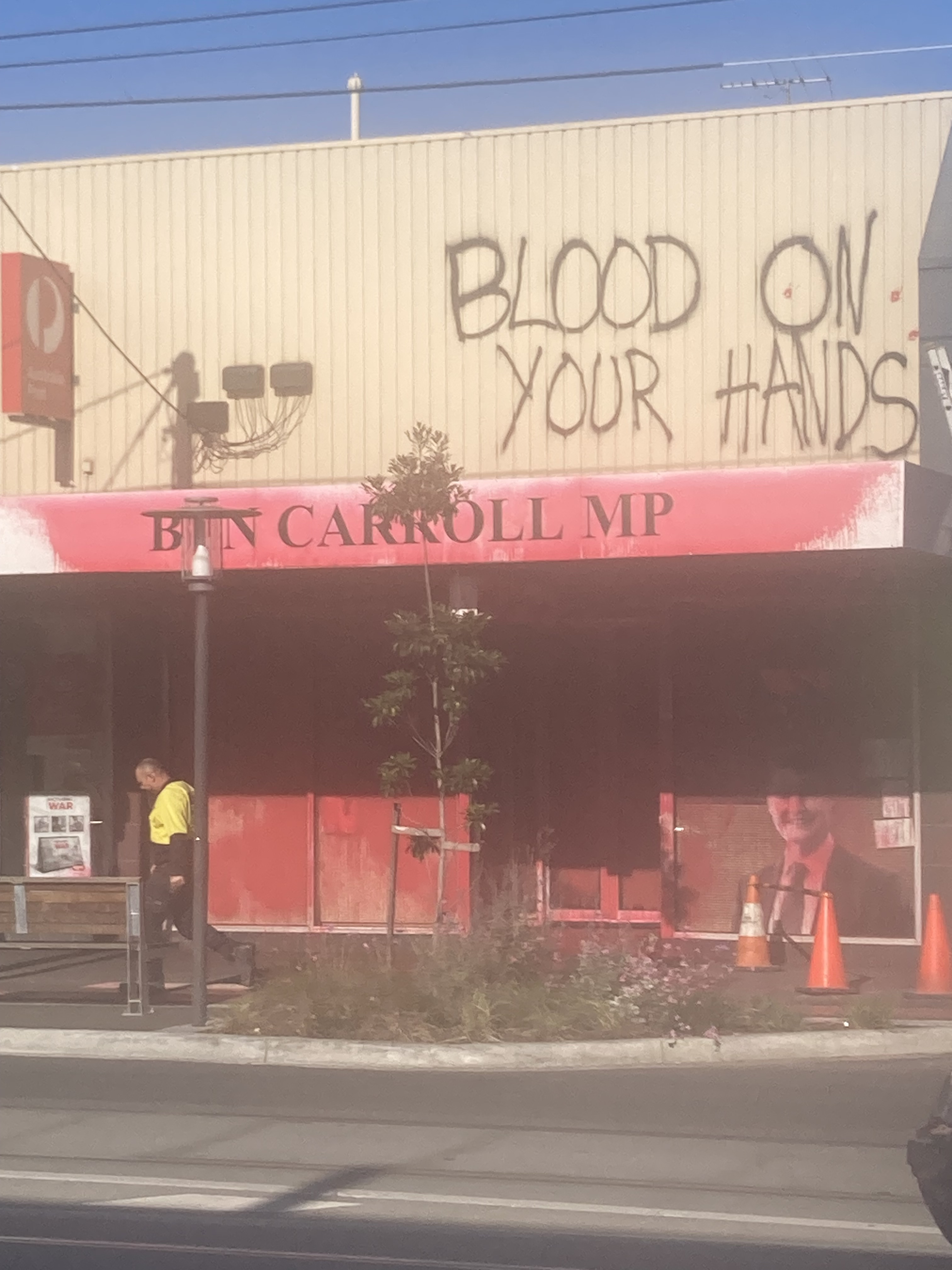
Someone really doesn’t like our local MP Ben Carroll…

Saw the below when in Keilor Road yesterday. Obviously someone has gone to a lot of effort to express their dislike of our local state MP.

Not sure whether it’s anything particlar in relation to his ministerial duties or simply that he is a senior member of a government who ruthlessly suppressed legitimate expressions of protest during the pandemic.

In any case, we are lucky in Australia that this is about as extreme as political protest gets.

Brisbane Olympics 2032 – A Missed Opportunity?

I first visited Brisbane in July 1989, and I happened to go along to see the Britain – Australia Rugby Union Test (I think these days Rugby Union in the UK is so well developed that they have four separate teams instead of one, but I am not one to pay close attention to Rugby Union at the best of times).

The test was at Ballymore, a Rugby Union ground which was far less than a stadium at the time. I get the impression that it was two embankments bulldozed upward on either side of the pitch for the benefit of spectators rather than properly constructed pavilions or stands. Very outer suburban.

I was used to the VFL crowds of the era, but Queensland Rugby Union fans were next level (even when compared to Collingwood supporters at home). On the way into the ground, my friends and I encountered an acquaintance who already seemed quite drunk (it was 11am), and what appeared to be mostly still full beer cans were flying around the ground during the match.

Oh my! This makes the utter tossers who support Melbourne Victory in the domestic soccer competition seem well behaved in comparison! (Of course, we are all familiar with the private schoolboy saying that Rugby Union is a thug’s game played by gentlemen. And presumably watched by thugs too.)

Queensland sport, both in terms of its spectators’ behaviour and the facilities for viewing it, have improved a lot since then. I was in the Storey Bridge Hotel near the Gabba in April 2005 when there was going to be an AFL game that night, and I was told by the staff that after the recent threepeat, the Brisbane Lions were as popular on game day as the Brisbane Broncos (ie the long established Rugby League team). In August 2015 I went with a friend to see the Bulldogs-Brisbane game at the Gabba and was quite delighted by the comfort and accessibility of the relatively recently rebuilt Gabba stadium. (The Bulldogs lost a see-sawing game, but I did not mind too much, and the following year we did win the premiership, which made up for decades of disappointment.)

Ballymore too apparently is a somewhat improved stadium, although no longer as important for any form of football as it was 35 years ago.

The upcoming Brisbane Olympics in 2032 initially raised high hopes for taking sporting stadia in Queensland to a much better level. The original plan was for the Gabba to be rebuilt as a 50,000 seat stadium rather than the current 40,000 seat configuration.

The Labor government has since reviewed its plans and shelved the idea of rebuilding the Gabba. Whilst this is not as ruthless as the Andrews Labor Government in Victoria first accepting the 2026 Commonwealth Games and then cancelling it in what appears to have been a cynical exercise in pre-election pork barrelling, it is prima facie a matter of some concern. After all, the Olympics is usually the sort of event that the overseeing government goes insane about, regardless of costs.

If I were the IOC, I would right now be rather nervous about the intentions and capacity of the Queensland Government to actually host the Olympics, and start drawing up contingency plans.

But the economics of building large sporting stadia, even in large cities like Brisbane, is somewhat questionable.

Brisbane is a city of about 2.6 million people. It hosts one AFL team, and various other teams in the various inferior football codes. The AFL team, the Brisbane Lions, plays its home games at the Gabba. At best, this makes for 11 home games in a year, plus possible home finals matches. (The exception to this is when in the Covid cursed 2020 AFL season, the AFL lifeboated the entire competition to Brisbane.) There is also a cricket test sometime in the summer, as well as various international limited over matches.

Let’s compare that to Perth Stadium or Adelaide Oval. They have two AFL teams each, so in a usual year, those fine stadia will host a minimum 22 AFL games (to say nothing of the current Gather Round in South Australia), possibly more if their teams are firing up in the finals. And they are as likely to have as many cricket matches as Brisbane.

And then there is the MCG, the global cathedral of both Australian Rules Football and Cricket. Aside from the usual number of cricket matches, including the marquee Boxing Day Test, the MCG also hosts a minimum of 45 AFL matches per year, plus AFL finals, including the AFL Grand Final (ie the most highly attended domestic competition final in the world). With 9 AFL teams located in Greater Melbourne, there is considerable economy of scale to enable both the successful existence of the 100,000 seat MCG and the 57,000 seat Docklands Stadium.

Plus Taylor Swift and similar concerts. Top tier acts are going to perform at the MCG, whilst second tier will go to Docklands, and third tier acts like the sort I like seeing will perform at Melbourne Park. (Sadly, the sort of musicians I really really like, eg Suzanne Vega, are related to the Palais these days, and previously to Hamer Hall and Crown Casino.)

Ultimately, and I hate to say this (especially as I have been a loud advocate for rebuilding the Gabba much much bigger than it currently is), it makes very little economic sense to build any major sporting stadia anywhere approximating half the scale of the MCG anywhere but Melbourne, as they will not be used sufficiently enough to warrant the large expense.

For this to change, there would need to be more AFL matches held in other cities, which would necessitate more AFL teams being admitted to the competition – something I do not think is viable except in Perth or Adelaide. Alternatively, more Rugby or Association Football matches would need to be held in such stadia common used for AFL or Cricket.

And would we really want that?

All Care, No Responsibility? Bonza Airlines Crashes (Metaphorically)

Having a particular interest in the English language, I like reading books like The Story Of English and Bill Bryson’s Mother Tongue, and biographies on lexologists like Dr Samuel Johnson and the murderous lunatic (I kid you not) who helped build the original Oxford Dictionary.

One word whose obscure origins do vaguely confound me, but which does fascinate me, is the Australian English term ‘bogan’. Prior to the late 1980s, we would use words like yobbo or ocker to describe someone of somewhat uncouth or vulgar mannerisms and behaviour.

Since then however, bogan has gradually become the word we commonly use across Australia for such individuals.

It appears to have its origins in the Irish surname Bogan. I met someone with that surname about 15 years ago actually, and there is a wine (I have a bottle of it in fact) which is named The Bogan, which was gifted to me last year on retirement and which is far more expensive than what actual true bogans would drink.

There is a Bogan Court in Boronia, in the far outer eastern suburbs of Melbourne. I have never visited it, and I have only very briefly passed through Boronia itself, but I have always had a vague feeling that bogan started as a description of people from that area, permeating out in to the rest of Melbourne from there.

In the early 1990s, there was a TV show called the Comedy Company, featuring a faux school girl Kylie Mole (stage name for the comedienne Marianne Fahey) who would rant at the camera in a mock Broad Australian accent, regularly using the word ‘bogan’ to describe various of her acquaintances and frenemies.

And hence it spread out on the airwaves across Australia, displacing other more local words which had similar meanings.

Let’s look at the words I have collected from my travels and acquaintances across our nation which have meanings similar, if not identical, to ‘bogan’ and which have been largely displaced by our fond Melbourne term of endearment:

Sydney – Westie

Brisbane – Bevan

Perth – Turbo

Canberra – Booner

Hobart – Chigger or Chigwell.

I have not yet discovered what similar term might have existed in Adelaide, and that does bug me.

But this does go to show how Melbourne is culturally dominant in Australia, that our particular version of the Australian English dialect is the one that is most influential. [Editors of the Macquarie dictionary, please do take note. This is important for lasting records of our language.]

Vires Acquirit Eundo! As our Founding Fathers would have said!

Bogan is, to put it mildly, a term used to describe a lot of things that people from my side of the city might like, or that people from my home town might be.

I don’t really mind that. After all, I just fessed up on Facebook to a former colleague as to why I am so fond of Titus Andronicus (mostly because it is Shakespeare’s equivalent of a Road Runner cartoon).

The elitist armchair socialists at The Guardian recently wrote about the existence of a bogan airline. They could have been talking about Jetstar or Virgin Australia (neither of which I am particularly keen on travelling with), but they were not. It turned out they were talking about a challenger called Bonza, which was going to offer direct disounted flights to the bogan market.

Bonza is very much the sort of colloquial Australian expression which could be used by a bogan to describe something which provides one with joy, a bit like Germans use Wunderbar! and Cartman’s Ginger hordes of the night use Huzzah!

Indeed, a google search under the term ‘bogan airline’ yields Bonza Airline’s website as the top hit, greeting us with the sentence: ‘G’day, we’re Bonza, Australia’s new, and only independent, low cost airline servicing regional domestic routes.’

Routes included flights from the Sunshine Coast base (near Australia Zoo, former lair of the Crocodile Hunter) to Newcastle, Mildura, Albury and Melbourne (Avalon Airport). Having been to Newcastle, Mildura and Albury, I can assure you that these are places which bogans would greatly enjoy, although not as much as Bali.

Sadly, it appears that Bonza has just collapsed, leaving its employees and (presumably disproportionately represented) bogan passengers owed considerable money, and employees in particular extremely anxious as to whether they are going to paid in a hurry.

The collapse of Bonza does raise various questions about the morality of the conduct of its owners, who, despite the name, are not exactly bogans, nor even Australian.

Using my online subscription with The Melbourne Age as my source, I have learned that Bonza is owned by a private equity firm based in Miami, 777 Partners. At the end of 2023, two of the planes in the Bonza fleet were redirected to other airlines owned by 777 Partners. Last week, the remaining four planes were seized by AIP Capital, an investment company owned by ACAP, the parent company of 777 Partners. Those planes have been transferred to the aptly named Phoenix Aviation Capital, which is owned by ACAP. This was all apparently a surprise to the Australian based board of Bonza.

[As an aside, ‘phoenixing’ is a term often used, usually pejoratively, to describe the way bankrupt businesses can resurrect themselves under a new company structure, leaving creditors behind in the ashes of the previous company structure.]

Whilst I am not an expert in finance, nor a lawyer, I do have the normal sense of morality and decency of the ordinary person in the street. It appears to me from my above paraphrasing of the news report that the owners of Bonza have suddenly chosen to cut their losses on the business, leaving employees and customers significantly out of pocket. This does not seem at all moral or decent or ethical to me, to say the least.

But that might not be the least, even though that alone smells to high heaven to mug punters like me.

News reports in The Age on Monday have raised accusations of fraud on the part of 777 Partners. Lenders to that company have lodged a lawsuit claimed that it borrowed millions against $US 350 million of assets which either did not exist, or did not own, or which were already committed elsewhere. The lawsuit alleges that there have been fundamental breaches of agreements and double-pledging of assets backing loans to the company. Further, the relationship between 777 Partners and its parent ACAP is extremely entangled.

The people involved as the architects in this debacle are not our loveable bogans. They are sharks in suits who are feeding on our bogans. I really do hope that the courts in New York hold those people accountable, although I fear that this is not going to help the employees or passengers of Bonza in the short term.

Broo Holds Two AGMs Back To Back

As the few readers of this blog would know, I am a shareholder in Broo, a craft brewing company which is listed on the ASX.

As a recap, I acquired most of my shares in early 2011 when, as an inspired marketing stunt, the founder of Broo offered a number of shares per slab for everyone who bought a slab (up to a maximum of 50 slabs) online from his venture. I bought two slabs, and then, a few years later after it listed on the ASX and was short of cash, stumped up 36 cents to buy another 20 shares, giving me 120 shares in the company.

The company has, this week, marked 2 years since it was suspended from trading on the ASX. At some point in this period, I framed and hung the ornamental share certificate I was emailed 13 years ago onto the wall behind my toilet bowl, as a symbol of how much value I ascribe to those shares.

Yesterday was another landmark day in the recent history of Broo. It held AGMs for both 2022 and 2023 back to back.

I did not bother attending the AGMs. I was en route to the Station Hotel in Footscray to start celebrating with two of my friends the fact that one of them has just started his pre-retirement leave (something similar to what I am still enjoying for another two months). We ended up doing yum cha in a Chinese restaurant in the Footscray Market, followed by some drinks at various other locations around inner Footscray.

Today the three of us are pondering whether drinking bourbon and cokes around a pool table at the back of the Courthouse Hotel (a rather rough pub) in Nicholson Street Footscray makes us bogans.

Anyway, back to discussing my nominal investment in a craft brewing company.

The AGM results and other recent company announcements are accessible through the Commsec app, so I read through them this morning. In summary, the remuneration report for both years was adopted, and the three directors were reelected, two in one of the AGMs, and one in the next.

The AGM seems to have been very vanilla, as the only votes against the resolutions were by proxy, so no disgruntled minority shareholders showed up to vote against them. The proxies voting against the resolutions added up to just under 45 million shares, or a bit under 20% of the votes exercised. 45 million shares, if they were valued at the 0.9 cents they last traded at in May 2022, would still be worth about $400,000, slightly less than what my entire diversified share portfolio of mostly blue chips and ETFs is worth. So whoever sent in their proxies in absentia with directions to vote against the current board does have a lot of skin in the game.

But company AGMs are rarely a place where disgruntled minority shareholders will air their grievances (aside from the serial pests who pass themselves off as shareholder activists). I do note from my google searches that there was an attempt by Kent ‘Groges’ Grogan, the founder of Broo, who was ousted just over 2 years ago, to have the company wound up in the second half of last year in the Federal Court over monies owed to him. Obviously that has been resolved in some way or other, as Broo still exists as a corporate entity.

An activities report from 30 April on the Commsec app indicates that Broo is well advanced into its plans to relaunch one of their craft beer brands and resume producing beer, and is also getting new investment into the brand.

I wish the directors well. Trying to resurrect a beer company is a noble aim, and I do not envy those who wear the crown of thorns which is the directorship of a struggling listed company, people whom I suspect have probably invested a lot of their own funds and those of their friends and family into trying to pursue this particular dream.

But I am a realist. All of the money which was raised in the Broo IPO in 2016 was spent on buying the Mildara Brew Pub and the land in Ballarat intended for a brewery. Those assets are all gone, and there is little remaining capital. In the 13 years that I have followed Broo closely, each and every endeavour has not ended well, or even, for that matter, gotten far off the ground. If the directors were to go out to ordinary shareholders like me with another rights issue, I am happy to come up with some loose change to acquire more shares, but that is more out of amusement value than any expectation that Broo is actually, under its new management, going to suddenly change the direction of its fortunes.

Channel 7 Versus The World

I doubt many people are familiar with the movie Scott Pilgrim Versus The World. Dorky guy who likes video games meets a suitable girl (vaguely goth, likes comic books and video games), but to win her, he must defeat each of her formidable seven ex boyfriends. It is like a series of challenges in a video game, each leading up to the Boss Fight at the end.

Or I guess so. I don’t really have the patience for video games.

The announcement yesterday of the verdict in the Bruce Lehrmann defamation case against Channel Ten reminded me of the Scott Pilgrim movie, except that the main character is Channel Seven (a far less sympathetic character than Scott Pilgrim), and that it is using various other actors of dubious integrity as proxies in its fight against the other television networks.

This of course started with the defamation action which now disgraced war hero Ben Roberts-Smith VC fought against Channel Nine and its various associated outlets, including the several former Fairfax newspapers, for having the temerity of accusing him of war crimes in Afghanistan.

Whilst Channel Seven was not directly involved in those proceedings, they did bankroll Roberts-Smith in his defamation action, given that he was then a senior employee of the network and well regarded by the management of the company.

Effectively, Channel Seven used Ben Roberts-Smith in a proxy war against the Nine Network, where the risks to itself mainly consisted of losing the money put upfront to fund the litigation, but where most of the possible liability and all of the potential reputation damage would be incurred by the litigant.

The Bruce Lehrmann defamation action against Channel Ten was finalised yesterday with a judgment that, on the balance of probabilities, Bruce Lehrmann had committed the rape. Whilst Channel Ten’s manner of reporting the allegation in question was not laudable, it was not defamatory.

But it was not just the alleged actions of Lehrmann and Channel Ten in question at this trial. Just before the judgement was due to be handed down, a disgruntled former Channel Seven producer raised details of circumstances relating to the year that Lehrmann had spent living rent free in a luxury apartment paid for by Channel Seven in return for his exclusive interview. Accusations of the provision of prostitutes and party drugs flew wildly.

This represents the second proxy war that Seven has been involved with in relation to its rival television networks.

Both cases do not reflect credit on Channel Seven. It shows a tendency to encourage people aligned with the network to litigate against its rivals, regardless of the collateral damage that these people may suffer from undertaking such actions.

Also, and this is what is far worse for the state of telejournalism in Australia, the Higgins – Lehrmann saga in particular shows not only the relentless way commercial networks like Seven and Ten are going to use their cheque books to pursue ratings for news stories, but the extremely partisan way that they are going to choose to report the news on such serious topics as criminal investigations. Channel Ten was Team Higgins, and Channel Seven was Team Lehrmann. Justice was served in no way whatsoever by the conduct of either network.

What this says, going forward, for potential partisan media conduct on sub judice criminal cases, is ominous for the integrity of the criminal justice system.

Reflections on being a Footscray / Western Bulldogs Supporter

About 8 months ago I rather reluctantly joined Facebook, mostly because it was a relatively painfree way to make contact with an intricate web of second cousins in Reggio Calabria during my imminent visit.

Since then, the number of fake profiles and would be scammers I have encountered have given me renewed cause to lament the 2019 demise of Google Plus, which was a far superior social network. Similarly to the fake profiles, the poor quality algorithm continues to feed me repetitious nonsense, such as the same reddit-lifted stories about cheating spouses, wicked stepparents and unfairly favoured children, reinforcing my impression that Facebook is only useful for making contact with people whom, for the most part, I have either lost touch with, or only known about indirectly.

But perhaps what I dislike most about Facebook is the platform it provides for toxic people to rant in an offensive manner about many things – and in a manner which usually involves poor grammar and spelling (something which really offends me).

I usually encounter that sort of offensiveness on one or other of the several Western Bulldogs fan pages I have joined. Where the moderators are either non-existent or weak, such pages have become soap boxes for the most toxic and mono-maniacal supposed barrackers to rant about how the Club needs to immediately sack our coach, Luke Beveridge, and perhaps even our president, she of the hyphenated surname I cannot recollect right now.

I find myself taken aback by such toxicity. Whilst we have had some disappointing seasons during the 9 year reign of Bevo as senior coach, we did win our miracle premiership in 2016 (see above photo for the Brothers Zanatta celebrating on the evening of 1 October 2016) and took us into another Grand Final as recently as 2021, ie approx 32 months ago.

The reality of the situation is that the Footscray Football Club has had a club culture not only inimical of success for many years, but where it was going to fail at each step it took on the final rungs of success. Aside from the 1970s where we would fail at elimination finals, we had the preliminary final defeats of 1985, 1992, 1997, 1998, and so on which made me despondent about us ever making into an actual Grand Final.

And then we had Luke Beveridge, a coach who is some sort of sports psychology guru. He saw that we had a serious cultural barrier in the way of success, where we saw that coming third was good enough for a season, and where the club believed that we could never make the grand final.

In his second season as coach, he destroyed that culture. In four decisive weeks in a row, his team defeated the runners up on the road in Perth, then Hawthorn at the G (Hawthorn being a team we had never beaten in a final in my life, plus setting a record by both winning two finals in a row and two in a year which the Bulldogs had not done in my lifetime), and then set up a grand final appearance by defeating GWS at their home ground somewhere in the obscure suburbia of western Sydney.

And then we won the miracle premiership.

Doing that, coaching a team from a club which has a significant number of cultural and psychological issues preventing them from seizing success, was a much more significant achievement than it would be if you were to do so by coaching a team like Hawthorn, or West Coast, or Carlton, or Essendon. It is a greater achievement than Collingwood breaking its drought in 1990 or Richmond in 2017 or Melbourne in 2021. The only greater possible challenge would be to get St Kilda a flag (FYI, I am old enough to have supervised a colleague whose brother was in the 1966 St Kilda Grand Final team).

The achievement of Luke Beveridge in 2016, in winning an AFL premiership with a club like ours, which did not believe in itself, is hard for outsiders to totally appreciate. For insiders to now revile him is totally graceless and ignorant.

Like, can anyone else achieve that result?

He almost followed it up again in 2021, which is not that long ago. No other coach has been able to get our team into two grand finals, let alone that close to each other in proximity in time.

I do think that this is the Golden Age for the Footscray Football Club. All we need is a Brownlow Medal or two to make it really so.

Bevo has done so much to cause the team to believe that it can achieve what previously was thought impossible for the team, and to cause it through its unpredictability to be feared by the competition at the serious end of the season (ie September).

He needs to be respected for that.

Until we can find a credible coach who might be able to conjure grand final appearances the way that he has, and miracle fairytale premierships, I do think that those toxic critics need to shut up.

Aside from that, I think I need to reflect on the general joy I feel as a Footscray supporter. We rarely ever succeed, and I have only ever met one person who was at the 1954 Grand Final. When we feel the unadulterated joy we get from a premiership like the sheer miracle that was 2016, not only is it sweeter than those which supporters of more successful teams might enjoy, but it also does go a long way to heal us of the suffering and hurt and disappointment we feel when we fall short, like in 1985 or in 1997.

And is not footy an exciting and unpredictable sport? One of the main reasons my dad as a new migrant claimed he got interested in it was its unpredictability. Even if our team does not win that often, we know that it does win sometimes, and that we have a coach who has made it believe that it can win, and has delivered on that.

Is that not enough to continue to love Australian Rules Football and the Western Bulldogs, and to want Bevo to remain as our coach for the foreseeable future?

CARN THE DOGS!!!!

The Man Who Broke Capitalism

I initially started my share portfolio in mid 1996 with 110 shares in Mayne Nickless. I had just bought my first home, read a book about share market investing for the first time, and saw an ad in the Australian Financial Review about endowment warrants.

I made an enquiry with a stockbroking firm trying to sell such warrants who then blithely informed me that Mayne Nickless was about to divest themselves of their 25% holding in Optus, and that the likely capital return would cause such warrants to pay themselves off in no time at all.

I decided I would rather go with the shares than the warrants, given that I was curious about obtaining Optus shares through this divestment.

Over the three years or so I held my Mayne NIckless shares (a $1000 investment), I learned a lot more about the share market than one could from reading a beginner’s guide. Firstly, the shares had spiked when the Optus divestment was announced, so I had bought them at about a 50% premium to where they had been previously. Secondly, the divestment (which came to involve a float of Optus) was significantly delayed by a major unexpected lawsuit involving disagreements over Optus’ pay TV arm, Optus Vision. These developments taught me a fair bit about the exuberance that investors such as yours truly allow to lead us astray when making decisions on buying and selling shares.

A few other more mundane lessons followed – such as participating in the dividend reinvestment plan (something I no longer opt into for any company), and taking up my entitlement offer to buy the shares in Optus eventually (again, something I think carefully about before I participate in these days). Finally, selling my Mayne Nickless and Optus shares at a time when buying and selling shares was not quite as easy as it is now.

It was still, in the mid 1990s, a time when share certificates would be physically issued when you bought shares in a company, and then would need to be sent back to the broker when it was time to sell. A pity I did not wait a while longer, as I might otherwise still have those share certificates as a souvenir.

Mayne Nickless was transitioning as a business at the time. It had been a logistics giant with an ancient lineage in Australia, but had encountered regulatory head winds in the early 1990s when some sharp business practices were discovered. Aside from selling out of Optus, it was rather listlessly divesting itself of various of its logistics businesses and putting the money into other operations. At the time I was a shareholder, nursing homes were the new direction for Mayne Nickless. This did not seem to be going that well for them.

Enter a new CEO. I am not sure whether Peter ‘Pacman’ Smedley became CEO before or after I sold my shares, but he did come both with a formidable reputation and considerable drive. He had gotten his nickname as CEO of Colonial, where he had undertaken many deals, buying up and merging many businesses to build Colonial First State.

Mayne Nickless became Mayne Group, and then started to focus their attention on pharmaceuticals. These days, it exists as Mayne Pharma, and I don’t think it has any real resemblance to the company I bought those 110 shares in almost three decades ago.

I know now years later that Pacman’s principal management focus of acquisitions and divestments was not unique to him (neither was his nickname), and nor was it necessarily effective, but was one of the three main tiers popularised by Dr Jack Welch, CEO of General Electric between 1981 and 2001.

Welch’s management approach has become known as ‘Welchism’, and I just finished reading a book all about it, David Gelles’ The Man Who Broke Capitalism. Welch took the value of GE from $14 billion in 1981 to $600 billion by the end of his reign.

He did this through three main techniques:

. treating staff as a cost rather than an asset – resulting in retrenchments, outsourcing, and offshoring

. dealing making – continually acquiring new businesses and selling others, regardless as to whether they fitted into the company or were profitable

. financialisation – engineering the financial reports each quarter so as to make it appear that the company was continually growing its profits.

Such techniques, as the manager of a large business, can sometimes be compared to sweeping dust under a carpet to make it a problem in the future. That GE is no longer a significant company is one of the legacies of ‘Neutron Jack’ Welch, but not the sole one, nor the major one.

Even though GE was a profitable and well run company, Welch sought to cut employees ruthlessly from the time he started as CEO. Outsourcing and offshoring soon followed. GE went from a company where it was a model employer with lifelong and even intergenerational loyalty to the company to one where employees were seen as a liability, and a ‘war on loyalty’ followed, one where ‘rank and yank’ was a major part of the staff management policy.

This has had a lasting and devastating impact on middle America, marking the start of the erosion of the lower middle class in America in recent decades.

The dealing making that followed often approached absurd. GE Capital, originally created to help consumers afford to buy electric goods from GE, became a major financial institution, and one which often was exposed to high risk financial markets. Some core business units, not being the top ones in their field, were divested. General Electric, which was started as a factory by Thomas Edison to make light bulbs, no longer has a light bulb division. It bought the NBC network. Content creation, rather than TV creation, seemed to matter more suddenly.

The financialisation, which involved juggling numbers to create the impression that profits were going up every quarter, has had significant consequences. Aside from creating a short sighted management focus on short term gain rather than long term planning, it also has created a management culture in corporate America where creative accounting to make numbers that fit the results has from time to time resulted in outright fraud, such as in Enron.

Putting these matters together, Welchism has led to the sad state where the CEOs of major listed companies are paid obscenely high ratios of remuneration compared to the average employee of their companies.

Australia is not immune to Welchism. Alan Joyce, the now widely reviled former CEO of Qantas, enjoyed a remuneration package very Welchist in its scale, whilst employing Welchist techniques.

His ruthlessness in dealing with Qantas staff, combined with his pursuit of outsourcing and offshoring, both damaged relations with employees and the general reputation of Qantas.

The outrage which emerged from the way that Qantas benefitted from massive taxpayer support during the pandemic and then gouged a major profit immediately afterwards is reminiscent of the way Welch manipulated financial results.

So too is the scandal which resulted from the discovery last year that Qantas had knowingly been selling tickets on flights which had already been cancelled. To say nothing of the obtuse way that people could claim and use credits from flights cancelled during the pandemic, and the declining value of frequent flyer points.

I am a believer in free market capitalism, and I am not prepared to agree with one of David Gelles’ underpinning arguments, that is, that Welch and his ilk were able to thrive because of an intellectual revolution arising from the thinking of Milton Friedman and similar advocates for free market capitalism.

The Friedmanite idea that the interests of the share holders in a business are the primary concern of the directors was the major one which Gelles blames for Welch’s actions as a CEO.

I however do not think that this idea necessarily leads to the atrocious outcomes that arose from Welch’s management techniques. Shareholders do not benefit from short term thinking which results in the long term destruction of shareholder value, nor from irresponsible decision making which allows CEOs to operate with impunity and to enrich themselves regardless of whether they run a company well or into the ground.

What I think is the cause of the behaviour of Welch, other such CEOs, and company directors generally is a lack of general decency or ethics, combined with a lack of an informed and active investor class able to confront and challenge management misfeasance.

Until the culture changes and we come to expect our CEOs to behave with more decency and less greed, it is well enough to blame Milton Friedman for his ideas, but that won’t fix anything.

Australia Post To Close Many Local Post Offices

How apt

For the past 30 years, for initial reasons more than half forgotten, I have rented a post office box at Highpoint West. The post office address is Highpoint City, not the original Highpoint West, nor the current simple Highpoint, reflecting the name of the shopping centre post 1986 expansion, which the post office has never bothered updating.

Thirty years is a long time. The Highpoint Post Office has moved location once, and the post office boxes have been moved twice, most recently twelve years ago to the barely accessible basement car park. I myself have moved home twice, dropped out of my masters degree, had three promotions at work, and recently retired from work.

It sometimes is hard to remember the person I was 30 years ago.

Through that time, I have, possibly due to pretentiousness, maintained my post office box, which now costs about $150 per year, and which has a constantly decreasing amount of traffic delivered to it.

Two weeks ago I received a notice in my box that whilst the PO Boxes will remain, the actual Highpoint Post Office which services them will close in late May.

It’s not the only one. Braybrook is about to close, as are Glenroy and Essendon.

I’m surprised about Highpoint PO. On some days, when it opens, there are huge queues to get served.

Closure of post offices is going to have an impact on the community. Many newsagents do not sell postage stamps (and barely sell newspapers anymore for that matter), as there is no profit to it, only nuisance. I recall the existence of primitive stamp vending machines about 30 years plus ago separate from post offices, but have not seen any such since, except in the Melbourne GPO.

The inability to buy postage stamps easily is going to impact further on the physical mail traffic, as it will be harder for those more likely to rely on snail mail to actually send it.

Post Offices, being government owned, also have a community service obligation. Where this en masse closure is occurring, it is difficult for both Australia Post and the Federal Government to assert that those community service obligations are being met.

As for me… I just spent over an hour ensuring that my residential address has become my postal address for all my banking, investment, tax, medicare, electoral enrolment etc records. All I need to do now is update my insurance policies (all paid up til next March) to my home address.

After that, I will not be renewing my PO Box next year. I will save that money. I wonder where I should return the PO Box key.

Mervyn Napier Waller – An Artist Who Needs No Gallery

Now that I am retired (well, not officially til July, but I am not planning to ever go back to the office), I do not think that I will ever have cause to visit Canberra again. Much as Blue Poles is now a part of Australian cultural history due to the initial controversy followed by the gradual acceptance, I do not see the National Gallery of Australia as particularly appealing, and I have been there, the National Portrait Gallery, the National Museum (with its restored FJ Holden) and the Museum of Australian Democracy (ie Old Parliament House) several times. The only appeal about the bunker which is the current Parliament House is the copy of Magna Carta on display, although there are a lot of notable artworks there. Nor do I think that Floriade is enough of an event to draw me. The reality of Canberra to me is subzero winters in Belconnen, and I have done my fair share of those over the years.

The one thing which might inspire me to visit the nation’s capital again is the Australian War Memorial, and in particular, the Hall of Memory. In there, the solemn stained glass windows and mosaics not only remind us of the sacrifices made to keep Australia free from foreign invasion and tyranny, but they are breathtaking artworks.

Their creator, Mervyn Napier Waller, was quite a talented artist, more so because he lost an arm in the First World War and all of his great works were created in the ensuing half century.

Melbourne is lucky in that, within walking distance of the National Gallery of Victoria, there are many of his works available to view.

And some which require a bit of effort.

But Melbourne really is an open plan gallery of Waller’s works.

Yesterday I did a guided tour of the Melbourne Town Hall, a building we all know by sight, but which few of us ever bother venturing within. There are many interesting things in there, and I daresay that it is a grander building than the Victorian Parliament less than half a mile away. What drew me there was the chance to see several of Napier Waller’s works held within. The main concert hall within the town hall has over a dozen panels on the upper walls, painted with faint friezes of classical scenes by Waller.

These are not his best works, by any stretch of the imagination, not if you have been to the Hall of Memory.

But these are only a sampling of what you can find in Melbourne.

Around the corner in Collins Street, on the south side between Swanston and Elizabeth Streets, all you need to do is look up slightly and you will see a mosaic with a scene from Midsummer Night’s Dream, encaptioned ‘I will put a girdle about the Earth’. Then hop on a tram down to William Street to the former State Electricity Commission HQ, where a spectacular mosaic of Prometheus, complete with a quote from Aeschylus, greets you in the foyer. Breathtaking.

Not far from there opposite Market Street is another of his works, but apparently concealed due to building modifications since Waller placed it there. Tragic.

Hop back on the tram and circle to the State Library, and there is another of his works on display, dedicated to peace after the First World War. Venture north to the University of Melbourne and you can do a scavenger hunt for his works. In the main art gallery there is a stained glass of his, salvaged from Old Wilson Hall after the fire. One of the libraries has another of his works, although I have never been able to make the time to find it. And a minor stained glass window of his is in one of the departments in the Science faculty (Botany if I recall correctly).

Then you might head back into the city to try accessing others. His stained glass is in Wesley Church (try to choose a day when they are doing an organ recital at lunchtime as they don’t always keep the church open). Another mural is in Florentino’s, which almost is enough to make me want to eat there (my tastes are not usually that fancy). And if you happen to go shopping in what is now the Versace store just down from the Athenaeum Club in Collins Street, you will be lucky enough to see another mural.

That is not all. Some of his works are in churches in the inner eastern suburbs.

Indeed, now that I am retired, I might go onto try looking for those out in the suburbs, not that I am a church going type. I doubt that there is any other artist in Australia who is so hidden in plain sight.

When Steampunk Collides With Jeeves and Oscar Wilde – A Brief Review of Forrest Leo’s ‘The Gentleman’

I usually think that certain novels or songs could only be created in the era that such genres thrived in. Jazz music is from the Jazz Age (ie the roaring 20s), and Disco is very 1970s. Regency novels are very, well, Regency. And can you imagine Dickens in any time and place but the Industrial Revolution grime of Victorian London?

There are exceptions. The late 1990s movie Velvet Goldmine, which was a tribute to the early 1970s era when David Bowie and Iggy Pop were at their best created new music which sounded like authentic Bowie.

How do you do this? I think you need to be entirely immersed in the sights and sounds and language and way of life of a particular place in time to be able to create art that is archetypical of that genre.

Time does not stop, even for the jilted Miss Haversham forever attired in her wedding dress.

To reach into the past and create a credible mimicry of a genre takes genius.

For a quick example, I should mention the semi-retired jazz/blues musician CW Stoneking. From what I gather, he was born to American parents somewhere in northern Australia and raised in an aboriginal settlement, remote from outside contact.

Exposed from an early age to a steady musical diet of jazz and blues, he has done far more than become a jazz guitarist. He has written several concept albums which feature music that sounds like it is from a particular era – whether it is the 1920s, the 1930s or the 1940s – but which is his own original music.

Jaw droppingly original talent, especially as it is as if he can reach us from 90 years in the past with new music from that time.

I have seen him live twice (most recently in a beer garden in Castlemaine), and he is bloody good. If he comes out of retirement again, he is well worth going and listening to perform.

So too is the novel I finished reading yesterday, ‘The Gentleman’ by Forrest Leo.

This novel is narrated in the first person present tense by Lionel Lupus Savage, a fopish and somewhat pretentious poet, one of the deadbeats of the Victorian Era Gentry whom many writers of that era (including but not exclusively Anthony Trollope and Oscar Wilde, and, a few decades later, Evelyn Waugh) would use for comic relief in their stories.

It is annotated by Savage’s cousin in law Hubert Lancaster Esq (who introduces us to the text with the passage: I have been charged with editing these pages and seeing them through to publication, but I do not like the task. I wish it on record that I think it better they had been burned.).

In short, our narrator Savage, having been profligate with his inheritance, has caused a young and wealthy aristocratic lady to fall in love with him so that he can continue to live the life of the idle rich. He is not in love with her, and when, at a party at their home, a ‘Gentleman’ appears who gives the impression that he is the Devil, he laments to this chap about his marriage and wishing his wife gone.

The next morning she is in fact nowhere to be seen, and Savage concludes (which obviously is the most simple and logical explanation) that his wife has been taken away to Hell by the Devil.

He comes to repent his indifference, and then, aided by his liberated sister, his aristocratic brother in law, and (of course) his butler, he starts to plan how to travel to Hell and win his wife back.

I won’t spoil the rest for you, except that there is a steam powered flying machine invented by a member of an exclusive inventor’s club located in the centre of London.

Reading through the rich and witty language, the story is one which has so many elements of the Jeeves and Wooster stories of PG Wodehouse (although Wooster was even more commitment phobic) and the Faustian tones of Oscar Wilde.

The author, Forrest Leo, has created a very original work which is extremely reminiscent of those English writers of a century or more before today. How has he done this?

What is most astonishing is that he is actually American.

Although this might explain it, as his biography reads: ‘Forrest Leo was born in 1990 on a homestead in remote Alaska, where he grew up without running water and took a dogsled to school.

Images of an isolated log cabin insulated in part at least with bookshelves filled with the writings of PG Wodehouse, Oliver Wilde, Evelyn Waugh, Hugh Hector Munro (aka ‘Saki’) and similarly witty ironic Englishmen come to mind. It is totally conceivable to me that someone living in the Alaskan wilderness could immerse themselves in the language and thinking of that time so as to give us a book which fits so well with what you would expect to have been published over a century ago.