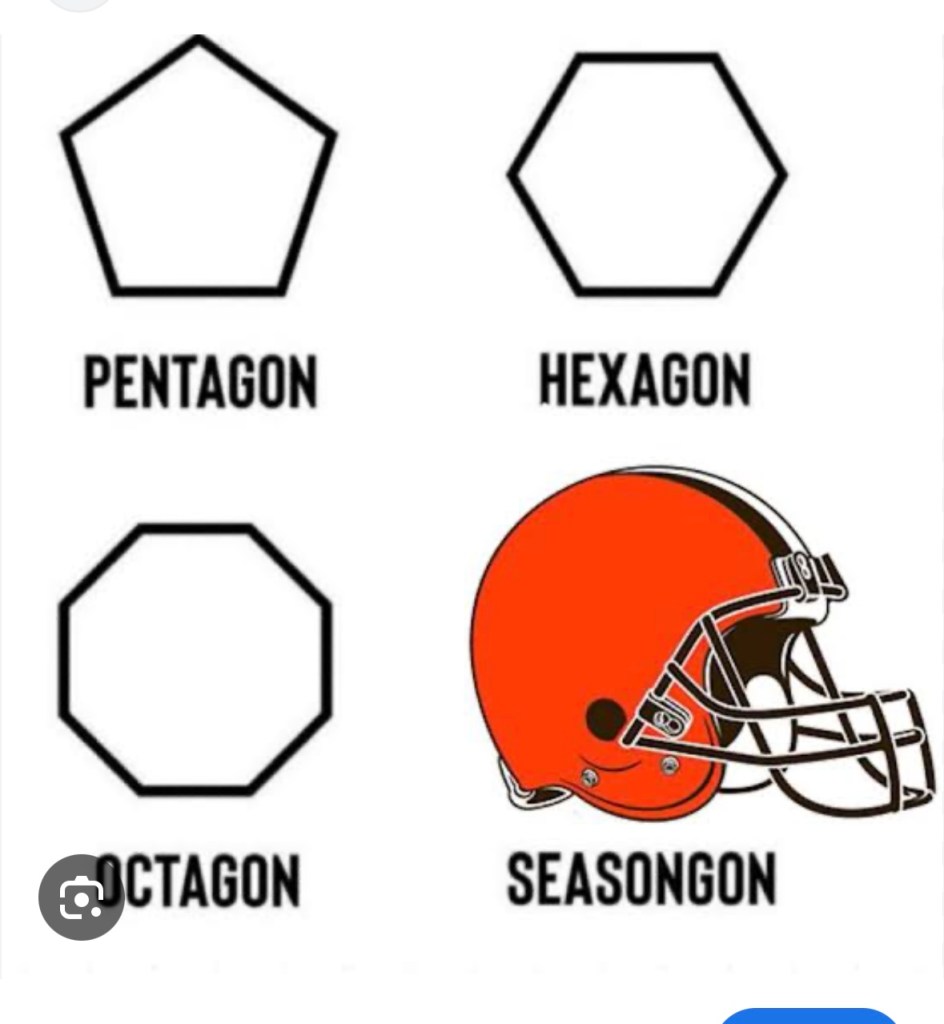
The Factory Of Sadness Remains Open

Screenshot

Why the Cleveland Browns? Why not the Dallas Cowboys (who have a famous team of cheerleaders) or the Green Bay Packers or the New England Patriots? If one is going to root for (to use that quaint American word they use instead of ‘barrack’) an NFL team, something which is not exactly normal for an Australian born and raised in the western suburbs of Melbourne, then why not choose a team which actually has a history of winning.

After all, I do not have any links to Cleveland or to Ohio, aside from watching the occasional episode of the Drew Carey Show sometime in the 1990s. I did not even actually know where Ohio was in the USA until I read The Pioneers, David McCullough’s engrossing account of the start of the westward migration of Americans in the early 1800s. (It also, sadly, was the last of McCullough’s books – all of which are worth reading.). But I think I had already chosen the Browns as my team before that.

To be honest, I support the Browns out of sheer perversity. As a supporter of the Footscray Football Club (aka the Western Bulldogs), I am used to feeling the love for an underachieving sporting team. Indeed, the 2016 premiership miracle has so sated my appetite for success that I will feel the warm inner glow from that year even if we do not ever win another flag for the rest of my life.

The Cleveland Browns have not won any championship since 1964 – before the Super Bowl era. Nor have they ever played in the Super Bowl. You can tell, as a Bulldogs supporter, that this resonates with me.

Their old stadium was described as a ‘factory of sadness’. The suffering of Browns fans is alluded to in countless TV shows and movies. Memes abound, such as the one with a despairing Browns fan and the caption ‘I once left my 3 Browns tickets on my windshield. I came back and there were 9.’ or the one with two hot women Browns fans ‘Why are females Browns fans cool to date? Cause they’re not expecting a ring in the future!’

I keep the Browns app on my phone so that I can check their progress each NFL season.

Given that it is coming up to Super Bowl soon, I opened the app this evening to read about the Browns’ 2024-25 season, and it was truly bad! They went 3-18 – which even for the Browns is a pretty poor year.

The Browns last made the playoffs (American term for finals) in 2023. They lost in the first week.

Of interest to me at the time was that I received an email from the Melbourne Browns supporter group (I did register for this several years ago) inviting me to attend a pub (Bell’s Family Hotel in South Melbourne) which was playing the playoff game and watch the game with other local Browns supporters.

I did not go, mostly because it was early on a Sunday morning, and I prefer not to start drinking alcohol until after 12pm, but I regret it now, particularly as it was the only invitation to a gathering of local Browns supporters I have received to this point in time. I suppose they only convene when the Browns make the playoffs, as I assume the pubs around Melbourne who show gridiron games live don’t bother to show Browns games unless they are in the playoffs.

So I will not be going to watch a Browns game at a pub anytime real soon. This is a bit of a pity, as I have accumulated heaps of fan gear – t-shirt, hoodie, and jersey (with the name of a player who left them around the same time I bought the jersey at a deep discount from Rebel Sport) – and would love an excuse to wear the gear.

Why Teams Need Their Rivalries

The AFL does not do ‘Rivalry Round’ anymore, or at least not at the moment. When they did do them, typically we would see the interstate clubs would each play their local rival, Carlton Vs Collingwood (obviously), Essendon Vs Richmond (mostly because of the Kevin Sheedy link, but possibly because of that infamous melee in 1974), Hawthorn Vs North Melbourne (because of the three grand finals in the 1970s they played against each other in), Melbourne Vs Geelong (just because…) and Western Bulldogs Vs St Kilda (because we both were bottom of the ladder teams with a distinct lack of success).

The supposed rivalry between my team, the Bulldogs, and St Kilda, does not really have too much bite to it. Failing to win a plurality of premierships (pre 2016 at least) does not really make for a satisfying rivalry. True, St Kilda did beat us in a couple of preliminary finals circa 2010 (or thereabouts), but their failure to then go onto glory erases any real sting.

At best, a rivalry with St Kilda is like drinking zero-alcohol wine – what is the point?

We do have a few teams where the Bulldogs have a better claim to a rivalry. We are now 1-1 in VFL/AFL Grand Finals with Melbourne, as well as being socio-economically different supporter bases. We are 1-0 in Grand Finals with Sydney, and have tended to beat them most times we meet them in recent years. We are 0-1 in Grand Finals with Hawthorn, as well as having been defeated by them in countless lesser finals in my lifetime (such as the 1985 Prelim).

Looking at other teams which I consider hoo-doo teams for us come September, Adelaide seems to have the wood on us every time we play them in a final – not just in the 1997-8 Prelims where they robbed us of Grand Final appearances, but more recently in the 2015 finals series, where a disgruntled second string player allegedly leaked the game plan to his brother in the Adelaide squad. Geelong has also beaten us in more finals than I care to remember, starting with the 1976 elimination final, and most emphatically in the 1992 Prelim (I left that game at three quarter time feeling quite depressed).

And then we have Greater Western Sydney, the newest of our rivals.

In the year of our Premiership Miracle, 2016, the Western Bulldogs slogan was BE MORE BULLDOG. That features on my membership scarf from that year (the one time I opted for a scarf rather than a membership cap).

In a gesture which could be described as either mischievous or mean spirited (I tend to think the latter), GWS choose to create a website that year entitled BE LESS BULLDOG, where they listed all the members of their coaching staff and playing list who had formerly been connected to the Bulldogs.

Obviously, with former local boy Callum Ward and former captain Ryan Griffin both playing for GWS then, it was a very sore spot for me and other Bulldogs supporters.

Possibly that also has to do with the realisation that the AFL probably gave serious consideration to the viability of giving the Western Bulldogs incentives to relocate to Western Sydney at the time that the two expansion clubs were being considered, similar to what was offered to North Melbourne if they were to base themselves permanently in the Gold Coast.

Happily we got the last laugh. Our team went to their obscurely located home ground somewhere in darkest Western Sydney, beat them in that closely fought Preliminary Final to rob them of a place in the Grand Final, and then the following week won the AFL Premiership in what concluded a month long fairy tale.

Even sweeter, former GWS player Tom Boyd kicked three goals for the Bulldogs in that Grand Final, all in the final quarter at a time when we needed to pull away and win the game.

Three years later, when GWS did make a grand final, memes reminded AFL fans that both GWS and Tom Boyd had kicked three goals in a Grand Final. Ha!

Since that time, we have had a rather intense rivalry with GWS. We win some, they win some. We do not give quarter.

It is safe to say that GWS can be considered the New Enemy of the Western Bulldogs.

Of all the other teams that I have listed above, I think that Hawthorn has the most claim to being our Ancient Enemy. This goes back to when they beat us in the 1961 Grand Final, a defeat which has not been avenged yet. Since then, aside from the 1985 Preliminary Final, they have beaten us in a long list of finals in my lifetime.

And yet there is one game which sticks out in my mind – the 2016 Semi Final. That was when we, against all expectations, defeated Hawthorn when they were the reigning premiers. I fondly remember at the 11 minute mark of the final quarter, when we goaled and went 42 points up, all the Hawthorn supporters started leaving. We started singing ‘Good night Hawthorn good night!’ at them as they walked out, the game now beyond doubt.

Hawthorn have bounced back from that – they beat us in that elimination final last September, reminding us that our Ancient Enemy remains a potent one, a truly existential threat for our success and survival.

These rivalries add some flavour to every sporting competition. There is greater satisfaction when a much hated rival club is defeated, and greater angst when they win. This is what truly makes people passionate rather than apathetic about supporting their teams.

I for one would love to see the Bulldogs triumph in an AFL finals series where they eliminate (in the following order) Adelaide, GWS, Geelong, and then Hawthorn.

That would be extremely satisfying.

Not Everyone Likes Rock N Roll….

I just finished reading Land Of The Long Weekend, the late Ronald Conway’s 1978 critique of 1970s Australian society, culture and consumerism.

It was heavy going. Whilst I am quite well read, Conway was even more read, in the way of an autodidact, and fond of quoting his interpretations of many famed authors and philosophers throughout his text, which made it necessary to go slowly and concentrate on comprehending every word. I suspect he needed to do this because, despite becoming a lecturer in Psychology at RMIT, he was self taught and wanted to prove to his readers that his intellect was just as good, or better, than that of people who went to university rather than having to drop out of school at age 15.

Conway, as one can tell from the titles of his books – The Great Australian Stupor was that of his previous opus – had a very jaundiced view of Australian society. He was more or less contemporary with the much more famous Manning Clark and Donald Horne, with whom one could say that he shared the outsider’s desire to mock his surroundings, although his own critiques were from a more conservative viewpoint.

I do not think I got much value out of reading Conway, and it is telling that whilst Donald Horne’s The Lucky Country is still in print after 61 years, Conway’s own book is only indirectly now remembered for the title, which occasionally gets used out of context for the economic inertia of our society which supposedly results from our proliferation of public holidays, rostered days off, and tendency to ‘chuck a sickie’. [Indeed, the reason I ordered an out of print copy through Amazon was because I wondered whether this book addressed these latter issues – it doesn’t, not really.]

But on page 296 came a passage on Conway’s dislike for Rock N Roll. I will quote the best bit of it below:

‘The recent death of the ‘daddy’ of rock, Elvis Presley, at the age of 40, bloated, exploited as well as exploiting, taught no moral to his ageing followers. They mourned his hermaphroditic crooning and jelly-postures of sentimental lewdness as if he had been the dead god Adonis instead of an instrument of the most culturally degrading mass profit industry since the African slave trade.’

I wonder whether Conway preferred classical music over rock, but I am not too inclined to worry about it. Personally, I am rediscovering the 1950s big band Italian lounge music my parents used to play on the weekends in my childhood.

In Which I Deeply Regret Installing Solar Panels

I have just finished emailing a preliminary enquiry to Consumer Affairs Victoria about my recently installed white elephant solar panels.

I deeply regret getting solar panels now, two months on, as they have still not been attached to my electricity account due to the failure of the solar installation company to provide Jemena (ie the actual electricity supplier) with the appropriate information to reconfigure my meter.

As some detail in this sorry saga, I provide the following points:

  • On 23 October 2024 I paid $4700 for the installation of solar panels (I declined the interest free loan from the state government because I do not like owing money).
  • At that time I was told that the company was going to arrange everything with my electricity retailer to ensure that the panels were counted in relation to my electricity bill. (This did not happen.)
  • On 13 December after some enquiries with my retailer (AGL), the solar panel installers sent me documentation which was required to reconfigure my smart meter. I forwarded this to AGL. They raised a request with Jemena on 16 December 2024 for the reconfiguration.
  • On 6 January 2024, when I decided to check progress, I was advised by AGL that the request for reconfiguration could not proceed because Jemena required additional information in relation to the solar inverter. In particular, a ‘commission CSIP inverter application’ needed to be raised. This was a new requirement.
  • I immediately contacted the installer, on 6 or 7 January about this. They were apologetic and said they would take care of it.
  • I contacted Jemena on 14 January and asked them if the required request had been raised and they advised that it had not. I asked them to provide me with written advice so I could provide to the installer. I emailed it to them and asked them to action this matter as a priority.
  • The installers contacted one of their tradesmen that day to ask them to action this by email.
  • I checked with Jemena again on 21 January and this matter has still not been attended to by my solar panel installer.

Right now, I have started keeping screenshots of texts and a record of all emails. I am not sure what (if anything) I can do, or how long a complaint to Consumer Affairs will take, nor what they can do.

What I will advise you if you are thinking of getting solar panels is:

  1. Tell any company who cold calls you to go to hell. Stick to some large well known company whom you otherwise deal with for routine things and which you already trust.
  2. Keep in mind that the money you can earn from your solar panels sending power to the grid has just been slashed by 99%.
  3. Solar panels are probably environmentally harmful and create emissions during their construction which will not be easily offset by the power they generate.
  4. You can probably spend the money on something far more worthwhile, like a holiday in Queensland. I sure wish I had!

Stupid me for agreeing to buy from cold callers – but I was in a good mood as I was getting my split cycle aircon system installed and thought that getting panels would be a cost effective way of running my aircon all summer long.

Trump On Greenland: The Return Of Manifest Destiny (or is it Manifest Insanity?)

In the first half of the 19th Century, many Americans were gripped with a sense of Manifest Destiny, an idea that they were destined to control the entire North American continent.

This led them in the 1840s to provoke a war with Mexico as a pretense to conquer large and valuable tracts of land, including everything from the newly independent Texas til California. Then, after the American Civil War, several decades were spent dispossessing, pacifying, and eradicating tribes of native Americans in the interior of the nation.

Not everyone was enamoured of this doctrine. This is probably just as well – it does not sit comfortably in the mostly rules based system which has evolved in the 20th Century after several of the most ruinous wars in history. Ulysses S Grant commented in an interview, many years after the war between the United States and Mexico:

“I do not think there was ever a more wicked war than that waged by the United States on Mexico. … The wickedness was not in the way our soldiers conducted it, but in the conduct of our government in declaring war. We had no claim on Mexico. Texas had no claim beyond the Nueces River, and yet we pushed on to the Rio Grande and crossed it. I am always ashamed of my country when I think of that invasion .”

Early on in his Personal Memoirs, when reflecting on his ante-bellum career, Grant sombrely observed:

“The Southern rebellion was largely the outgrowth of the Mexican war. Nations, like individuals, are punished for their transgressions. We got our punishment in the most sanguinary and expensive war of modern times.”

Greenland’s Army Prepares For Trump’s Inauguration

From Sea To Shining Sea indeed!

Once and Future President Trump has made some belligerent comments in recent days which are reminiscent of the ideas of Manifest Destiny, talking about taking control of Greenland, making Canada the 51st state, and regaining ownership of the Panama Canal.

Many of the comments which Trump has made over the years since he embarked upon his political career have seemed to express views which best belong in the 1840s or 1850s.

Much of his isolationism and anti-immigrant rhetoric, which first propelled him into the White House with his promise of a border wall, seem reminiscent of 1850s Nativism (commonly described as the ‘Know Nothings’), which had been directed at the fresh waves of Irish and continental European migrants who were flocking in growing numbers to the USA in newly developed steam ships.

Manifest Destiny was an earlier idea, and one of more lasting impact to shaping the USA. Whilst it found its most cynical and wicked expression in the Mexican War in 1846, Manifest Destiny originally grew from the religious ideas of the puritan ‘pilgrims’ who arrived on the Mayflower, with their attachment to the ‘city on a hill’ from the Sermon on the Mount (Matthew 5:14).

The pilgrims felt that they were on a Mission from God, and that idea came to permeate American political thinking for centuries to come.

Much as the attempts to force the American Colonies to pay taxes and incur expenses for the maintenance of the military establishment needed to protect the colonies in the Seven Years War are cited as the main reason for declaring independence from Great Britain, British rule also impeded the expansion of the colonies beyond the Appalachian Mountains. This was something which the American colonial leaders deeply resented.

It is not really mentioned, except in passing in the Declaration of Independence, where it is obscurely touched upon:

“He [ie George III] has endeavoured to prevent of the population of these states, for that purpose obstructing the laws for naturalization of foreigners, refusing to pass others to encourage their migration hither, and raising the conditions of new appropriations of lands.

Nine simple words at the end of a short paragraph. A truth which is more sinister than self evident, but probably one which the leaders of the American Revolution placed greater weight on than many of the other paragraphs justifying their rebellion.

With independence, the fetters came off. They bought, conquered, or annexed everything which is now the United States by the end of the 19th Century, including the formerly independent Kingdom of Hawaii deep in the Pacific Ocean, with little regard for former occupants or sovereignty.

Manifest Destiny made this all OK, as Andrew Jackson might have said (one of his election campaigns is believed to have originated the term ‘OK’, incidentally).

When Trump makes his broad statements about Greenland, Canada, and the Panama Canal, he is harking back to a time, 180 years ago, when such thinking among Westerners was seen as more or less normal.

Such thinking is not normal anymore. Several ruinous wars (and I am not simply talking about the First and Second World Wars) have caused geopolitical thinking to move away from the idea of warfare as a rational means of dispute resolution, or that conquest of territory is a legitimate expression of foreign policy.

The reversion in 1999 of the Panama Canal Zone to Panamanian sovereignty was a result of a treaty signed by the late Jimmy Carter with the president of Panama in 1977. Many on the American Right deplored this greatly during the 1980s, and demanded that the treaty be disavowed.

The treaty has been in effect for 26 years. What should Trump do now? Disavow it and occupy the canal by force? Such disregard of the sovereignty of other nations in the Americas would not be new – there are plenty of examples of this in my lifetime, including the invasion of Panama to depose General Noriega 36 years ago, and the invasion of Grenada. To say nothing of the CIA coup in Chile in 1972.

But such an action reeks more directly of Manifest Destiny than the superficial excuse of national security given for those invasions and coups. It would be done the same way that treaties were broken with the Iroquois, Shawnee, Cherokee, Sioux, and numerous other Indian nations. Manifest Destiny justified the breaking of those 400 treaties, and it could be similarly used to justify breaking the 1977 treaty on the Panama Canal.

The problem is that if the contemporary USA cannot be trusted to honour some of its treaties, it cannot be trusted to honour any of them.

Take the North Atlantic Treaty. Denmark is a signatory and therefore an ally of the USA. Greenland is an autonomous region of Denmark. Occupying Greenland would be an act of invasion against an ally. The impact on the national security of the USA in causing upheaval in NATO would be enormous, far greater than the gain in gaining Greenland.

Canada? Since the UK effectively defeated the USA in the War of 1812, the only people who have publicly suggested the invasion of Canada are the creators of Southpark, when they produced the first Southpark movie in 1999, and the highly toxic and hypocritical Michael Moore, who made an actual movie (Canadian Bacon) on this premise once. So, there have been two unsuccessful movie comedies on this subject.

One is left to wonder whether Trump is getting his foreign policy ideas from Trey Parker and Matt Stone, who are satirists, and who do not want their stated ideas taken seriously. Their other movie creation, Team America: World Police, could also be, worryingly, be taken literally by Trump as a blueprint for foreign relations, given his utterances. None of it seems so funny now, does it?

But when you look at what Trump says on foreign relations, one cannot help but wish for the return of circumspect and mature leaders like General Grant, who saw Manifest Destiny for what it really was – a pseudo theological justification for military conquest.

Vale Charlie of Charlie’s Pizza

There is very little left of the Footscray that I remember as a child. Growing up on Gordon Street, we were forced to move north when the hospital expanded when I was seven. That side of the street got bulldozed. Years later, the Baptist Church over the street closed down and then got redeveloped as units (my brother and I went to the kindergarten which had been located at the back of the church). The part of Gordon Street north of Ballarat Road, adjacent to our next family home, has changed radically in the past 50 years too. The ammunition factory is now Edgewater, and the Modern Maid stove factory got developed into housing in the mid 1990s. Individual houses have been redeveloped at an accelerating rate as well.

A lot of the businesses are gone too – long established ones. Ted The Toyman (est 1930s) became Ted’s Cycles and closed within the past five years, a victim of land taxes. The shop front is still vacant. Only one of the many longstanding shoe shops (Harry’s Shoes) remains (Kifts and Hicks are now just memories). The shop fronts which were Jim Wong’s Chinese restaurant (a Footscray institution) and Poon’s (an even older Chinese restaurant which recently relocated to Sunshine) remain empty. Il Paesano Pizza closed about 10 years ago when the new owners ran it into the ground, and Domenico’s Pizza changed owners about 6 years ago.

Nor should you get me started on listing all the pubs which have been redeveloped or demolished outright – although the Barkly is the one I most lament, due to time spent there with my dad on our walks to Footscray shopping centre.

It looks like another Footscray institution is likely to be gone now. Charlie’s Pizza has been at the Ballarat Road end of Droop Street since 1974. News dropped on Facebook yesterday that its owner, Charlie Morabito, died a couple of days ago.

I have not eaten in Charlie’s for quite some years, as I have not lived within home delivery range since 1996, and I never felt it quite the sort of place where I would want to dine in. My brother, however, is a regular there, and loves doing a late night steak there, and would chat regularly with Charlie about local community gossip.

Charlie also originates from my mother’s home village, Ferruzano, in Reggio Calabria. This makes him what we would call a Paesano, a fellow villager. Most of the people from Ferruzano (commonly known as Ruzani, much the way people from Melbourne are Melburnians and people from Footscray are Footscrayites) moved to Melbourne after the Second World War, so there are more of us here than there are in Italy.

He was quite a character, with his 1970s disco wog hairstyle, sideburns and moustache, all carefully dyed black, even though he was well into his 80s. He also liked to pretend that he was a decade younger than he was. You can probably surmise why – he still had an eye for the ladies.

He stubbornly stayed there on that corner of Droop Street for half a century, making his pizzas and watching Footscray shape shift into what it is now. He was one of those constants, at a time that everything around him was changing, something which we locals could rely on.

And now he too is gone, and with him, we probably see the end of his popular pizzeria too. Footscray and its community is much the poorer for this.

Adding Wesfarmers To My Share Portfolio

A few years ago, during the years of Plague and the isolation that ensued, a close friend of mine emailed me with the suggestion that I don’t need to bother with shares. Unlike most people, he pointed out, I belong to a defined benefit superannuation fund with a generous pension on offer, and in which I have huge equity.

He did have a good point – the actuarial value of my current pension is almost double that of my house, and I am getting a large payroll each fortnight than I did whilst working for the Man (lower tax and no 10% gross voluntary contribution to my super fund will do that) .

But I am so used to having a share portfolio over the past 28 1/2 years that I do not ever see myself divesting myself of shares.

However, I think I have made it fairly clear over the five or so years I have had this blog that whilst I enjoy owning a share portfolio, I am not that enamoured of individual stocks.

Most of my portfolio is held in ETFs, Listed Investment Companies, Real Estate Trusts, and Conglomerates. This way, I diversify my holdings and minimise my risk. After all, I have made some fairly poor decisions in stock picking in the past.

The main exception to that is Treasury Wine Estates, for obvious reasons.

This investment position continues with my latest purchase, 100 shares in Wesfarmers (formerly known as the Westralian Farmers Cooperative).

Wesfarmers owns a very diversified portfolio of businesses, most famously Officeworks, Kmart, Target (which I pronounce in the French way because I am facetious), and Bunnings. But it also stays true to its farmer coop roots with a fertiliser business, and various other assorted ventures.

It even currently is the owner of the Soul Pattison chemist chain, which used to be owned by (and the original core business of) Washington Soul H Pattison, which now, incidentally, is my largest shareholding.

Just like the latter, Wesfarmers has very right to call itself a conglomerate.

At $71.50 per share, it looked a little expensive according to the current broker consensus. But, as the Chinese say about the best time for planting a tree (either today or 20 years ago), the best time to buy shares is either right now or 20 years ago. I’m planning to gradually build up my Wesfarmers share holding, just like I have my Soul Pattison (sans pharmacy) shareholding.

Sadly, the AGM is in Perth each year, so I fear that I will not be checking out their corporate catering as I do when I attend company meetings in Melbourne.

Bernie Finn Returns – Yet Again!

I have written about former local state upper house MP Bernie Finn on various occasions in the past, particularly when I suggested he get given a knighthood (I was being facetious, if you don’t quite know how to read my tone!).

I will be honest and concede that his first coming as an MP in 1992 was of some value. He won the lower house seat of Tullamarine in the state election where the Kirner government got deservedly flushed down the toilet. That was a habitually Labor held seat, and he was not expected to retain it in 1996, but somehow he did. My impression was, that as a relatively youthful MP, he did a good job in holding a place on the Coalition backbench.

By 2006, when proportional representation had been introduced for the state upper house (a mistake I say – the upper house vote should be restricted to homeowners and other ratepayers rather than allowed to the plebs), Our Bernie got a second chance. He topped the Liberal ticket for Western Metropolitan, which guaranteed him election.

As the Liberals decided not to permit sitting state MPs to be challenged for their preselections for many years, he was able to retain his seat for four consecutive terms.

During that time, he increasingly showed a maverick and rather feral nature, leading some to ponder whether it would have been better to open up preselections for challenge earlier.

In the end, he was expelled from the party room over some tone deaf social media comments on abortion – an issue which, whilst supposedly near to his heart, he had never bothered actually taking a stand on in parliament.

As I have written before – his expulsion was way overdue. He really should have been expelled when he secretly reneged on a pairing arrangement and voted in a division when he had begged for an exemption as he did not want to be present in the parliament at Easter. That the opposition leader and the parliamentary party tolerated his underhand behaviour at that time did not do them any credit.

After his expulsion, Our Bernie returned to his first political love, the DLP, and brought a disgruntled Labor MP Adem Somyurek (famed for branch stacking) with him, in time for the 2022 state election. Our Bernie was not successful in his bid for reelection under the auspices of the DLP, but his boon companion was.

At the time, I described the DLP decision to run Our Bernie and Mr Somyurek Esq as a Hail Mary Pass.

My thoughts at the time were the following:

Hospital or Hail Mary Pass? The DLP Gamble Their Principles on the Prospect of Electoral Success

In that post, I observed my views on the DLP’s gamble thus:

This does not strike me as without significant risk. Neither has the integrity or idealism which normally represent a DLP candidate , but represent a blatant lack of principles and a proven disregard for ethical behaviour in their public life (Finn in his Good Friday ‘pairing’ stunt and Somyurek in his branch stacking).

If either was to be elected, who is to say that they would not then desert the DLP for another opportunity later down the track? Or even worse, were to remain as DLP MPs whilst repeating their history of reprehensible behaviour.

I more or less warned that:


The more likely outcome is that the DLP do not win any seats, but appear discredited and cynical through the cold and calculated decision to gamble their principles and ideals on two tired old renegades. This could end up costing them support amongst their existing members.

Interestingly, neither of these gentlemen remain in the DLP today – and whilst the DLP actually did help one of these chaps get elected, Mr Somyurek is now listed on the Victorian Parliament website as an independent and Our Bernie has jumped ship, again, for the resurrected Family First party as their lead Senate candidate for the next election.

So I think that the decision by the DLP in 2022 to back the Finn-Somyurek ticket has only served to discredit the DLP, and they don’t even have a current seat in any parliament to show for it – something that they will need, if they don’t have 1000 paid up members, to contest the increasingly imminent federal election.

Perhaps Our Bernie realised that, prompting his decision to join Family First.

What has inspired me to write about Our Bernie today is that after much inactivity on Facebook, he has recently appeared in my Facebook feed, in full throated voice, unmitigated and unfiltered. I’m not quite sure when he started posting on Facebook, as I have only been able to doom scroll back about two weeks, but it is clear that he is posting many times per day, every day. I can only assume that he is sitting around with a glass of decent shiraz in one hand and his smartphone in the other, thinking of what next to say.

His utterances (I will not dignify them with the description ‘writings’) are mostly aimed at his dislike of most of his former colleagues in the Victorian Parliamentary Liberal Party (except for his replacement, Moira), his joy at Trump’s reelection, and his Moiraesque views on abortion and gender issues. Interspersed between those are some ad hominem jabs aimed at Dictator Dan and Albo.

In other words, they are quite self-serving and immature – particularly for someone whom I believe to be into their sixties by now.

We have this to look forward to between now and the federal election, and I dearly hope that Our Bernie does not block me on social media, as I find him quite entertaining.

Puneet Puneet Redux

When walking to the bus stop this morning, I saw the front page of the Herald Sun – a shrink wrapped copy lying on the driveway of a house somewhere around the corner.

‘Bring Him Back!’ was the headline.

Having grown up reading The Sun News Pictorial in the morning and The Herald in the evening (prior to their sad merger into the one entity in 1990), I knew exactly whom the headline writer was referring to: Puneet Puneet.

Puneet Puneet (what a name!), as everyone knows, is Melbourne’s answer to Great Train Robber Ronald Biggs. Except that Biggsy seems to have had a lot more panache and verve in his career as a fugitive from justice.

As a recap, Puneet Puneet was a 19 year old learner driver who had an unfortunate accident in Southbank in 2009 where he killed someone. It did not help that he was drink driving and speeding either. He pleaded guilty to the subsequent charges early on and was released on bail pending sentencing. He then ‘borrowed’ the passport of a friend and fled Australia.

Since then, attempts to have him extradited back to Australia have proven ultimately fruitless. He was arrested at his wedding in 2012 (one of his friends could not resist the reward money to inform on his whereabouts), and has been in and out of custody since then. The Herald Sun today observed that he has had 147 court appearances so far whilst fighting his extradition.

The sole ‘current’ road block to his extradition comprises domestic violence charges laid in 2022. Apparently extradition cannot occur until those charges are dealt with – which can take 4 to 6 years.

The article in today’s Herald Sun was another plea from Puneet Puneet’s victim’s father for the Federal Government to do something to expedite the extradition. I can sympathise with his desire for the delays in his son’s killer facing justice, but I also have long since formed the view (as in an earlier post on this case https://lostforwords.blog/2020/04/24/the-strange-and-highly-dickensian-case-of-puneet-puneet/) that the Indian legal system is sufficiently Dickensian as to make the Courts of Chancery in Dickens’ tedious novel Bleak House seem efficient.

So far, to the frustration of involved parties, the legal team behind Puneet Puneet have tried all sorts of absurd but highly effective tactics to delay extradition. At one point, a new judge was appointed to the case and wanted both sides to repeat their verbal arguments – making me wonder about the probity of the new judge’s motives.

Now there is the domestic violence accusation. I do not know what to believe. But I do not envy Mrs Puneet. I expect that her parents arranged her marriage to this highly successful chap because of his family’s relative wealth. To have her groom torn from her during their wedding celebration would have been humiliating (but possibly also a blessing). Since then, he at one point disappeared whilst on bail with his mistress (a woman who probably does not have her parents to blame for her connection to such a fine and honourable gentleman).

Does the domestic violence accusation have merit? I could easily expect someone with the demonstrated character of Puneet Puneet in the fifteen intervening years since he fled Australia to commit domestic violence. But it is very possible that this is just a cynical ploy by his legal team to buy even more time, and that Mrs Puneet has been bullied by the family and the legal sharks into making these allegations mainly to help him evade justice in Australia.

After all, the societal and cultural attitudes demonstrated in many parts of India towards women are not exactly convincing that domestic violence is abhorred and prosecuted. Don’t take my word for it – look at section 6 of the US State Department Report on Human Rights Practices for India:

https://www.state.gov/reports/2023-country-reports-on-human-rights-practices/india/

I am very cynical about the likelihood of Puneet Puneet returning to Melbourne anytime this decade (if at all) to face justice. The only consolation to the family of his grieving victim is that the Puneet family has probably spent a large part of their family fortune on keeping him away from justice, and that he has, at least, spent considerable time in remand at various intervals over the past 12 years.

But what will happen if he does return? Will he be allowed to recant his original guilt plea and demand a trial? Will his legal team argue that the publicity and opprobrium he has incurred since his flight means that he cannot get a fair trial?

I do not expect any of this to end very soon.

The Upcoming War On Home Owners – How Victoria’s Debt Can Be Repaid

When I was much, much, much younger than I am now, and actively used to read books on Libertarianism and the like, I remember one libertarian writer observing that if everyone lived in mobile homes and could move wherever and whenever they liked, they could hold governments accountable simply by voting with their feet (or wheels). So, if for example, a government were to impose extortionate taxes and conscription on its citizens, overnight they would lose all their citizens as they would have driven across the border.

Much as I dislike the term ‘Libertarian’, I still think that the philosophy is great in theory. The mobile home example is just one paragraph in a much more nuanced political philosophy, although I think that most American trailer park rednecks might consider themselves Libertarians without knowing what it means or how to spell it (or wanting to move their mobile homes at all).

One of the problems with the mobile home example in practice is that most of us don’t own mobile homes, nor do we want to live in them except as a matter of last resort. We like living in real stand alone homes, on land that we own, and where we celebrate when we end our bonded servitude to the banks by paying off our mortgages.

Upping stumps and moving to an entirely new jurisdiction is an expensive proposition, even for those who do not have the binding links of having family, friends, jobs, community ties and other bonds in our home cities.

And for most people, their home is one of their greatest and most valuable assets.

Which is something which policy makers in state governments know very well.

A few days ago I promised to explain how the Victorian state government can repay the giant debt the state currently owes after a decade of profligate spending.

As a crash course in the scale of Victoria’s debt, there are approximately seven million people in Victoria right now and a debt of approximately $188 billion. This equates to $27,000 for every man, woman and child in Victoria.

Has your jaw dropped yet?

Back in 1992, when the Cain-Kirner government was thrown out of office after a decade of what, in comparison to the Andrews-Allan government, looks like fiscal restraint and high integrity, there was a significant degree of debt. Premier Kirner, in the last days of her government, legalised poker machines, hoping for a river of gold in taxes from those in order to save her from a humiliating election defeat. Her government had already sold the beloved State Bank of Victoria off after its dodgy merchant banking arm had incurred gigantic losses.

The incoming Kennett government had to be very careful with money. They privatised utilities in order to retire debt, and had little choice but to raise taxes where they could – petrol taxes and financial institution duties on bank accounts. One way or the other, they got rid of the debt.

Taxes on bank accounts, aside from bank interest being taxable as part of your income tax, appear unthinkable 30 years later. I’m not sure, due to the doctrine of rational ignorance (ie I didn’t care enough to read the fine print), whether FID was eliminated in perpetuity when the Federal-State deal on GST and related tax reform was agreed upon in 1999.

As it is, there are several taxes which state governments seem totally uninhibited about levying currently.

First, we have gambling taxes. A major cut of the money which the casinos and pokies venues make goes into state government taxes. After all, Joan Kirner did not legalise poker machines and lay the groundwork for a casino in Melbourne because she wanted, as a committed socialist, to increase the liberty of the common people. She simply was clutching at straws for an alternative source of venue to save her pathetic government from defeat.

Then we have payroll taxes. These are politically unpopular, as they are a tax on employment. All the same, just as when a drug user talks about needing to get clean but the reality is that they cannot go without their drug of choice, our elected leaders love to talk about cutting or getting rid of payroll taxes, but the budget realities do not permit that.

Motor vehicle taxes are the next sort. There are all sorts of ways to justify motor vehicle taxes, mostly in the form of car registration fees each year – for the upkeep of roads mostly. Fuel excise used to be taxed by state governments until a High Court case in 1997. Since then, the federal government imposes a fuel excise (separate to GST) and shares it with state governments. [Personally, I think we should impose a registration fee on bicycle ownership, but that has more to do with my monomaniacal hatred of cyclists, rather than any real desire to fix the bottom line of the state budget.]

Finally we have land taxes of various forms.

The indirect and most obvious one inflicted on home owners is the municipal one – our much hated council rates. A lot of ill is hidden in those. Over the past 20 years, much cost shifting on services which should be provided by the state government has gone into getting local governments to undertake services which should be done at the state level, and where the local ratepayer is now footing the bill.

The council rates notice is also where the fire services levy (now recently renamed the emergency services levy) is collected. I noticed that recently, as one of his final acts, the miscreant former state treasurer Tim Pallas quietly renamed and doubled this levy. Obviously this is not done in order to double the services available to protect Victorians from fire (eg buying those giant water bombing helicopters useful for bushfires), but simply because the government needs to find money from somewhere to address the gaping wound of the state debt.

Then there is the stamp duty on property purchases. I saw this as annoying when I last upgraded my home, but I do think it is probably a necessary user pays tax to protect the land titles system and put something towards the upkeep of infrastructure.

Land Taxes have been imposed in one form or other for many years. They usually are taxes which are imposed on any real estate aside from your principal place of residence. The land tax threshold was lowered last year to any non-principal residence holdings of a value of $100,000 or above ($100,000 does not get you very much in Melbourne these days – a Brighton Beach Box goes for about $400,000). Any holdings valued at above $1,000,000 now get taxed at 0.9%.

Then there are those windfall taxes on rezoned land. I am not sure how they work, whether it is immediate (unfair) or when land is sold, but they are there supposedly to pay for more infrastructure to support the population Ponzi scheme which the Victorian (and Australian to be honest) economy increasingly bases itself upon.

And if we go back in time, there are Death Duties. These were abolished in the late 1970s. The only Death Duty which exists now is the indirect one of Capital Gains Tax on a deceased estate. However, the recent introduction of tiered probate fees in Victoria for estates, where estates above $7 million will incur a fee of $2318.90, represents an increase of up to 625% – a death duty by stealth. [And if you think that is only going to affect very few people, just remember that quite a lot of elderly home owners will have accumulated a lot of house and share and superannuation by the time they are in their mid 80s – a house in working class Footscray can easily go for $1.3 million right now.]

So… how do I see the Allen Labor Government moving to cover the $188 Billion debt it has created?

There will be some squeezing around the edges with more taxes on gambling and on car registration.

Most of the tax burden is going to fall on land owners, increasingly on home owners.

Council rates first. The Emergency Services Levy will continue to be increased. Cost shifting of services to local government will continue, and with it, increases in rates. This will affect home owners and investors equally (unless councils start to discriminate against investors, as is policy in some areas), except that investors can claim income tax deductions and home owners cannot.

How about stamp duty? This is erroneously linked to the cost of buying your first home, and there is a myth that abolishing stamp duty (or converting it into an ongoing annual payment) will make home ownership more affordable. My feeling is that converting it into an annual payment will be a politically expedient way of introducing a new land tax on residential home owners – a tax which can then be regularly increased according to when it is necessary or expedient to do so by the state government.

Land taxes next. Property values tend to increase, unless you happen to own an apartment as an investment in Docklands or something similar. There is probably very little need to lower the threshold for the value of a non-principal residence below $100,000, nor to raise the amount payable in tax for those valued under $1,000,000. After all, capital growth will eventually see many more properties nudge over the $1,000,000 mark and into the 0.9% bracket. There may not be a need to even increase the tax paid in that bracket, but I would not rule it out.

There even could be a push to introduce a land tax threshold for principal residences, where any value above a threshold of, say, $2 million would be taxable. As property prices rise, most homes in Melbourne would probably creep into such a threshold within the next decade. Do I think that this government is capable of doing such an appalling thing to home owners? Of course I do – there is very little else in the course of their abuses of power over the past decade which they have not done.

And of course there are death duties. I do not think that a direct or overt death duty is necessary. I think that the very clever and cynical idea of tiered probate fees, as recently introduced by the state government, is sufficient. Capital growth, both in land and shares, will push more and more deceased estates into the higher fee tiers. Whenever more money is needed, then there can be the expedient of increasing the fees on those higher tiers.

This is an appalling state government, where the opposition has just become that much more ineffective with today’s change in leadership. What we will now see, particularly if we have the calamity of their reelection in two years’ time, is an effort to repay the debt they have created through irresponsibility by imposing the costs on home owners.