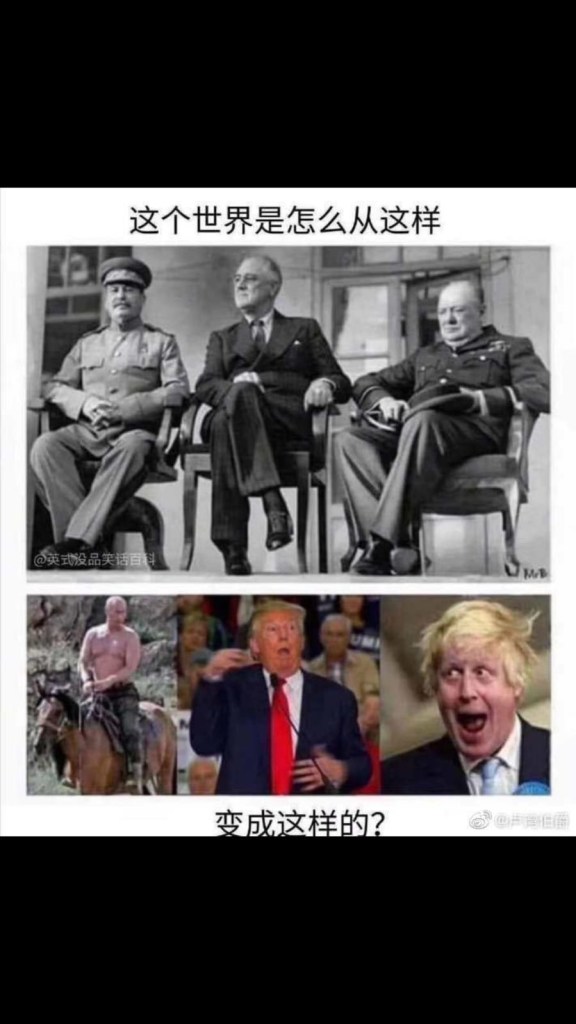
Then There Were Giants…

I'm old enough to know that I don't have any answers, but that won't stop me talking

Let me start by saying that despite the suggestiveness of the heading of this posting, I am not announcing a Road To Damascus style conversion to Marxism, socialism, or even social democracy. I remain a cultural conservative with a commitment to politically and economically libertarian values (much as I dislike the word ‘libertarian’).
But I have always had a degree of sympathy for protesters. Aside from the fact that they are needed for the continuance of a healthy democracy (as is the tolerance of protesters – by tolerating them so heartily as I do, I am actively contributing to the health of our pluralistic society, no?), I admire the Quixotic idealism of protesters, even when I think they are way wrong or being just plain silly.
At the time the Occupy Movement were active several years ago, after the Global Financial Crisis, I thought that they were either way wrong, or almost crazy. But whilst I am still a believer in free market capitalism and the idea known as ‘democratic capitalism’, I cannot sit around unquestioningly accepting the current practices of reserve banks without thinking that there are a few things which are very wrong, and which require me to at least ponder whether the people in the Occupy Movement had a point (rather than feel inclined to call out at them something witty like “Hey you, get off the drugs and get a job!”).
Skepticism is not a bad thing, and it does not mean that you abandon the beliefs or values that you try to adhere to. I have been skeptical, to varying degrees, about religion and the existence of God since I was 15, yet I still tick the Roman Catholic box on the census form and self-describe as Catholic in the profile for this blog.
Similarly, I can and should be skeptical about some of the tenets of capitalism, in theory or in practice. Especially at the moment, when not only are we facing the most serious economic crisis since the Second World War but I have significantly more in savings than I did at the time of GFC or any of the other financial downturns since 1987.
‘Economic rationalism’ is a good starting point. This is the assumption that individuals are going to behave in a rational and self interested way, and that cumulatively, the synergy of enlightened, rational, self-interested individuals is going to result in the best economic outcomes for the whole.
On the whole, this still remains better (both from a moral and a utilitarian perspective) than what the main alternative is – central planning. After all, if you cannot trust individuals to make decisions which are the best for themselves, can you trust one person, or (even worse) a committee of people, to make better decisions for everyone else? What makes the central planner cleverer or more rational than each other individual?
But that is the fallacy both of Capitalism and Communism. Both doctrines place great weight on human rationalism. Capitalism, in that individuals through rational decision making, are going to make separate decisions which cumulatively are going to result in greater riches for all. Communism, in that all individuals will form some sort of collective consciousness that will result in a paradise.
As I have observed in a previous posting, I am skeptical about rational economic man. Markets are mostly driven by fear and greed, as I am finding out from my daily observations, and the greed is mostly just ‘fear of missing out’. The markets should be lower than a Chinese coal mine right now, but they are bouncing around the 5000 mark (I am talking the ASX 200 here, not the Dow Jones).
Let’s take another fallacy of the capitalist system (or of human nature) – ‘ethics‘ – ie that people are going to almost always behave ethically in their economic dealings with others. I am a very trusting person on the whole, and I do not want to change that aspect of myself. But when you look at the financial edifices that fell apart in 1987 (why were some instruments called ‘junk’ bonds?) and in 2008 (‘subprime’), not so close inspection reveals that many people put avarice in front of ethics, and that whilst Bernie Madoff went to gaol, so many others who did not behave well seem to have gotten off Scott free.
And nothing has been done to fix those sorts of ethical issues – we just allow more complex financial instruments to develop, which few people understand.
Even P.J. O’Rourke, great defender of free markets, conceded on a visit to Australia after the GFC that there were ethical problems.
Then there is the assumption of ‘free‘ markets. To quote Team America, albeit in a totally twisted context, ‘Freedom isn’t free’. Not only do governments pursue policies which regulate or manipulate markets and currencies, but reserve banks do so on a major scale.
Which goes a long way to explaining what is going on at the moment financially.
Let me qualify this by saying that whilst I am very good at managing my personal finances and share investments, I do not have an economics degree, or any training in finance or accounting. I have self-taught myself quite a lot from remaindered textbooks and from reading economists like Galbraith, Von Mises, Von Hayek, Friedman, Stieglitz and Levitt. But in the past few weeks, whilst trying to make sense of bond markets, currency moves, interest rate cuts, and commodity prices, all whilst trying to work out whether or not to put my money back into the share market and if so, when, I have been made starkly aware as to exactly how ignorant I am about finance.
[As Socrates would put it, true wisdom means realising that you know nothing. This makes me wise.]
Reserve bankers are very clever people. They understand all these levers which they can pull to manipulate markets, and how each decision will play out. It is the rest of us who get befuddled and who end up scratching our heads and wondering what is going on and what should we be doing.
What is going on is that governments and reserve banks worldwide, but particularly the US Federal Reserve, are pursuing policies which effectively mean that money is being printed. This is not physical money, as in the Zimbabwean or Weimar German variety. It is conceptual money, like what you have in the bank rather than under your mattress.
There will be several effects of this money printing. One is inflationary. The money you have, whether in the bank or under your mattress, is going to lose some of its value faster due to higher inflation. Low interest rates will mean that you cannot offset this inflationary movement through earning interest in the bank.
Another effect is to prop up asset prices. As money is going to be worth less due to inflation, shares and other assets (such as investment properties) will not decline in value.
A third effect is to potentially spur people into riskier asset classes. If bank deposits are getting eaten by inflation and low interest rates, but the share and property markets are being stabilised by money printing, then those becomes a safer place to leave your money – even though shares are a higher risk proposition for most people and property itself is a very cumbersome and sometimes even more risky investment.
Which leads to the question:
Cui Bono?
Who is it that benefits from those interventions in the market that inflate prices? Is it the average mug punter in the street who is struggling to pay off their mortgage or save for a house deposit? Is it the over-educated bum hipster barista who disdains capitalism and thinks Che Guevera was a good guy (he wasn’t, by the way, he was a murdering butcher) and who wants to hop on their fixie and go to a protest rally? Or is it someone with a large share portfolio, large salary, and a mansion in Toorak (who has been able to exploit tax loopholes to pack away a large amount of money into the family trust and their superannuation fund)?
It is more likely to be the Toorak mansion owner, although I would hazard a guess that a mere multi-millionaire has less to gain than a billionaire does.
Is it any wonder that the Occupy Movement have something to get angry about? Inflationary government interventions are constantly occurring that transfer wealth from the poor to the mega rich. This is not free market capitalism. It is not really any form of capitalism. This is plutocracy, the state sponsorship of the rich.
About seven years ago, I made a very speculative (and ultimately spectacularly unsuccessful) investment in a venture which was seeking to close a deal to clean up some of the abundant pollution in mainland China.
As I trusted the friend who put me onto this (despite his starting to live a fantasy life approaching that of Walter Mitty), I ended up ignoring more red flags than Moscow on Mayday.
In retrospect, the utterances of the ‘director’ of this venture comprised several red flags. He regularly spoke not so much about how they were going to close one or other deals with the communists, but how he was going to spend the money he was going to make from the deal. He sounded like an Amway pitch in reverse (my exposure to Amway is limited, but I am familiar with the style of their pitch), in that he needed to convince himself, rather than others.
The shopping list included:
. a private jet
. a villa on the Amalfi coast
. a very big party at a cigar bar in Hawthorn to celebrate and share the good fortune when the deal was closed
. buying a title of nobility from the deposed Italian Royal Family.
None of this ever transpired, although, given his subsequent conduct as a director in relation to the conflict of interest between his own interests and those of his trusting investors, I get the feeling that he was 80% of a Count anyway – he just needed to buy a vowel.
But I can laugh, mostly.
One conservation with him was particularly revealing about the pragmatism of his political convictions. He said: “In Australia I am a monarchist, in America I am a Republican, and in China I am a communist.”
When we are looking at the current situation with the Pandemic and relations with the Peoples’ Republic of China, you have to perhaps wonder how many other, far more successful and decent, businesspeople share this pragmatism, and whether it is indeed in Australia’s national interest for them to have that pragmatism.
The incident engineered by iron ore magnate Andrew ‘Twiggy’ Forrest yesterday at a press conference involving the Australian Federal Health minister, where an official from the Chinese Embassy was able to use the press conference as a soap box to criticise Australian government policy is in the minds of most people today, and with legitimate concern.
Twiggy Forrest is one of Australia’s bunyip aristocrats, related to Sir John Forrest, one of the fathers of Federation, and a far better bunyip aristocrat than most. For many such, the idea of noblesse oblige is now one of supporting the spending of taxpayer money on the less fortunate, rather than one’s own money. Twiggy Forrest however, has pledged billions of his own fortune to support worthy causes (and unworthy ones, like Western Australia’s local Super Rugby team).
He is a very decent and generous man, who seeks to use his fortune in part at least for the benefit of his community.
However, in the incident with the Chinese Embassy official, he has brought into stark relief the conflict of interest which many of our richest people, and many of our retired politicians, continuously hope the public ignores.
That is, that due to their significant economic dependence on the Peoples’ Republic of China, their interventions in the public area in Australia are frequently tainted with the interests of Communist China, rather than those primarily of Australia.
I am not a Marxist who will claim that property is theft and that capitalists are exploiting the workers (not only is that theory a gross oversimplification of economics which ignores the evolution of high finance over four hundred years, but it also is based on an erroneous absolute theory of value). Nor am I a militant conservationist who wants to see us stop mining. Making an honest living under a democratic capitalist economic and political system allows for the greatest real good for the greatest number of people.
But what is going at the moment, and which has been troubling a growing number of people in this community since before the publication of Silent Invasion two years ago, is that there are serious attempts by the Chinese Communist Party to unduly influence our society and our democracy.
Where your company sells iron ore principally to Communist China, as do many of our mining magnates, you have a strong interest in keeping your customer happy.
Right now, many Australians are angry at that customer. Whether or not the coronavirus escaped from a Wuhan research laboratory due to poor biosecurity measures (psst.. would you want to buy an infected pig?), the communist regime still is perceived as having quite a lot to answer for in relation to the Pandemic. It is believed to have acted too secretively and mendaciously in relation to the early days of the Pandemic.
In January, before the severity of the outbreak was widely known elsewhere, companies owned by Chinese communist officials stripped the shelves of stores of sanitiser, thermometers, masks, and medical supplies and shipped them back to the PRC. The communists also tried to weaponise the virus against Taiwan, by trying to exclude Taiwan from access to information about the growing health emergency.
Now, people are angry, and many are scared – if not for themselves, then for their elderly relatives. Many people are worried about their jobs, their small businesses, their savings, and their homes, due to the economic chaos which has been unleashed worldwide.
Whilst Twiggy Forrest’s heart may be in the right place, he is understandably silent on many of the flaws of his major customer who is such a large trading partner of our nation. He talks about us sharing ‘one heart’, but he does not mention the millions of Uighurs who are locked up in ‘re-education’ camps, or the repressive Orwellian technology which now ensures the sheep like compliance of the ordinary Chinese citizen, or of the repression of Falun Gong, or the involuntary harvesting of organs for profit.
By engineering this incident, Twiggy Forrest has given his fellow citizens further cause to consider whether we allow companies owned by members of the Chinese Communist Party and their associates the social licence to operate in Australia, and whether indeed we should reassess the level of ties and trade with the Peoples’ Republic of China going forward.
In the Aeneid, Virgil wrote the famous words:
Timeo Danae Donae Ferentes
History has taught us the Trojans’ mistake. You do need to look a gift horse in the mouth. Especially now when he is wearing a mask.
There is a saying I read somewhere several years ago, but which I cannot attribute to any source (believe me, I tried to find one today), which goes along the lines of:
‘Blessed is the country without a history.’
This is because when you look at the details in history, you usually find the four horsemen of the Apocalypse: War, Famine, Pestilence and Death.
War is a big one. The Temple of Janus in Ancient Rome had doors that were only ever closed in times of peace. From the death of King Numa until the defeat of Carthage in the First Punic War, the gates were open for 400 years. They then were closed for 8 years, and then open again for 200 years. The history of my ancestral homeland for the subsequent 2000 years probably does not need any further illustration.
With due respect to the original inhabitants of Australia, who will probably disagree (and no offence is intended), the homeland of my birth is different, particularly since the peaceful commencement of the Australian nation at Federation 119 years ago. Our wars have been mostly far from our shores, although my visits across Northern Australia (Broome, Derby, Darwin, Cairns) have impressed on me that the air raids during the Second World War are well remembered.
The 20th Century, and the first two decades of the 21st Century, have seen much of the four horsemen. My parents were born in Italy in the 1930s during a Fascist dictatorship, and lived through the fighting around their villages, which they both could vividly recall years later.
Whilst my collection of books on Australian history includes many on the First and Second World Wars, Korea, and Vietnam, most Australian history tends, in comparison to what occurs beyond our shores, to be rather pacific – unless you count what happens south of Lake Burley Griffin (the writings of Alan Reid about the period 1967 to 1975 are most interesting).
To a large extent, we have so far effectively banished the four horsemen from our shores, at least compared to the rest of the world. I think my parents realised that when they settled in Melbourne in the late 1950s, and I think I inherited that realisation from them, which is why it took me until age 47 to make my first ever journey back to Italy.
Perhaps that narrow minded Italian Catholic conservative peasant from Footscray aspect to me is not as limiting as people sometimes think. People who are more broad minded are more likely to walk across the Global street without looking both ways.
Take for example an acquaintance of mine, someone with whom, to be honest, I share a mild, mutual, but civil dislike. I heard last year from mutual friends that this chap was tired of living in Melbourne, and was planning to up stumps and move to France, and had started taking lessons in French to facilitate this plan.
Apparently, he was sneeringly describing Melbourne as a ‘provincial’ city.
As someone born and raised in Footscray, who has spent my entire life living and working in Melbourne or its metropolitan surrounds, I did raise my eyebrows a bit at this condemnation of my home city (Melbourne is my home city, Footscray is my home town). After all, Melbourne is a city of five million people, with many parks, clean air and water, a very cosmopolitan and tolerant society, and the consistently highest liveability scores in the world. (To say nothing of the largest tram network on the planet!)
I might not have seen much of the rest of the world yet, aside from Italy, where most people, including in relatively small cities, live in five or six storey apartment blocks rather than in houses on decent sized blocks, but I am a bit skeptical about whether you are going to see a higher degree of sophistication in Europe than you are in a ‘provincial’ city like Melbourne. We have all the trappings of high culture here: opera, ballet, symphonies, theatre, art. We also lack the arrogance and chauvinism of much of Europe.
Nor has Australia suffered the direct threat or reality of totalitarian tyranny, the way that Europe has during much of the 20th century. (This is not by luck, it’s by the concerted commitment of Australian society to resist and defy tyranny – something that is an inherent part of the nature of our society.)
And right now, the third horseman, Pestilence, in the form of the Coronavirus, is running roughshod over much of the world, especially Western Europe. However we seem to have it mostly under control in Australia now (at a breath taking financial price, mind you).
So… how appealing does living in a city in France look to you right now?
Aside from which, my acquaintance lives off his dividends from a large share portfolio (I should be so lucky!). We don’t have Famine, but the second horseman has an accounting degree, and not only has the share market dropped, but dividends are falling due to the economic contraction caused by the Pandemic. To continue to live his semi-retired life of Riley, he is going to have to sell capital.
So I doubt this chap is going to be able to head off to live in Marseilles or Lyon or Nice anytime real soon. I feel so disappointed for him that he will have to suffer living amongst we Hoi Polloi in Melbourne, especially at a time when all the cafes, bars, and restaurants in Fitzroy are closed.
As a general rule (with a few exceptions like A Tale of Two Cities), I dislike reading Charles Dickens. I find him verbose and preachy and most of his characters are mere caricatures. When reading The Old Curiosity Shop, I found that I wanted to punch the grandfather in the face, he was so exasperating.
Bleak House is very much in the above mould of highly unenjoyable Dickens novels. As he was paid by the word for most of his work, Dickens can be very unreadable. Bleak House is only saved by the manifestation of the deadbeat Skimpole, an arch-sponger who preys on the trusting and kind-hearted. We probably all have met at least one Skimpole in our lives, I know that I have.
The underpinning issue driving the plot of Bleak House is Jamdyce and Jamdyce, a long ongoing inheritance case being considered in the Court of Chancery, on which several of the main characters pin their hopes of being able to make their fortunes. Apparently it was based on a real case at the Chancery, where a contested will read in 1797 was not determined until 1859.
The extradition case of Puneet Puneet, currently before an Indian court, reminds me of Bleak House, and the snail-like grindings of the Court of Chancery in its deliberations in Jamdyce and Jamdyce.
For those who do not know, the unusually named Puneet Puneet was an Indian student and learner driver who, in 2008 at age 19, was speeding in South Melbourne whilst under the influence of alcohol, and hit and killed a pedestrian. He subsequently was charged with serious driving offences, and pleaded guilty, and was released on bail pending sentencing.
At which point, his apparent willingness to take responsibility for his actions and his grievous mistake (who cannot remember being 19 years old and an idiot) turned out to be a charade. Either through deceit or complicity, he obtained the passport of one of his friends who superficially resembled him, and fled the jurisdiction, returning to his home in India.
This did cause some outrage in the community, resulting in a reward being posted by the Victorian government. For a few years, Puneet Puneet was able to go about his life in India, putting his mistake in Australia behind him, and even to fall in love (or at least to agree to a marriage arranged by his parents for him).
This resulted, in 2014, in his arrest on his wedding day by Indian police. Apparently one of his friends had decided that the lure of the reward money outweighed the value of Puneet’s friendship (well, this friendship might not have been worth much anyway, given that I recall reading that the friend whose passport had been used by Puneet to flee Australia had gone to gaol for this unfortunate coincidence) and dobbed him in to the authorities.
And this started an extradition case which has stretched for some six years so far. Some of that time, the first couple of years or so, Puneet Puneet spent on remand in an Indian gaol. Since then, he has been out on bail, and he has engaged a lawyer who appears to be highly effective at delaying tactics. Either that, or the rules of court in that jurisdiction are extremely lax.
Some of Team Puneet’s legal defences have been rather hurtful – it has been argued (along with the appearance of some Australian citizen witnesses who later felt remorseful for doing so) that he would not get fair treatment in Australia, and that Australia is a highly racist place. It would be naive to say that there is no racism in Australia, but I think the same situation applies in any other country, particularly one with several sectarian political parties whose adherents are prone to violence against their opponents and who enjoy great political success.
But some of the most recent tactics strike me as exposing an inherent weakness in the court system. A judge who was newly appointed to the case late last year ruled that he wanted the extradition side to make their verbal submissions to the court all over again, as he had not been there to hear them. That itself would add months.
And last month, the lawyer representing Puneet Puneet has made many excuses for not attending the court. One was ill health, although he was reportedly seen in another court shortly before that.
Just as in the Court of Chancery 200 years ago, justice delayed is justice denied. How can the family of the young man who died in that tragic and highly avoidable accident move on with their grieving and achieve closure when the perpetrator of that tragedy is refusing to face justice and hiding behind a highly inefficient system?
There are no winners in this. If Puneet Puneet had faced the consequences of his actions 12 years ago, he would have probably been dealt with leniently by the courts – his youth and guilty plea would have resulted in some mercy. Now, if he does return, it will be after having been a fugitive for over a decade, where his claims of remorse and regret will seem very hollow indeed. And he has already, whilst fighting to avoid justice, spent two years in remand and had this entire matter hanging constantly over his head, consuming the wealth of his family. Is all that punishment enough? That would be for an Australian court to decide.
I thought I would just give a shout out for Andew Buller Wines of Rutherglen, my favourite winery of all.
My favourite wine, since the year 2000, was the RL Buller & Sons Calliope Shiraz, which Andrew Buller would make.
Sadly, the winery has changed owners in recent years, but Andrew and his wife Wendy are still in business, making fantastic big wines at their Cannobie property just outside Rutherglen.
Not only do they make amazing big shiraz and durif based dry reds (but they also make great fortifieds and sparkling wines), but they are also very very nice people. I have attached a link to their cellar door club in case anyone wants to join it and support them in their amazing wine making endeavour. Come on, you won’t regret it!

The author (above, middle), with the fine winemakers Wendy and Andrew Buller on my visit to Rutherglen in February 2017.
https://www.andrewbullerwines.com.au/pages/become-a-cannobie-club-member
I got a few push notices just now indicating that Virgin Australia is going into voluntary administration, the latest victim of the coronavirus crisis.
This does mean that a large number of people are likely to lose their jobs, which is a sad outcome. It also leaves Qantas without a competitor, which might not augur well for airfares going forward (and downstream, the domestic tourism industry).
It got me to thinking about how impermanent airlines are, even though they seem such rock solid businesses.
Do you remember vinyl airline bags? Back in the mid 1970s, they were all the rage. Your parents would buy you one (in my case, from the Coles Variety Store in Footscray) so that you could carry your lunch to school. My first one was a dark green Singapore Airlines bag, and then, two years later, a blue Ansett bag.
Any kid could recognise an airline from the tail fin logo. Qantas, for example, back then still had wings on the kangaroo.
And you knew that Pan Am was the American flag carrier airline – well, TWA did not fly to Australia, and who ever heard then of Continental or Delta or United?
All those airlines seemed immutable then. But how many of them are still around now? I know that Pan Am is long gone, the fallen giant of the airline industry, as with its rival TWA. I think Continental doesn’t exist either, but I am not too sure.
Of course, I am certain that Ansett no longer exists. It collapsed in a heap in August 2001, taking 58,000 of my frequent flyer points with it.
I am not presenting myself as some sort of Jetsetter. I wish I was. But my hard wired peasant origins mean that I still see travel as somewhat of an extravagance, which may result in me being one of the more wealthy corpses in the cemetery.
I earned most of my 58,000 frequent flyer point the typical way, with a credit card. In my case, it was a co-branded Ansett Diners Club card, which I got in early 1996. You don’t really see Diners Club anymore, and I cancelled mine soon after the Ansett collapse with minimal regret. I assume I got some bonus points somewhere along the way, because I did redeem three flights between 1997 and 1999, and I would expect that my credit card spend in the 1990s would have been somewhat lower than it is now when I earn close to three times as much.
I learned a somewhat valuable lesson out of the Ansett collapse, and that was that collecting frequent flyer points for the future was not a smart move. A more valuable lesson might have been to try and be a little more frugal in my spending, rather than treating my credit cards as ‘magic money’ (as a girlfriend a couple of years later described them).
In the eighteen and a half years since my Ansett points (enough for a business class trip around Australia) disappeared, I have not bothered to accumulate frequent flyer points. I cash out (mostly as cash back) credit card points from the bank on a monthly basis, and I use supermarket loyalty points for discounts at the supermarket (I do notice that there are no flybuys offers of discount wine redemptions at the moment, hmmm).
After my first trip to Italy in 2016, when I accumulated a few Virgin Velocity points from using Etihad (another airline on the brink), I did transfer some flybuys points over to Virgin Velocity to see if I could get a free flight somewhere. My experience with trying to redeem those as a flight left me underwhelmed, so I redeemed them as a gift card and bought myself a nice bottle of wine instead.
Similarly, when I travelled with Emirates six months ago, I was disappointed that I was not able to get any Qantas points for the trip with their global partner, but I was not distraught. The challenge of accumulating frequent flyer points through an actual flight, combined with the premiums and fees on converting bank or other loyalty points into frequent flyer points (my bank charges an annual fee if you want such conversions), means that the hassle is not worth it.
Getting value out of frequent flyer points is either a myth from a time over 20 years ago when those programs were more exclusive and special than they are now, or a contemporary labour on a Herculean scale, where all your guile and cunning and patience is needed to squeeze that value out.
But losing frequent flyer points is very much a First World Problem and one, if not to laugh about, then not one to gnash teeth over either. More serious is that Virgin will have a lot of customers who have paid money for cancelled flights, where the airline credits they have received in lieu will now be worthless. And far more serious than any of that are the consequences for the people who are going to lose their jobs.
In any Anglo-phonic democracy, particularly those based on the Westminster system, the role of the loyal Opposition is important. It is there to scrutinise the behaviour of the government of the day and to constructively criticise it’s policies.
If it does a good job of that, and the government of the day does a poor job of governing, then it may be rewarded at the next polls by being elected as the new government.
At times of crisis, usually those of war, there is greater bi-partisan behaviour in the Westminster system. Take for example the classic partnership in the Second World War between Churchill and his rival (and yet friend) Clement Attlee. Times like now, where we have a pandemic, are rather unprecedented. The First World is enduring something which is definitely NOT a First World Problem.
Where an Opposition ceases to exist, due to it becoming part of a government of crisis unity, this can work to it’s advantage, as Attlee found after the War, as the voters can come to identify the Opposition with the successes of the unity government.
But the bipartisanship of political action in the time of crisis can also leave an Opposition struggling very hard to remain relevant. Right now, the nation is being led by a bipartisan National Cabinet, consisting of the Prime Minister, the State Premiers, and the Territory Chief Ministers. They achieve consensus, albeit with some ambiguity, regardless of what colour of the political beliefs they hold.
What this has achieved so far appears to be quite good for the community. Only 70 deaths and 6500 or so infections, whereas the pandemic is continuing to escalate in severity in most other countries, particularly those also in the First World like the USA, Spain, Italy, Germany, France and the UK. So far, only about one Australian in 4000 has contracted the disease, whereas in the USA, this is more like one person in every 500, and Spain one in every 250!
Things are worse in the Third World. In Nigeria, where the pandemic has not yet gotten out of first gear, at least 18 people have been killed by security forces trying to enforce social isolation policies (those are victims of the pandemic, but ones who are not going to be counted in the pandemic’s official fatality count).
Which is a sober reminder, like it or not, that our political leaders in Australia are doing a fairly good job of using the emergency powers they have been given with moderation, and that the police forces have not been excessively heavy handed in their behaviour.
So this does leave the Oppositions, both federally and at a state level, regardless of which side of politics they are, struggling to find a role to keep them in the picture.
What they then do in that struggle can make them either look sensible, or like whining little bitches (if you pardon the phrase).
I can’t play golf. That is not something to do with the current lockdown rules. I just lack the coordination to swing that club in a way which connects properly with the ball. I doubt that spending a more few hours at the driving range in Ascot Vale is going to fix that.
Some people can’t play golf because the current social distancing rules in Victoria are forbidding it (as well as fishing – another activity I have yet to master). And they are pissed.
A Victorian State Opposition front bencher has taken up his cudgels on behalf of those frustrated weekend golfers:
Obviously, this is a burning issue for some people. I expect that if you are a member of a country club or a private golf club, or some such more exclusive social organisation dedicated to wealth and privilege, you can worry about this. More people are probably worried about paying the mortgage or the rent, or keeping employed, or either themselves or an elderly parent getting infected.
And this is why I expect that objecting to the interpretation of social distancing rules in a way as to prohibit solo golfing is not going to find much traction for the state opposition. It is very much a First World Problem at a time when we expect our political leaders and senior health officials to be focused on keeping the community safe, not on lowering the average golfer’s handicap.
I mentioned the 18 dead in Nigeria as victims of the pandemic who will not be counted as such in the fatality totals. The bans on elective surgery could result in indirect victims of the pandemic here, as preventative procedures such as colonoscopies are in pause, increasing the risk of bowel cancer to those awaiting those operations. Rather than complaining about not being able to golf, saying something constructive about looking at what sort of elective surgery should be allowed to resume would resonate more loudly with voters.
In the early 2000s, there were a couple of Chinese restaurants in Little Bourke Street named after Mao and Deng. They did not last long, because the food was not very good (the Post Mao Cafe based it’s menu on what apparently was Mao’s favourite dishes, which appears to have been the Chinese answer to the chiko rolls, fish & chips, and pie floaters which bogans here in Australia might like).
I did visit Post Mao Cafe once (once was more than enough as far as the food went). What did impress me was the sheer volume of Communist kitsch on the walls. There were marble statues (only mantel piece sized) of Mao seated, and wall sized murals of Mao.
I said to the waitress that I was impressed by all the Mao materials they had, but that he was not a very good person. She replied: ‘Why do you say that?”
I said: “Well, he did cause about 50 million people to die in the Great Leap Forward.”
She was quite surprised about this, which was the first exposure I had to the sad reality that most citizens of Communist China know less about the true post war history of China than Homer Simpson.
One of my friends, about a decade ago, married a North Vietnamese princess. That is, she was not your typical Vietnamese-Australian like the ones in my Physics and Chemistry classes in high school – the South Vietnamese who fled when the communists rolled their tanks into Saigon in 1975. She was a student whose father had been a colonel on the other side, fighting what they considered (probably rightly, despite my anti-communist concerns) a war of liberation.
When the Colonel and his Lady (if you pardon me writing in my bourgeois way) came to visit Australia to meet their new son-in-law, I ended up taking my friend John, his brother, and the Colonel to a boozy lunch at Jim Wong’s in Footscray. He seemed to enjoy this, although Vietnamese do not really get along well with the Chinese.
His English was very limited, although he did understand words like ‘fascist’ (I was talking about my beloved uncle Tony) and other political terms (I believe that he was quite fluent in Russian though).
After lunch, I was given a lift back to my place, where I gave my newfound communist acquaintance a choice of wines to take home from a winery delivery I had just received. He chose the sparkling wine in a Champagne shaped bottle, which did not surprise me, given that Vietnam was colonised by the French for a while, and whether they like to admit it, this has influenced their tastes a lot.
To impress John’s father in law that John had suitable friends, I showed the Colonel my busts of Ho Chi Minh and Chairman Mao, and I dug out my East German drop banner. I am certain I made the impression on the Colonel that I was some sort of closet communist in the north western suburbs of Melbourne.
Aside from his in-laws, my friend John is about as close to being a communist in sympathy as I am. Apparently he was quite surprised by my collection of communist materials. When he next saw me, he asked me: “Why the hell have you got all that communist crap in your house?”
To which I replied: “Kitsch value.”
This had not occurred to my friend, but it is true.
Whilst communism is an amoral and murderous idealogy (although to be fair, Marxism is very clearly in the Western tradition of philosophy, and whilst you might disagree with it, you can at least respect it’s place in that continuity), I try to appreciate the kitschiness of their tacky memorabilia. Hence I have busts of Mao, Ho, Lenin and Stalin.
I even occasionally like to read my copy of the Red Book, for laughs of course.
For the most part, aside from the fact that I do not find the Peoples Republic of China at all cute or funny, I like to celebrate that the Cold War ended with the Soviet Union whimpering to a stop rather than with an atomic bang by collecting communist kitsch memorabilia.
Indeed, if there were gnome sized statues of Lenin, I would like to decorate my back yard with them, festooning my citrus trees with Lenin looking garden gnomes.
It is probably still possible to buy online full sized statues of Lenin exported from behind the former Iron Curtain, and I think that it would be quite amusing to get one such and install it in the middle of my front garden.
But I am not sure that the good people of Avondale Heights would quite appreciate my sense of humour.
A couple of weeks ago, I headed to the local bottle shop to buy a six pack of beer for a Friday night drinking session with some colleagues over Zoom (I need not have bothered, as I decided to switch after a couple of stubbies to red wine – which is my poison of choice at home).
At the bottle shop, I mentioned my evening intentions to the attendant, and he remarked that I was the third person that afternoon to tell him that was what they were planning for the evening.
Which does indicate a lot of how we are coping with the lockdown (is that what we should call it, or is there a more technically accurate term that spin doctors will insist upon?). Are people drinking more, or is it just that people are not drinking in public? Pubs, bars, and restaurants are all closed, which means that the opportunity for civilised social drinking has disappeared. Zoom has suddenly become the communication medium of the Friday night boozer.
What happens to all those pubs, bars and restaurants between now and when it becomes safe for them to reopen is a rather troubling question. I do not want to see otherwise successful businesses going to the wall, especially not those which have long histories.
When you look at the pubs of Melbourne, for example, most of those in established suburbs date to the 1860s or 1870s. I believe that the pubs of Footscray, which I know best, after those of central Melbourne, date to the 1870s, and that only half of those which existed when I first came of legal drinking age in 1987 remain extant, the rest being converted to apartments or totally new developments, or even (as in the late, misnamed Bayview) a car park.
Pubs are places with long social histories of the neighbourhoods in which they stand, and people have long and fond memories of times they have spent in pubs, especially when they were younger and more foolish.
I fear that many long standing pubs will not reopen after this pandemic is over. It is getting harder and harder for them to remain viable, even with clever owners who can draw in clientele with gastropub themes or poker nights, or cynical management with large poker machine rooms where the bistros used to be.
Aside from the pubs, what about the bars which are opening up in all sorts of locations, and which require less room and fewer expenses? In Footscray in the past few years, bars which have opened include Mr West in Nicholson Street Mall, Bar Josephine, Sloth Bar, Little Foot, and at least three others.
In other, more inner suburbs, like Carlton, Fitzroy, Richmond, Collingwood, South Yarra, the bar and restaurant scene is much older and more established. Will the pandemic hollow that out?