Will George RR Martin Do A Robert Jordan On His Readers?

I do like ‘High Fantasy’, having read The Lord Of The Rings for the first time at age 11. Back in my teenage years, many fantasy series had comments on their cover referencing Tolkien to encourage people to buy those lesser works.

For example, The Sword Of Shannara had ‘For those looking for something to read after finishing Lord of the Rings’ in prominent lettering on the front. I did read it, and several other of the Shannara books, but I did think that they fell far short of Tolkien, and have not bothered with Terry Brooks for many years.

Another series had ‘Comparable to Tolkien at its best’ on the cover. I do not recall, 40 years later, whether it was Stephen Donaldson’s Chronicles of Thomas Covenant the Unbeliever, or Julian May’s Saga of the Exiles to make this claim. But it was a bold claim.

Of course you can both compare Donaldson and May to Tolkien at its best. You can compare both and say that they are far worse.

I did not finish either Donaldson or May. Thomas Covenant was an anti-hero who committed a rape early on in the first novel, and that was it for me (I believe that ultimately the agony stretched on for at least seven books). I do not remember whether I gave up on Julian May during the second novel or the third, but I do know that I did not bother with the final novel in the quartet.

It does sometimes take me a while to cut my losses.

Let’s take Robert Jordan and his Wheel of Time series. I was on a train in late 2007 when I found an abandoned copy of New Spring, the prequel to what was then still an incomplete series.

I read it, and found it sufficiently engaging, unlike Donaldson or May, to start reading Wheel of Time.

He did take a long, long time to get the series going, and I did find it increasingly tiresome, with succeeding novels each having sillier names. I finally gave on at Book 8, The Path of Daggers, thus sparing myself the tedium of the next 6 novels, including the last three which were phone book sized tomes completed by Brandon Sanderson after Robert Jordan’s death.

I probably should have done some online digging and discovered that Jordan was mortally ill and unlikely to finish his story in his lifetime and cut my losses earlier on. His widow and publisher agreed that they did not want to leave readers hanging, so they hired Brandon Sanderson, who is a very prolific fantasy (and Sci-fi) writer, to finish off the series for them.

These days, in the Sci-Fi/Fantasy section of some book stores, Sanderson in his own right enjoys more space even than Tolkien (who usually has about 3 feet of shelf space), for his own confusing series (I use this as a plural) of high fantasy.

Which gets me to George RR Martin, probably the only high fantasy writer to approach the cultural impact of JRR Tolkien, probably through the HBO Series (now completed) of his own high fantasy epic, A Song of Ice and Fire, which was filmed under the name of the first novel, A Game of Thrones.

Everyone has been talking about GoT (as it is known) over the past decade, even those who, like me, have not seen the TV show. I did see the ‘Red Wedding’ episode on the flight back from Italy in either 2016 or 2019, and found it amusing in a dark way, not too dissimilar to the way I found Titus Andronicus or The Road Runner cartoons amusing.

I will say that circa 2010 or thereabouts, I attempted to read the first novel, A Game of Thrones. I cut my losses about 100 pages in, when Bran surprises two of the royal houseguests in his family’s castle having incest, and gets thrown to his doom (he is only crippled). It struck me as a little too bleak and nasty, and the writing style seemed rather turgid to me.

So I decided that Life Is Short, and I can do other things rather than persevere with reading the whole series.

Perhaps one day, I will borrow someone’s Stan streaming password and watch the TV show. It seems to be a story which is better watched than read, and I have no regrets so far about doing neither.

Since joining Facebook in August 2023, I find many of Martin’s comments and opinions circulating on a range of topics around the plot lines of other fantasy series.

One of his opinions, which really baits out Tolkien fans, is that Gandalf should have remained dead after falling in Moria.

That one does show a very different (and bleaker) world view from that of Tolkien, who as a devout Catholic, was a believer in resurrection, and whose Wizards were actually angelic beings (Maiar) sent as messengers from the supernatural rulers of Earth to fight Sauron.

Another is his claim that Jamie Lannister would beat Aragorn in battle.

He is being provocative, and we must remember that it is all just fiction, of a high fantasy variety.

However, I also keep in mind that Tolkien actually did finish The Lord of the Rings. George RR Martin has not completed A Song of Ice and Fire. The first book was published in 1996, and the fifth book was published in 2011, 14 years ago. At least two more books are forthcoming.

But when? Martin is now 76 years old. If he does not get a move on, there is an increasing chance that he will either be too infirm to complete the novels, or die before he can complete them.

And then what? Will his estate do a Robert Jordan and hire Brandon Sanderson or someone similar to finish off the series. Sanderson is similarly verbose to Martin, so we would be assured of suitably hefty tomes. But Sanderson is also, being a Mormon, nowhere near as dark in his world view.

Of course, Martin does employ researchers, some of whom have since started their own careers as fantasy writers. I expect that those probably share sufficient of Martin’s bleakness to write something which would be acceptable to his literary executors.

And if you accuse me of burying the body before it is even cold, then the only real answer is that George RR Martin needs to get off his butt and finish what he started.

Why Do Katy Perry’s Antics Remind Me Of A Don Knotts Movie?

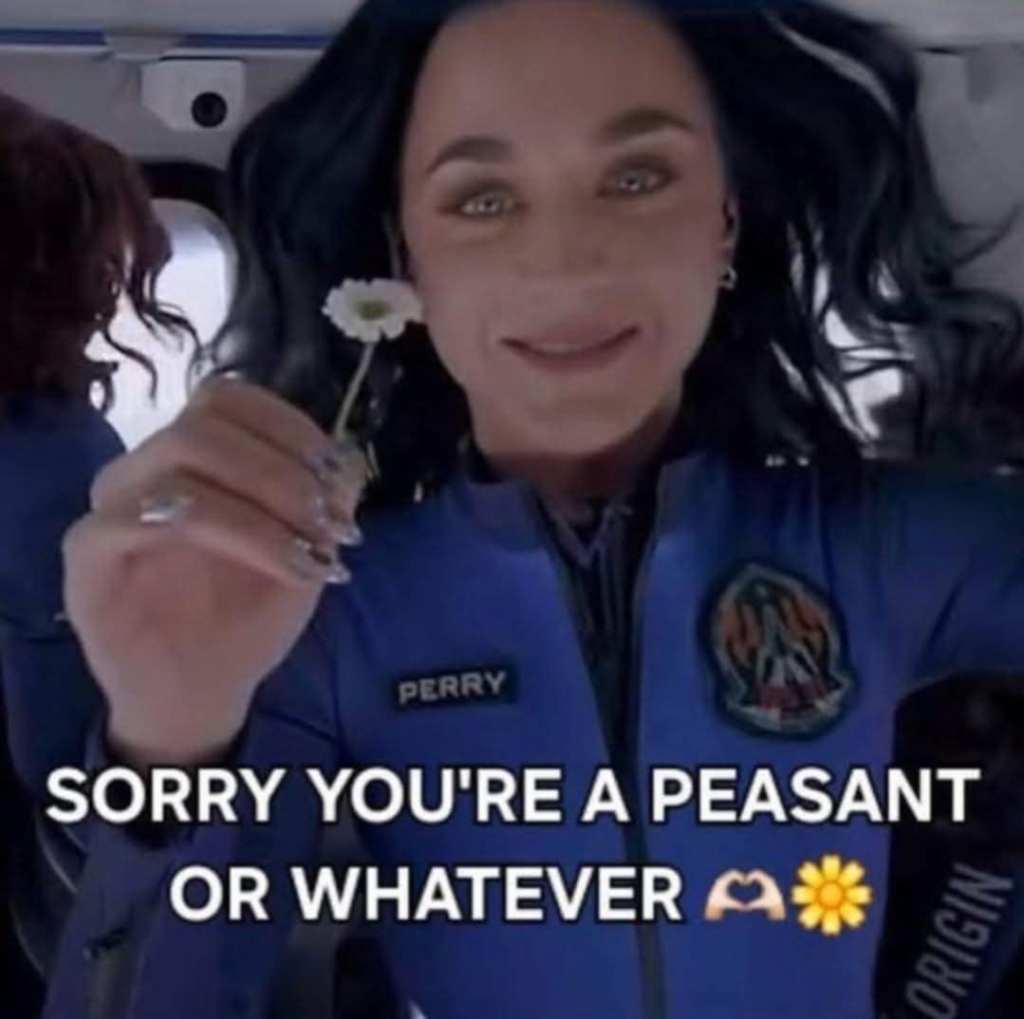
This morning my Facebook feed exploded with lots of commentaries and memes and parodies of the recent Amazon Blue Origin spaceflight starring Katy Perry.

It seems that I am not Robinson Crusoe in my reservations about the heroism and nobility of this eleven minute ride to the lower limits of outer space.

More than a few people have commented on the environmental implications of a pointless rocket launch (well, pointless except for the publicity for Amazon). Others have indicated that six rich and famous women taking a rocket ride is well and good, but most people in America have to worry about rent and healthcare costs.

The vacuousness and self-serving nature of the comments by Ms Perry and her companions have also underlined the futility of this particular adventure.

Which causes me to think about a rather silly 1967 film starring Don Knotts, The Reluctant Astronaut. For those who did not watch Sunday afternoon movie matinees on TV in the 1970s, The Reluctant Astronaut stars Don Knotts as an amusement park ride operator who ends up travelling to space on a fully automated spaceship, so as to demonstrate that space travel does not have to be only for elite test pilots.

Sounds like a precursor to Blue Origin, no?

The only real difference, aside from the lack of cleavage, is that Don Knotts succeeds in disabling the autopilot and then being at risk of being stuck in space.

Fear not however. His experience as the operator of a space themed amusement park ride gives him sufficient skill to trigger the retrorockets and return safely to Earth. If I recall correctly (it is well over 40 years since I last saw this film), his capsule lands on the deck of the aircraft carrier tasked with retrieving him.

Should We Really Consider Katy Perry An Astronaut Now?

A former friend of mine liked Star Trek too much, to say nothing of Babylon 5 and other science fiction shows.

Whilst he did not mention this to me, he did confide in a mutual friend that one of his dreams was to go into space.

I don’t think it would have happened, even if he somehow acquired the money for a space tourism ticket, as losing sufficient weight as to no longer be morbidly obese was not another of his dreams. Even as a mere passenger, a person needs to be sufficiently healthy to make the medical clearance, and someone with an BMI of about 55 is not going to get cleared, let alone to fit through the capsule hatch.

Besides, with that sort of morbid obesity, it would be unlikely that a spacecraft could lift him off the ground unless the rocket was a Saturn V.

I was thinking about his astronaut fantasy this week when I heard the news about an all female crew starring Katy Perry and Jeff Bezos’s current fiancé doing a spaceflight on an Amazon Blue Origin. They were being described as astronauts.

This did cause me some pondering. All of them were passengers on an automated rocket which had no real mission purpose other than publicity and space tourism. None had done any training for the mission, as far as I can see, beyond what is needed to be a passenger in a rocket ship doing a suborbital flight slightly above the Karman Line.

Even in the early days of space flight, when missions were almost entirely controlled from the ground, when we would send some very brave men (and some women) into space on top of some very primitive rockets (converted ICBMs initially), there was a scientific purpose for such missions, and a sense of discovery. The astronauts were all initially elite pilots, and then, later, when mission specialists were included, engineers and scientists at the top of their profession.

They were indeed worthy of the title Astronaut (or Cosmonaut, or Taikonaut). They were members of a crew setting out on a voyage of discovery, either piloting the ship or otherwise contributing to the mission.

Even though John Glenn was sent up for a second mission in his old age, with the justification that he would be tested for the effects of space on the elderly, rather than just the first space tourist, he was already an astronaut, being the third American in space.

But what was the mission parameter for Katy Perry and her ‘crew’?

Apparently, the market price for a ticket on a Blue Origin flight is $28 million. It is merely space tourism, not discovery – an expensive and more dangerous form of amusement park ride.

Calling Katy Perry and other passengers on a space tourism flight actual ‘astronauts’ is, in my mind, stretching the definition past breaking point. They are merely space tourists.

The Apathy Election

It’s now just over two weeks since the Federal Election was called, and last night, nominations closed.

I don’t think that it is just me – it seems that virtually everyone does not care two hoots about this election.

The level of apathy appears to be much higher than I have ever noticed (or not noticed) before.

I guess that there are a few reasons for this.

One is that traditional news media – in the form of television news and newspapers – is dying out. I for one do not own a TV anymore, and do not bother watching the TV news at all. Nor do I bother buying or reading a physical newspaper very often (I do read it on those days when I visit the Savage Club, as I did yesterday – where they offer The Age, The Herald-Sun, The Australian, and The Australian Financial Review).

I don’t think that I am unique in my attitude to the news anymore. Instead of watching the news on TV, I might just relax on my couch with my tablet and stream some Netflix, totally news free. I do subscribe to The Age online, but I mostly just skim that or the ABC News website. Nor do I bother with the Newscorp site much, unless I want an update on celebrity gossip.

Indeed, unless something relates to the share market (where my eyes are constantly turning), I don’t really bother much with news.

Another factor in the apathy is that this election is that involving a first term government. The last time a first term government lost an election was Mr Scullin during the Great Depression. That in itself was what Nick Taleb might call a ‘Black Swan’ event.

The Albanese government has not exactly set the world on fire – it has been very slow and bland, unlike the dynamic and sometimes turbulent first terms of previous Labor Prime Ministers after winning an election (who can forget Mr Whitlam, Hawke, or even the somewhat deranged Rudd?). But in being slow and bland, it has only made one misstep – the Voice referendum. It’s defeat makes people like me a little more reassured that Albo will not stick his neck out with other more radical constitutional referenda, such as proposing a Republic (I am a staunch monarchist after all).

So the current government has not really upset anyone, and as I do not bother reading Coalition campaign materials too closely, I am struggling to find anything in particular which Albanese has done wrong. Indeed, the revised tax cuts benefit me, as a self funded retiree, a bit more than what the Coalition offers.

A third issue is the lack of reformist zeal or actual policy on the part of either side. As I have mentioned above, Albanese is leading a very bland government which has done very little. This is unique in peacetime Labor governments, all of which have previously striven for radical and courageous change. Aside from some minuscule tax cuts which will benefit most tax payers equally, I cannot see much on offer. Where are the big ideas?

Dutton, as opposition leader, is not offering much of an alternative. His big idea is to softly talk up the idea of some constitutional referenda, including one to give Federal Ministers the power to strip certain dual nationals of their Australian citizenship if they are terrorists. That idea is definitely not liberal in its origins, and does remind me more than a bit of Bob Menzies’ most illiberal attempt to ban the Communist Party in the early 1950s.

Red baiting might have been electoral gold then, but it did not convince citizens to support rewriting the Constitution to ban the communists – people are rather skeptical of giving government too much power to abuse. Dutton dog whistling about Islamic terrorists might appeal to a small part of the electorate, but to me, it is a disturbing attempt to open the door for some very draconic laws unfitted to an Anglo-phonic democracy.

So here we are, with an election which we do not really care about, and parties whom we do not respect or admire.

Is it any wonder that the major parties are losing primary vote?

And should we, as citizens, be more worried about all of this?

I would be – but at the moment, sadly, I don’t give a damn.

It’s The Economy, Stupid….

It has been an interesting few days since the tariff announcements and retractions by the Trumpster. Share market fluctuations have been sufficiently volatile as to resemble the ‘Big Wednesday’ which that stable of share market commentary newsletters has been predicting.

I have been sitting tight though. I know that my ability to predict the market on any one given day is not great, given my personal experience. Nor can I or any other rational individual predict what Trump might say or do next, nor how the markets might react.

And even if I were to subscribe (at what is quite a steep price) to the newsletter being spruiked as being able to help you make money out of this much volatility, there are two speed brakes on being able to profit too much. The first is the inevitable need to declare capital gains for tax purposes, which would be extremely tedious if we are talking about various small wins as the market ebbs and flows. The other is that if I were to liquidate most of my portfolio and then try to buy back in, my online broking account would not allow me to buy in at the same volume as I sold out, without me leaving a significant proportion of funds already sitting in the portfolio as collateral.

Which means I will be cautious and just sit, and resist the temptation to prematurely empty my emergency fund (which is not that huge at the moment anyway after all that money wasted on solar panels) into some share purchases.

What makes me a little more relaxed about this is two meetings I attended earlier this week.

The first was a luncheon at one of my Clubs on Monday, where the surprise speaker was a prominent recently retired economist, who made many sage and insightful observations both on his lengthy career, and on the current malaise. One major takeaway from his talk was that it was not principally the Smoot-Hawley Tariff Act of 1930 which greatly exacerbated the Great Depression (as I had been led to believe), but rather, that the Federal Reserve had reacted to the share market crash by drastically cutting the money supply.

I suspect that I have been poorly informed by the various libertarian leading economists I have read over the years on such matters. Not that this is enough to convert me from a Free Trader to a Protectionist.

An enjoyable event, with good convivial company (I was invited by one of my fellow Club members to a regular Wednesday luncheon), and lots of decent wine.

The other meeting was the Wilson Assessment Management investor information roadshow on Tuesday. Being the holder of 25,000 shares in WAM, their flagship listed investment company, I was invited. And being retired, with nothing more amusing or profitable to do on the day, I registered weeks in advance.

Let’s start with the free lunch – it was at the Sofitel in Collins Place after all. I quite enjoyed the sandwiches (high quality), salads, hot dishes, and deserts. No sausage rolls alas (as to be found at last year’s Insignia Financial AGM), and no wine (as at Treasury AGM), but all up I was satisfied.

On a more intellectual level, listening to the team of lead investment managers for each of the five or six LICs Wilson offers was most reassuring. Their theme, which they came up with before last week’s Trump tariffs, was ‘Ignore The Noise’. A very apt theme when you look at what has been happening.

There was a lot of talk on the practical implications of the economic decision making of the current administration, as well as some talk of insanity (I am not sure that the word ‘lunatic’ was used to describe the Ginger King, but it was at least implied) in how things are being decided.

Of course, since Tuesday, the tariffs have been temporarily walked back, causing the market to surge, and then, overnight, to fall again when fear and uncertainty replaced the optimism.

This is an insane time to be an investor. I can relax to some extent mostly because I am a home owner and my main asset is a defined benefit superannuation pension. The share portfolio is a pleasant bonus. My inclination is to leave my money to sit untouched in the share market rather than to trade. The only other rational alternatives in my opinion are to either liquidate and have the money sit in my savings accounts, or to buy a lot of gold bullion.

But the Wilson team did make many reassuring noises to investors about the best thing to do is to stay calm and sit it out. They were also promoting a new income product they will be floating at the end of the month, whose IPO closes today (WMX). I will be keeping an eye on it as I am interested, as I get older, in more investment products which will offer a regular income – even though my current pension is greater than what I took home when I was actually working.

But who knows what is to happen? Trump and his gaggle of advisors come across as somewhat crazy and unstable.

In Which I Join Treasury Wine Estate’s Shareholder Online Wine Shop

Apologies in advance if this post reads a bit like a kid in a candy store, but wine is one of my favourite subjects, and it gets exciting to make some new discoveries or rediscoveries.

My Treasury Wine Estate dividend was paid on Wednesday – $200.

When I read the email notice of the dividend payment, it mentioned that as a shareholder, I am invited to join their online wine store: cellardoor.co and to enjoy some major discounts on Treasury’s portfolio of wines.

So… why not? Particularly as I get a $20 welcome discount.

I set up my account and started browsing.

I have previously observed on this blog that Treasury has reduced the total number of brands it produces to just over 20, including all its offshore brands. I based this on my study of recent TWE annual reports – about the only corporate document amongst my various investments that I actually read very closely.

On looking through the website, I was pleased to find out that this is not actually the case. There are 35 different brands listed on the Cellardoor site, most of whom are Australian or New Zealand brands (plus one Italian brand). None of the US based brands like Beringer were on offer.

Of course, I am not sure how much of that consists of brands which are continuing to produce wine up to the current vintage, and how many have been discontinued and are only available as back vintages.

After some browsing through the clearance offers, I decided to order 18 bottles of the Vortex 2019 Shiraz – marked down from $30 to $9. That looked like a bargain, given the size of the discount and the amount of bottle age on the wine. Mind you, I have never heard of the Vortex Wine Company before, and I suspect that I might never hear of them again, given that there were no wines on offer aside from the 2019 vintage.

Even Rosemount is still on offer through the website, although only 8 different wines were displayed, including the flagship Balmoral Syrah at $50 per bottle, marked down from $75. It is many years since I either saw or drank the Balmoral, so I will have to seriously consider ordering some in future, now that I know where to find it.

I was not disappointed that there were only two Rosemount Diamond Label wines, both whites, for sale. The days when I would joyfully tuck into a bottle of the Diamond Label Cab-Shiraz blend over a meal in a Chinese restaurant are long gone and my tastes are much more up market.

Jamieson’s Run is still on the list, although when I clicked on the link, there were no wines. I don’t think I will lament Jamieson’s Run – it was a slightly premium wine circa 1995.

Wolf Blass is still available – $25.50 for the Grey Label Shiraz is a very appealing price. Sooo tempting!

Of course, I had to log out. My monthly bills from both of my Clubs have arrived and I need to pay those rather than be too extravagant in rebuilding my wine collection.

Some Reflections On Trumpist Tariffs

I am vaguely acquainted with someone whose grandfather was, in the era of the Bolte Premiership, a politician and a major protectionist. From what I have been told about this chap, the nicest thing that could be said about him was that he owned a company which made radios and TVs locally in Australia.

That is a lovely thing, is it not?

The first TV my family owned was from a brand made locally in that chap’s factory. Within a few years, the dial to change the channel broke, so we had to change the channel with pilers. Reception with a reliable signal, even with a rooftop antenna in a flat area close to the city (ie Footscray), only allowed us to watch channels 7 and 9. Vertical hold, causing the picture to jump constantly, was also highly unreliable.

And the TV broke down regularly, requiring a TV repairman to constantly visit and fix it.

After ten years of this, my mother had enough and insisted that my father buy a new TV. My father and I visited Mighty Muirs in Footscray (a precursor to the Good Guys) and picked out a National Panasonic colour TV.

It had push button channel selection. No vertical hold issues. The TV could pick up reliable signals from all five of the free to air TV stations available across Melbourne, including the newly rebadged Channel 10 and the newly launched SBS (this was January 1981 after all). With sudden access to the ABC, I could finally watch Countdown every Sunday night.

And most importantly, this Japanese made TV did not break down even once for about 20 years. It lasted almost long enough for the transition to digital TV signals which would have made it and other Cathode Ray Tube TVs obsolete.

I get the feeling that politicians like the owner of that TV factory were very vested in using their political influence in opposing free trade and supporting the existence of tariffs, not so much as to protect local manufacturing jobs, but to compel their fellow Australians to buy inferior locally made products when far superior and arguably cheaper imports would otherwise have been available.

We don’t make TVs in Australia anymore. We import them and we export agricultural produce and minerals. This is a good thing, as we now, as do other countries who have converted from protectionism to free trade, follow the more sensible Theory of Comparative Advantage first articulated by David Ricardo in 1817.

Put simply, we focus on what we do best, and trade that with other nations who do something else best, and we are both richer for it.

Ironically, the grandson of that TV factory owner turned politician is not a protectionist. During the many years that I have had a vague acquaintance with him (he is a close friend of a former friend), he has been a very vehement free trader, and has supported removal of tariffs from the comfort of his armchair. He has a family trust to ensure that he has not had to fend for himself, or to hustle for the luxuries of life, so in a way, he is indirectly protected by tariffs, or at least the profits incurred from a long forgotten tariff on electrical goods.

My childhood experience mentioned above with our family TV sets is a good reason for anyone to oppose tariffs, although it was only as an adult when I learned about free trade and free markets and the like that I actually formed an opinion on the subject, one which I have adhered to for all of my subsequent adult life.

The announcements this week by President Trump of a wide range of tariffs on friend and foe alike have been met with a range of emotions – derision, anger, concern.

It is interesting that Australia’s subantarctic external territory the McDonald and Heard Islands, where the only permanent occupants are penguins, have been slapped with tariffs. After all, there are no exports or imports from or to there.

There is a lot of cause for anger. There have been many years of friendship and mutual trust and support between the US and many of the nations now hit with tariffs. The vilification of Canada, the friendliest and closest neighbour to the US, is uncalled for and puerile. We in Australia have plenty of cause for disappointment, anger and distrust.

There is also much cause for concern. Allow me to indulge in a quick history lesson: the Smoot-Hawley Tariff Act of 1930 converted the Wall Street crisis which had mostly just been the bursting of a share market bubble into a full blown global economic depression which then was a major cause of the Second World War.

The kind of ignorant and troglodyte economic policies currently being imposed by Trump not only will shake the world economy severely, but also are part of an irresponsible and short sighted program which will do much to damage, if not destroy, any trust that the free nations of the world have in the leadership of the US.

I can only see one positive in all this. There are many people, mostly centrist or left of centre, who usually support protectionism and oppose free trade. They will now have to reflect, when they observe Trump as the greatest champion of tariffs in at least 95 years, whether they will have to change their position on free trade.

That could be a seminal paradigm shift in political and economic consensus.

Are We About To Have A Share Market Crash? I Really Wish I Knew!

I’m not quite old enough to remember when the surfer movie Big Wednesday was in the cinemas. I think it might have been in 1978, when I was still in primary school.

I did see it in the last week of school in 1982, where study for the year ceased and the teachers offered us various activities to amuse us, including showing various recently released films in the high school theatre (from memory, aside from Big Wednesday, they included First Blood, Amityville 2, Stir Crazy, Flying High 2, and Every Which Way But Loose).

Big Wednesday was about a group of surfer dudes trying to negotiate life and waves during the Vietnam War, including where most of them attempt to dodge the draft (in a very funny scene which would now be considered very non-PC, one pretends rather convincingly that he is gay, and is rejected by the US Army only to be diverted into the Marines).

The main protagonist, played by William Katt before he destroyed his career by starring in the TV superhero comedy The Greatest American Hero, doesn’t shirk his duty and goes off to serve in the Army.

He returns at the start of the closing act of the film, revealing he is wearing the chevrons of a sergeant.

Then all our surfer dudes reunite to surf in 1974 on what they will remember forever as Big Wednesday, a day when the waves are up higher than ever before in their memories.

It was not a great success at the time, and to be quite honest, I find it hard to see the point of the film, even though I do like a lot of John Milius’ other work (you can imagine why I like such films as Conan The Barbarian and Red Dawn).

So does a film about surfing have to do with the share market?

Well, I subscribe to a few share market commentary newsletters, although these have not given me great fiscal joy over the years. The parent company for these newsletters has the annoying habit of frequently spruiking their other products, including newsletters which are considerably more expensive (or is the more accurate word to use: ‘premium’?).

Their spruiking usually consists of promoting a rather verbose and lengthy and somewhat sensationalist ‘must see’ video, which explains part of what their reasoning is, and then ends with the hook as to why you should subscribe now.

The current product they are spruiking is some particular premium newsletter which is predicting major falls and high volatility in the share market, as early as this week, but definitely before July.

The narrative hook they are using is ‘Big Wednesday’, drawing an analogy between the surfer film and the kind of big waves which share market investors could face in the next few months. With the guidance of their hand picked experts, a canny investor can surf these waves and trade their way to a handsome profit….

It makes for a nice story.

The problem for me is that I have been subscribing to newsletters from this particular office for at least twelve years, and this is not the first time that they have used ‘Big Wednesday’ as the hook for this sort of extreme volatility narrative.

I suppose it is better than the alternative, to borrow Henny Penny and her ‘sky is falling’ stampede.

But as I do have a long memory, I cannot help but get a little skeptical about this current announcement that the share market is about to crash. Particularly, as they are recycling the same phrase they used a few years ago.

After all, in various of the stellar tips which I have taken up over the years from this stable of commentators, I have lost small sums investing in some highly speculative companies which they were very convincing about, and some rather larger sums on other companies which could be considered blue chip. I’ve never yet had some tip go stratospheric on me.

But we are all asking the question as to whether the share market is going to crash, and how much volatility are we about to see if it does?

I would dearly love to know.

But what I am going to do is to sit tight. My portfolio is mostly EFTs, LICs, REITs and conglomerates. It is highly diversified. The only exemptions to that are Treasury Wine (the motives for which I hold this company I regularly discuss in this blog) and Brightstar Resources, a highly speculative gold mining stock into which I punted $500 in December (on the advice from one of those aforementioned share market newsletters).

If we go down, and bounce, then I will do more harm to my finances by trying to pick the waves than by sitting tight and waiting for things to straighten out. After all, my main assets are the roof over my head and a defined benefit retirement fund. My share portfolio itself is only there as a bonus, not as a basis, for my wealth.

Behold Your False Profit!

In the late 1980s, some local film makers produced a rather silly film about a computer nerd who summons a future sharkish version of himself to the present. It was called Future Past.

Most of the film then consists of him trying to suppress his demonic future self (some sort of insider trading stock broker with what was at the time a cool designer mullet) and send him home to the future or to oblivion.

The only really funny bit of the film was where the future self inflicts himself on the cultish fundamentalist Christian parents, who are otherwise totally disengaged from the protagonist.

They, and the rest of their cult are busy singing their hymn, which goes something like this:

By the bank where Jesus saves

By the bank where Jesus saves 

By the bank where Jesus saves.

The future anti-hero plays a key on his harmonica and then diverts these morons onto his version of the hymn:

In the bank where Jesus saves

In the bank where Jesus saves

In the bank where Jesus saves

Jesus is my chief accountant

Profit with the Prophet

Good scene – hopefully whoever wrote it went on to much greater success.

It was quite an archetypical film as far as that era went.  That I remember it actually existing does not add any more credit to it than what any post-Oz-ploitation film might merit.

But when we look wearily at similar adventures, such as Jack and the Beanstalk, or my own investments in magic beans (and related end of multi decade friendships), or cryptocurrency, you do need to wonder about what has been going on in recent years.

Ben McKenzie is a bored actor most famed for his role in The OC, and more recently for his marriage to uber babe Morena Baccarin.

During COVID, being less marketable than his wife (she is someone who does always get one steady job after another after all), Mr McKenzie in his boredom decided to use his economics degree and his latent celebrity to become an investigative financial journalist. He was able to interview a lot of the peculiar and outlandish characters who were involved in the crypto currency financial industry. 

Hence he co-wrote a book called Easy Money, where he talks about cryptocurrency and related Ponzi economics.

Of quite value are some of his interactions with certain of the gurus of the ponzinomic world … just before FTX collapsed into a pile of financially radioactive liability, the financial genius sometimes known as SBF and responsible for that mess agreed to interviews with Ben McKenzie.  Those interviews might, or might not, given the time frame of the book, count towards the evidence in the prosecution of SBF for his various alleged crimes.

What I do dispute in that book is not whether such things happened but whether such things are Ponzi schemes.

My view, as expressed previously in this blog, is that a Ponzi scheme is different from a bubble which has been caused by hysteria of crowds, where FOMO etc has pushed up the price of an alleged asset way past what is rational for it to be valued at.  

South Sea bubble, Tulips and Poseidon are great examples of that sort of thing.

A Ponzi scheme is where someone creates a financial system where a potential bubble can be exploited.  That is, you lie about the performance of some shares, and promise to keep paying out at that rate.

This is the one problem that I have with Ben McKenzies’s book.  He cannot tell the difference between a bubble and a Ponzi scheme.  Otherwise, his book is amazingly entertaining and warning about the threat which the cryptocurrency bubble poses to our financial system.

Will My Solar Panels Ever Break Even? Very Unlikely – They Will Probably Break Down First

I have been grumbling about my huge mistake in getting solar panels five months ago since I realised in mid December that I would have to do all the Kafkasque legwork to get them added to my meter and count towards my bill (by Kafkasque, I am referring to Kafka’s novel The Trial, which is about an existentially absurd inquisitorial bureaucracy).

Overnight, AGL emailed me to confirm, in a roundabout way, that the meter has been reconfigured and that the panels are now generating power towards my account. Huzzah! Finally. Two cheers for my solar panels finally working!

The notice also told me that this meant my plan was being adjusted and would result in an additional estimated $921 per annum on my electricity bill unless I changed to a different plan related to the panels.

That alternative plan could save me an estimated $197 per annum over what I had before.

Hmmm… if I had left the $4700 in my bonus saver account with my bank, it would be earning 4.65% per annum, $218.55 (uncompounded).

So in effect, those solar panels are, in terms of opportunity cost, causing me to lose $21.55 per year.

Plus the capital itself has been badly invested, and is sitting on my roof as an added load (the girlfriend of a close friend had the roof of her much newer house cave in a while ago thanks to solar panels).

And I have had well over three months of aggravation in trying to sort things out with the cowboy installation company, the electricity supplier, and the electricity retailer.

To borrow from Paul Kelly’s anthemic song, I’ve done all the dumb things. But getting solar panels might be the dumbest decision I have made in a jolly long time.