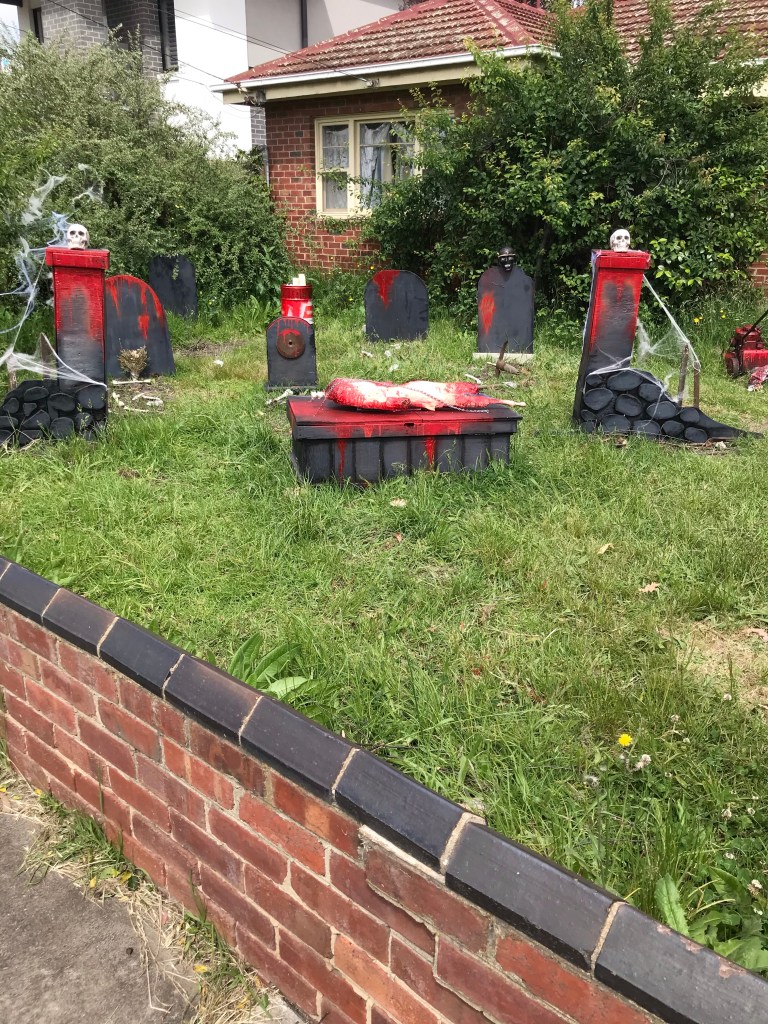
Doesn’t this sound like Chief Wiggum smashing Homer’s tail light?
Australian Rules Finally Becomes The National Football Code
The reason why Melbourne is the sporting capital of Australia, and quite possibly the world, can be summed up in one simple word: economics. This one word masks a lot of complicated history and social progression.
Organised sport is a very recent phenomenon. Before the industrial revolution, the vast majority of people lived in absolute poverty, where the struggle to avoid starvation took up much of their time and energy, and what little rest time was left was devoted to worship.
There is a good reason why horse racing is called the sport of kings. Maintaining any horse, such as those for working the fields or for warfare, is an expensive proposition. Having specially bred horses which are not suited for work or warfare is even more expensive, as it is the sort of leisure practice only open to the very rich, and which does not yield any productive return, except in conspicuous consumption.
And so it is that organised sport started to develop with the industrial revolution, where, for the first time, an increasing volume of people had sufficient means above the mere struggle for subsistence to have both the leisure time and the energy to regularly compete together, albeit in sports where the equipment required was minimal, such as those vaguely related codes we call ‘football’.
From the 1850s when the Gold Rush occurred through to the 1890s, Melbourne was one of (if not THE) wealthiest cities on Earth. This transformed society in the colony in many ways. One was that the relative wealth available and the value of the labour of most of its denizens meant that they could all bargain more competitively for higher wages, and hence led the world in better working conditions and the development of trade unions. Education, of an increasingly universal nature, flourished in the colony, as it could afford to keep children in school for longer and invest more in making them more skilled future members of the work force.
And the increased leisure time meant that organised sport could emerge much sooner in Melbourne than in most other places in the world. The Melbourne Football Club, started in 1859, is much older than any of the great English Premier League soccer clubs. [Even my own club, the Footscray Football Club – aka the Western Bulldogs – dates to 1883, giving it an ancient lineage.]. The immediate predecessor to the Australian Football League, the Victorian Football League, spun off in 1896 from the somewhat older Victorian Football Association.
Need I mention as well that Melbourne, in 1877, was the birthplace of Test Cricket? And that the wealth our city had meant that the Melbourne Cup horse race started in 1861 (remember what I just said about horse racing being very expensive). [Other famous races are often either younger, like the Kentucky Derby in the USA merely started in 1875, or not much older, like the Grand National in the UK in 1839.]
That Melbourne currently celebrates two public holidays dedicated exclusively to sporting events is probably unprecedented in the world, and indicative of the significant wealth which drove the establishment of the unique sporting culture in Melbourne during the Gold Rush.
The AFL home and away season, driven by the 10 Victorian based clubs, usually has the 4th highest average attendances in any domestic sporting competition in the world, and the AFL Grand Final, when held at the MCG, is the most highly attended domestic sporting completion final in the world.
The AFL, under that name, has existed since 1990, but it had been 8 years in the making, starting from 1982 when bankrupt VFL club South Melbourne relocated reluctantly to Sydney and became the Swans, followed by the inclusion in 1987 of the West Coast Eagles and Brisbane Bears as expansion clubs. The Adelaide Crows joined in 1991, followed by Fremantle in 1994, and Port Adelaide in 1997 on the demise of Fitzroy (I doubt any Victorian based Lions supporters will disagree too vehemently there). The inclusion of Gold Coast and Greater Western Sydney circa 2012 took the competition to its current 18 teams.
Horror in Melbourne greeted the first time, in 1991, a non-Victorian team played in the AFL grand final, and even more so the following year, when West Coast won it. But that was nothing as compared to the period from 2001 to 2006, where six successive premierships were won by non-Victorian teams, and where, in the latter 3 seasons, no Victorian team even made the grand final. By then, a team in each mainland state had won the AFL premiership at least once, and you could could say that the league had become a national competition in fact as well as name.
However, Australian Rules Football, as we used to call it, has never been very widely supported north of the Murray River prior to the expansion of the AFL. NSW and Queensland have mostly been devoted, albeit in a half hearted way, to Rugby – mostly the League variety which is almost unique globally in its degree of support in Sydney, and to a lesser extent Union.
I intentionally say that the support for Rugby League and Union in NSW and QLD is half hearted. They do not have the same sporting culture as Melbourne or Adelaide (which is like a smaller more concentrated version of Melbourne in all the things that we like). Take for example club membership figures. South Sydney Rabbitohs, in 2015 (the most recent year I could find figures) had a membership of 35,000 – and they are one of the most successful and popular NRL clubs. In 2015, the Western Bulldogs (one of the least popular and most unsuccessful Melbourne based AFL clubs) had a shade under 36,000 members. The Sydney Swans had 49,000 members in 2015, and now have over 60,000.
And so we come to October 2020. The AFL Grand Final was played at the Gabba in Brisbane last night. Most of the AFL season has been played in Queensland this year, with the remaining games played in WA and SA. The AFL has left its cradle in Melbourne and established itself, for the time needed for the competition to survive, outside its home state, and indeed in Queensland, a state where AFL is almost a novelty sport, rather than a part of its sporting culture, a place where they supposedly prefer Rugby League.
That the AFL has been able to do this represents the maturity of the competition and its importance to Australian society on a national level. It has shown now that it can survive outside Melbourne, and that there are political and business leaders elsewhere willing to support it.
It is now an opportunity for the AFL to build on this, as it has progressively done so in the 39 years since the decision was made for South Melbourne to relocate to Sydney, to consolidate greater support for Australian Rules Football in Queensland and NSW. I believe that soccer (ugh!), and the two forms of Rugby do not offer much competition – the conduct of NRL players makes AFL players look like saints, and Rugby Union is in a state of growing chaos both nationally and within this hemisphere.
A Plea To The “Honourable Men” Of The Victorian Parliamentary Labor Party….
Brutus: Let them enter:
They are the faction. O conspriracy,
Sham’st thou to show thy dangerous brow by night
When evils are most free?
(Shakespeare, Julius Caesar, Act 2, Scene 1)
Julius Caesar is, in my view, one of the most under rated of Shakespeare’s plays, one which I feel belongs right up there with the four great tragedies Hamlet, Macbeth, Othello, and King Lear. The great tragedies each not only have pathos, but they explore an existentialist dilemma. Hamlet is about the earliest pre-fall dilemma – knowledge and innocence. Macbeth is about guilt and innocence. Othello is about love and hatred. King Lear, the only of Shakespeare’s plays which approaches Greek tragedy in its themes, is about trust and betrayal.
Julius Caesar, at its heart, is about the dilemma of love and duty. Its hero is Brutus, who must choose between his love for his best friend, Caesar, and his duty towards his country. Appalled and horrified by the unlimited power which Caesar has seized as dictator, undermining the Roman Republic’s institutions and rule of law, Brutus is reluctantly persuaded that he must become a tyrannicide, even though the tyrant is his closest friend and benefactor.
And at the heart of the play is one of the four most powerful passages written by Shakespeare, right up there with Juliet’s balcony scene, Macbeth’s lament after his wife has killed herself, and Hamlet’s famous soliloquy. I’m talking, of course, about Marc Antony’s funeral oration, which has captured imaginations for four hundred years and inspired countless other artists in different ways, including Charles Bronson and Ringo Starr.
At the start of Caesar’s funeral, the tyrannicides appear to have won, and in the fall of the tyrant they have restored the Roman Republic. In the surviving consul, Antony, they do not see a threat to their agenda. And his speech starts off fairly mildly:
“Friends, Romans, countrymen, lend me your ears.
I come to bury Caesar, not to praise him.
The evil that men do lives after them;
The good is oft interred with their bones,
So let it be with Caesar.”
But the mood of the crowd does shift, as with biting sarcasm, Antony gradually turns the crowd from relief at the death of the tyrant to anger at the tyrannicides. His constant use of the term ‘honourable’ in describing Brutus and his co-conspirators, suggests that they are anything but:
“O masters, if I were disposed to stir
Your hearts and minds to mutiny and rage,
I should do Brutus wrong, and Cassius wrong,
Who, you all know, are honourable men.
I will not do them wrong; I rather choose
To wrong the dead, to wrong myself and you,
Than I will wrong such honourable men.”
Politicians who either have held a ministerial position, or who sit in the Victorian Legislative Council, are entitled to use the title ‘The Honourable’ in front of their name. So, many of the members of the Victorian Parliamentary Labor Party are “honourable” men (and women).
Of course, right now as they sit passively in their offices like so many sheep, I use the term ‘honourable” ironically, just like Marc Antony.
There is a tyrant in the state of Victoria, Premier Daniel Andrews. With the complicity of his parliamentary party, and three irresponsible cross benchers in the legislative council, (again ‘honourable’ men and women), he has used the excuse of a pandemic (which his own incompetence and lack of accountability caused to run out of control, killing 800 people needlessly) to suspend the Rule of Law in Victoria, to suppress the right to protest and freedom of speech, and to enable the police to operate in a heavy handed and oppressive manner against the citizens of this state.
Given that the right to protest has been suppressed to the point where people get arrested for even suggesting it, is there any surprise when people start vandalising the office of such a tyrant in the dead of night – it is the only form of protest that they feel is left to them?
But I make a call to the “honourable” men and women of the parliamentary Labor party, such as my rather goopy looking local MP, the Honourable Ben Carroll. It is time for you people, like the Roman senators led by Brutus, to turn tyrannicide (metaphorically of course) and sack Daniel Andrews as leader of your party.
Do something decent for a change instead of being complicit in the destruction of the Rule of Law in Victoria whilst you keep your swinish snouts firmly in the feeding trough. Sack Dan. Perhaps then people might not throw you out at the next election.
The Space Race Without Heroes – Retelling The Right Stuff
The late second temple Jewish general and historian known to us as Flavius Josephus is one of the most interesting characters of his society and time in history, not so important as Jesus or as influential as Paul, but perhaps just as fascinating in his own way. After all, his very survival of a suicide pact at the end of the Jewish War and his subsequent patronage by the Flavian dynasty makes for an interesting story in itself, even if he had not sat down to write about his times, and the history of his peoples.
I got around to reading Josephus just over a decade ago, and the thing that really struck me when reading The Jewish Antiquities is that it is a retelling of the Bible with one major omission: God.
Today on Disney +, I watched the first two episodes of the series retelling Tom Wolfe’s The Right Stuff, the dramatic history he wrote 40 years ago about the origins of the space race and the Mercury astronauts, and it struck me that the script writers have created a story without a hero.
I was 16 when I read The Right Stuff, and I guess you could tell then, a couple of years before Bonfire of the Vanities took the world by storm that Tom Wolfe was a novelist in a journalist’s body, just waiting to burst out. Kauffman’s film adaption of the book, which I saw within a year of reading the book (when it premiered on TV), was epic big event cinema for the mid 1980s, and faithful, in its own way, to the book, whilst retelling it through a much more spectacular medium.
But what Kauffman and Wolfe both had in their version of the space race story was a hero, straddling the sky and overshadowing all other characters, a protagonist whom all others measured themselves against, and each in their own way was found to be lacking.
That was depicted most graphically in the climatic scene of the movie version of The Right Stuff, where the Mercury astronauts are taken to a Texas celebration in their honour by Vice President Johnson. There, a fan dancer gyrates and turns on stage, whilst the scene cuts away to where the real hero, test pilot Chuck Yeager is trying to push a modified F104 Starfighter to an altitude record, before he spins out of control and finally ejects. Gordo Cooper (played very aptly by Dennis Quaid as brash and shallow), one of the Mercury 7, is asked by a journalist who is the best pilot he ever met, and fumbles as he remembers Yeager and tries to name him, before giving up and just claiming he himself is the best.
Of course, the audience knows the truth, as Yeager marches triumphantly out of the wreckage of his plane, helmet under one arm and parachute under the other. He might not have the fame, nor have reached the stars, but he has conquered adversity, and shown himself to be the true hero.
The problem with the National Geographic series Disney is now streaming is that it picks up the story halfway through. The Right Stuff is not so much about the Mercury 7, as it is about the culture of the pioneer test pilots who rode their rocket planes and early jets through the late 1940s and early 1950s over the high desert, wrestling them through the sound barrier and frequently cratering into that desert. Most of the Mercury 7 astronauts hated The Right Stuff when it was released, as it was a fly on the wall depiction of that era, and portrayed them more as flawed but acceptable supporting characters in a much more epic story.
Starting the story with the selection of the astronauts and focusing on their flaws and struggles, particularly those of Alan Shepherd, John Glenn, and Gordo Cooper, is to present a story where there are no real heroes, no figures to admire and respect. Instead, we see them as the imposters that they may have seen themselves, masquerading as great American heroes.
Don’t get me wrong – I will be watching the entire series, and I do have respect for the men who can fly those monsters across the sky and into space. But this is not epic storytelling the way that Wolfe and Kaufmann produced when they made The Right Stuff the story that we know and love. For that, you need epic heroes, not imposters.
Collingwood get eliminated from the AFL finals – most of Australia has something finally to smile about
Ok… my team got eliminated in week one of the AFL finals, but after the 2016 premiership miracle, I am not too put out.
One thing that always gives most Australians something to smile about is the suffering of Collingwood supporters. As a kid in the late 1970s and early 1980s, when Collingwood kept making grand finals and kept on losing them (North Melbourne in 1977, Carlton in 1979 and 1981, Richmond in 1980), it was the kind of thing that gave me great cause for amusement (that same period was not a time where the on-field performance of the Footscray Football Club gave much cause for joy).
There are always heaps of Collingwood jokes going round. In 1981, when Buck Rogers in the 25th Century was on TV, one of the jokes was:
Q: What did Buck Rogers say when he woke up after 500 years?
A: Has Collingwood won a premiership yet?
Most jokes about Collingwood are far more mean spirited than that, and I am guilty of telling heaps of those.
Biggest Collingwood joke today is a sight gag last night during the Geelong-Collingwood semi-final, where the Channel 7 cameras kept on constantly crossing to a view of Eddie McGuire looking miserable whilst his team was slaughtered by the Cats. You see, just about everyone who does not barrack for Collingwood finds their President For Life and cashed up uber-bogan footy commentator hugely annoying. Indeed, whenever I would see him on Channel 9 (back in the days when I actually was still watching free to air TV), I would change the channel. Schadenfreude and being a non-Collingwood AFL supporter go hand in hand.
Grumbles about gardening
A few weeks ago, my mother indicated that she wanted some cucumber seeds. So I went to the Reject Shop to buy some (as Bunnings and other hardware & gardening supply stores are all closed, the Reject Shop is the only place which seems to be both open and have vegetable seeds for sale).
Sadly, they were sold out, so I went to Plan B, and went online. The Bunnings website is not exactly the most easily navigable, and I get the impression that they are not really into home delivery anyway, so I quickly abandoned them and went to Amazon (not a site I am keen on, given that Amazon are reputed to be an appalling employer and who wants to enable them to become a monopoly retailer anyway).
So I ordered a pack of 5 different types of heirloom cucumber seeds
According to my order history, they were ordered on 18 September, and they were expected to arrive by 30 September.
Well, it is 4 October now, and the only details onside are ‘Your package was probably delivered as we expected it to arrive by now.’ In the meantime, Amazon have started spamming me to write customer reviews of that product, on that latter expectation.
[Whilst grumbling about Amazon, I might as well mention that I ordered a particular mask (why can’t Australian retailers adapt and sell decent masks inshore?) on 25 July, and it is expected in the next week. Why it took several weeks to actually ‘ship’ does mystify me.]
The inability to readily obtain vegetable seeds at the moment does get me wondering. Why don’t the supermarkets stock some of that stuff in their minuscule gardening sections? You could say that it might encourage people to grow their own instead of buying from the fruit and veg section of the store, but why then do supermarkets sell flour and cake mix as well as bread and cake?
Anyway, it is spring and people like to be out and about. Much as I like binging on Netflix etc, gardening is one of the things which makes lockdown that much more bearable, and ready access to the right vegetable seeds would make it more so.
Almost the face of a stranger
I shaved off my isolation beard yesterday. Not because, after almost six months since I started growing it, that the state of lockdown in the Peoples Republic of Victoria has come to an end, nor because it does not fit well behind the masks which have been mandated by our technocratic Premier when we set foot outside our homes.
Quite simply, I finally got sick of it.
Looking in the mirror after six months concealed behind a beard, it is almost the face of a stranger I am looking at, cheeks and jawline which I have become unused to, and which probably have changed a little with fluctuations in weight over that time. Or is it that I am paler than usual?
Getting the garden ready for summer
About 7 months ago I planted some lavender cuttings along my front fence. Two of those survived, and today I added another two plants I bought a few days ago from the supermarket to those.
This is not much, but I feel that providing more food for bees is probably important, even on a micro-scale.
Soon, it will be Melbourne Cup Day, by when the tomatoes should be planted. So far, the seedlings I have been growing are nowhere near suitable in size for transplanting, but give it another few weeks and they definitely will be.
After all, is there much else that anyone can do at the moment besides garden? And as Bunnings and all the plant nurseries are closed down, if you want to grow your own vegetables, you have to do it by seed, which is what I prefer to do anyway.
All Power, No Responsibility: A Brief Appraisal of the Failed Andrews Technocracy
“Hell is truth seen too late” – Thomas Hobbes, Leviathan
If, in some sort of twisted social contract, people were to consent to live in a technocracy with the removal of most of their rights and liberties (including much of their freedom of speech), you would expect at least that the technocrats running that system to be competent at delivering the safety and security which are the trade offs for the loss of all that freedom.
I think the philosopher Hobbes, who could be considered through his Leviathan to be the post-Platonic pioneer for such technocracy, would see that as the alternative to a life which is “solitary, poor, nasty, brutish, and short”.
In the failed technocracy which is the Peoples Republic of Victoria, we do not have that sort of assurance from the elected and appointed technocrats ruling the state. Life is solitary, as we are all more or less forbidden from leaving our homes; it is (for many small business people) poor due to the obliteration of their livelihoods; it is nasty, for the police are hassling elderly ladies in parks and arresting pregnant bogans in dawn raids for the major crime of advocating the right to protest; it is brutish, for similar reasons of autocratic overreach; and, due to the failure of the authorities to contain the Covid, there is the threat of it being short.
The groundswell of questions around the failures of the Andrews Technocracy, both to contain the covid in hotel quarantine, and in the harsh measures supposedly deemed necessary to address that failure, came to a head on Friday, with the resignation of the Health Minister after the Premier’s evidence to the enquiry pinned all the blame on her, something she evidently disputes.
But it appears that no one has actually taken responsibility for the various decisions and errors which led to this renewed outbreak and the disastrous lockdown. It is a case of Everybody, Somebody, Anybody and ultimately Nobody, as the old saying goes.
This became clear a few weeks ago, when the curfew, which was ordered by the Chief Health Officer Professor Sutton, was questioned. Professor Sutton denied responsibility for recommending it, and gave no public justification for it, showing a failure to turn his mind to the issue at question, and therefore leaving it open under administrative law for people to wonder whether he had actually lawfully made the decision to order the curfew (administrative law requires that you actually turn your mind actively to considering the questions rather than just signing whatever is put in front of you). At the same time, the Police Commissioner denied all responsibility for recommending a curfew.
So who ordered the curfew? Premier Andrews does not have the legal power to do so – all the emergency powers actually lie with the Police Minister and the Chief Health Officer, and he cannot order them to make a decision, they have to make the decisions themselves. If one or other of them followed direction from the Premier in this way, then they would not be actually exercising their powers lawfully.
We also now have the situation where former Police Chief Commissioner Ashton has denied in front of the current judicial enquiry, that he had a preference one way or the other for the use of private security in the hotel quarantine. However, the evidence trail contradicts this.
Similarly, there has been a lot of denial by state officials in relation to the offer of Defence Force personnel to enforce the hotel quarantine.
Indeed, success has many fathers but failure is an orphan.
The consequences of this ineptitude have been extremely serious. Victoria has now been in lockdown for a further three months, which will result in serious long term economic cost. It also will have human cost – there are close to an extra 800 Victorians unnecessarily dead directly as a result of the Covid resurgence. Then there is the indirect human cost – the rise in the suicide rate and the deaths of those unable to access their usual elective and other medical treatments (for example, my elderly mother’s appointment to have her pacemaker checked appears to have been delayed, which puts her at greater risk).
The unwillingness of the police leadership to commit to enforcing hotel quarantine, combined with the failure of the State Premier to accept the offer of ADF help (and to lie about it), has cost this state. It would have been better for the police to enforce the quarantine than what they have done since, ie hassling elderly ladies on park benches, arresting pregnant bogans in dawn raids, and handing out thousands of fines to irresponsible idiots. Is this what policing is there for?
When you look at the answers of ex-Commissioner Ashton to the enquiry this week, you have to wonder whether he has perjured himself. Combine that with his involvement in the Lawyer X saga where the police appear to have perverted the course of justice on an industrial scale, and you do have to wonder about whether or not the next dawn raid Victoria Police should do might be to arrest him on charges relating to those matters, rather than trawling through Facebook to find bogans wishing to protest.
That would send a better message to our inept technocrats who are busy abusing their emergency powers that no one is above the law, and especially not insipid pocket despots like themselves.
How can you tell when Daniel Andrews is lying?
His lips move.
I think the answers of our technocratic premier at the enquiry into the failures of hotel quarantine do show a lot of short comings in terms of his judgement and his veracity.
Yet thanks to Fiona ‘Yar Yar Binks’ Patton, he retains emergency powers to abuse for the next six months.
And abuse them he has, and will.