There was an Old Lady, who lived in a shoe….

A couple of years ago, in an unexpected display of Walkey Award-worthy investigative journalism, the writers of gossip magazine New Idea (commonly called ‘No Idea’ by those who do not read it) ended the political career of National Party MP Andrew Broad.

Mr Broad, it transpired, had been trying to pick up women (whilst married) on a sugar baby website. One of those women decided, given that she had not profited from meeting him, to sell her story to New Idea.

That is probably the most truthful and accurate piece of reporting printed in New Idea in recent times. But it did meet the criterion of tittilating gossip, which is what the readers (if you can call them that) of New Idea and similar magazines buy it for.

Which segues me to the title of this post. Jennifer Aniston is one of the long standing cover girls of these gossip magazines, given her beauty, succession of handsome boyfriends and husbands, and the general drama of her personal life (which would delight the readership as they indulge in a spot of schadenfreude). For a long while, New Idea would run cover stories announcing either her pregnancy or (after she reached an age where this was no longer likely) her adoption plans.

If half of the reports about Jennifer Aniston’s supposed pregnancy were true, she indeed would have as many children as the proverbial old woman who lived in a shoe.

What has caused me to go on this rant about gossip magazines this morning (at a time when Australian Army war crimes and the activities of communist China are far more pressing), is that last week’s cover story for New Idea combined the mix of editorial malice and superficiality which is innate to the gossip magazines.

The cover featured a picture of the former Home and Away starlet known then as Bec Cartwright and now as Bec Hewitt, wife of a former leading tennis champion. The heading to the story was ‘Dumped’.

Of course, it did not relate to what first comes to mind (ie the end of the Hewitt marriage), but rather to something to do with Bec Hewitt’s now somewhat superfluous acting career.

Cover stories featuring the insinuation that the long married Hewitts have broken up are one of the staples of New Idea, along with Jennifer Aniston’s personal life and the supposed activities of various younger Royals. You can see why – rich, good looking, famous. The bored housewife pushing her trolley down the supermarket aisle is going to get her fix of schadenfreude from the cover story, and buy the gossip magazine.

I am not sure how long this has generally been the formula followed by gossip magazines, but it does offend me for several reasons. One is the blatant dishonesty of the cover stories. Another is that these stories are, aside from untrue, pretty shallow. But the most serious is that they represent a degree of thinly veiled malice.

Over the past few years, just about all of the so called Lads’ Magazines such as FHM, Ralph, Loaded and Zoo have closed down. They were accused of promoting ‘rape culture’. At the very least, they were sexist and silly, focusing on images of artificially big breasted young women, alcohol abuse, fast cars and other toys for boys. The public outgrew those sorts of silly publications.

Is it not time that the public outgrew New Idea and Women’s Day? I wish it were so.

Fake Photos and Real Bodies – How Communist China Really Behaves

Have you ever seen a real dead body? Relatively few people do, and hopefully very rarely. I have only three times – just after my father died, at the open casket rosary reading for an uncle, and at an open casket funeral for the father of a close colleague. It is not something you really want to see, and you should never trivialise it, as the body is all that is left of someone who in life was loved by others.

About two or three years ago, an exhibition toured Australia which was called ‘Real Bodies’. It featured the corpses of various dead people, stripped down to their muscles and organs, and preserved using a process called ‘plasticisation’ or some such. These bodies were often posed in such a way as if they were undertaking actions in real life, like running or kicking a soccer ball. I was sickened to the stomach when I read of it.

These bodies all originated from Communist China, and they all seemed to be of young people. Young people are statistically less likely to die of natural causes, which makes me wonder how exactly these bodies were sourced. I have grave suspicions that, in a country where involuntary organ transplants occur from dissidents and political prisoners, those bodies were the remnants of lives which had been violently cut short by the regime.

Definitely not something to view for one’s own amusement.

I was thinking of this exhibition this week when I was reading about the Chinese government’s inflammatory tweet about Australian war crimes, featuring a doctored photo.

As I have written recently in this blog, I am appalled by the revelation that some of our troops have committed war crimes in Afghanistan.

But there is a big difference between those war crimes and the crimes against humanity committed in Communist China. Australian war crimes have been committed by individuals and units in violation of our laws, and where the only blame that can be laid at the feet of the Australian nation is that of a failure of leadership in the defence forces, rather than a condoning of such atrocities. These have not been covered up. They have been investigated and prosecutions are to follow. People will be held accountable.

The Communist Chinese state is totally different. Right now, aside from its involuntary organ donation program and its provision of freshly slain corpses for museum exhibits that trivialise the lives of those who have died, it continues to repress its Uyghur minority, with millions detained in what could be best described as concentration camps. It continues to repress the formerly independent nation of Tibet. It constantly ignores international law.

That the Communist Chinese state behaves in this way is not surprising – they are after all a totalitarian dictatorship which has, over its 70 year history, been responsible for the deaths of tens of millions of their own people. The free people of Taiwan and the formerly free people of Hong Kong have great reason to be anxious, as they are the first at threat from this tyranny after the people on the mainland.

And we need to remember that there is a very big moral difference between our own nation and Communist China, for all that those inflammatory twitter images seek to present Australia as worse than they are. The Commonwealth of Australia does not condone war crimes or crimes against humanity by its agents. It punishes those who commit such crimes. The Peoples Republic of China, on the other hand, has a policy of committing crimes against humanity against its own people. That is a big difference.

The Ghost Of Breaker Morant

Australians are not always good at picking their folk heroes. Ned Kelly is still seen by many, and not just by the bogan element, as a rebel against oppressive authority, rather than as a petty criminal from a family of petty criminals who turned into a cold blooded murderer and hostage taker.

Similarly, Breaker Morant, executed during the Boer War for murder, has been seen by many as a martyr and a scapegoat for the failings of British imperialism. Few look at the details of what he did, and what his legal defence was.

The accusations on which Morant was charged included the summary execution of a wounded prisoner of war, four other prisoners of war, and of the killing of at least four civilians. His defence did not centre on his innocence of the guilty deed, but that he was following orders to ‘take no prisoners’ issued by Lord Kitchener.

This defence, some five decades later, would become infamous as the Nuremberg Defence.

The trial of Breaker Morant and several of his fellow officers, for what effectively were war crimes, is one of the few times that any Australians have been accused and held to account for such abhorrent conduct. That he has, despite his deeds, been seen since that time as a scapegoat and a martyr rather than as a war criminal is indicative that there is a lesson in this episode that we have not learned.

This is a particularly salient point this week, on the release of the Brereton Report into alleged war crimes committed in Afghanistan which has found that at least 39 civilians or prisoners have been murdered by Australian special forces troops, and recommended that criminal charges be brought against 19 soldiers.

How could this happen? Australia has a great affection for its defence forces, and for the tradition of citizen soldiers who have volunteered for duty in defence of the nation in two world wars, a tradition which makes up a great part of the foundation history of the Australian nation. Our firm belief is that our soldiers fight fair, despite the brutality of war, and that we protect civilians.

When did we stop being the good guys?

The Brereton Report does not come as a major surprise. In recent years, various journalists have run stories, based on allegations made by former soldiers present, of war crimes committed in Afghanistan by various soldiers. One of those, the VC winner Ben Roberts-Smith, has taken court action for defamation against the Fairfax press on allegations made against him. He has in the past day announced that he has put his medals up as collateral to fund his legal defence, coming forward as one of the men likely to face charges as a result of this report.

There appear to have been some very significant shifts in culture within the special forces, as well as some serious failings in leadership that have led to this situation. Whilst patrol leaders (ie NCOs) appear to have been the ring leaders in the actual perpetration of those war crimes, such activities do not occur in a vacuum. The leadership of special forces, as anywhere else in the Army, lies with commissioned officers. What were squadron and regimental commanders doing whilst SAS patrols were systemically committing acts against unarmed civilians or helpless prisoners? At the very least, they were not sending the right messages, or setting the right tone, for the culture and the behavioural expectations of their units.

More worryingly perhaps, many of these former special forces officers have since progressed into the higher levels of command in the Army. Whilst they are not accused of complicity in war crimes, the failings in their leadership of the special forces is something for which they need to be held to account professionally.

This is perhaps where the issue of Breaker Morant comes right back at us. He committed war crimes, and the complicity of his senior officers, including Lord Kitchener, was never established, despite his attempt to argue that he was simply following orders. Whilst it goes without saying that officers of the Australian Army would never, in this day and age, give such unlawful orders, the failure of their leadership to prevent such behaviour from occurring, or to take action on it much sooner than has been the case, is a matter of grave concern. Whilst it is unlikely, given the findings of the Brereton Report do not accuse any officers of misconduct, that any unit commanders are going to face court over the actions of their subordinates, there is a need to admonish those commanders for those failings in leadership.

Maybe it is time that the Defence Forces stop valuing and rewarding service in the SAS so highly amongst its officers. Leadership of the Defence Forces needs to fall on the shoulders of those officers who are capable of leading in an honourable way, and of inspiring their troops to behave honourably, not upon those who turn a blind eye or deaf ear to a toxic culture.

Reflections on the US Presidential Election

I lost $50 last week. I bet with one of my friends that Trump would win the presidential election. The ‘enthusiasm gap’ between him and Biden (ie the number of crazy-scary people who would go to rallies to support Trump as compared to Biden), as well as the recent proof that opinion polls are about as good as calculating election results as a toss of a coin, convinced me that Trump was going to win.

And until his petulant display since the election result has clearly been in, I would say that his performance as president has not been, despite his perpetual tendency to behave like a 14 year old rather than a 74 year old, not too bad.

Now of course, the crassness (which readers of this blog would know I define as ‘rich people behaving badly’), mendaciousness, and general lack of dignity of his behaviour has me thinking that, despite my very conservative inclinations, Trump leaving the White House in 70 odd days time might be a good thing.

However, America has been through worse presidential election crises. 2020 is a ‘fake’ crisis, and even the one which people still might remember, the contested ballot in 2000 in Florida, was pretty much a storm in a tea cup, easily resolved.

For real crises, let’s look at 1800 for starters, when the villain of the musical Hamilton almost became president due to tying with his running mate, Thomas Jefferson. That was when the electoral college was not popularly elected in each state. Vice President Aaron Burr has always captured my imagination as the most interesting of America’s maverick senior statesmen.

Now of course, Trump probably is in the process of surpassing him.

Or let’s remember 1824. The election was split closely enough that it fell into the House of Representatives where Anthony Hopkins lookalike (remember Amistad) John Quincey Adams was elected president over Andrew Jackson.

[Adams fils might not have been the greatest of presidents, but he was a great man, and more importantly, a very decent man, one who spent his whole life, including a career in the House of Representatives after his presidency, defending individual liberty and opposing slavery.]

And there there is the Compromise of 1877, under which the contested election of 1876 was decided in a shady deal, where Republican Rutherford Hayes [you might remember he was mentioned in The Simpsons in the ‘We are the mediocre presidents’ song] was accepted as president by the House Democrats in exchange for the withdrawal of federal troops from the former confederacy. And so civil rights in the southern states was set back 80 years or so.

American democracy has always had its shaky moments, and this is an important thing to remember (Abraham Lincoln got elected despite not even being on the ballot as an option in most of the southern states, which his opponent Douglass saw as a matter of concern which caused him to campaign even harder there in vain in order to try to preserve the legitimacy of the system). I am a student of American history, and I know it better than most Americans do (I say so without any trace of arrogance, but a tinge of concern, being an outsider looking in).

[As a footnote – you would remember from such classic 1970s TV shows as The Dukes of Hazzard and The Misadventures of Sheriff Lobo that law enforcement and civic leadership in the rural south at least has been seen as a corrupt joke by Hollywood, although that has ignored the real problems in the great metropolises.]

I expect that America will get through the next 70 days OK, and that it will then seek to work on building a new aspect to the always changing consensus which keeps it going, but which is always at risk of falling over. What it needs to realise is that there is a problem with the Antifa and other violent illegal movements of the left, as much as there is of the Trumpist populist chauvinists of the right, and that there is a much bigger institutional problem (of which Biden as a lawmaker has long been a part) where a very large proportion of the population is unnecessarily criminalised and incarcerated.

America is not communist China. But it does need to stop imprisoning people severely and potentially unjustly, and it needs to stop militarising its police forces. Maybe then it can really become the Land of the Free that it sings that it is.

Never After: Huxley’s Twisted Take On The Tempest

I have three hardback editions of the Complete Works Of Shakespeare – two identical (aside from the dust cover) from my teenage years (one was a present for my 14th birthday, and one was an academic prize at the end of year 10), and a nice leather-bound one I was given more recently for my 50th. All three have sentimental value, and have pride of place in the bookcase where I keep my books by and about the Bard.

But the fonts in those are rather small, so they are more for show than for reading. When, as I still do from time to time, I read Shakespeare, I prefer to reach for one of the paperbacks I have for each individual play.

However, at age 14, with all the hubris and naivety of a teenager, I did set out briefly to try and read all the plays, and to do so from my Complete Works volume. I was twice that age, when, with access to individual paperback editions and a much better appreciation for the beauty of the language, I finally did read all the plays.

Being methodical, I decided to start at the beginning of the volume. The Tempest being the first play in that version of the Complete Works, I read it, then skipped to Romeo and Juliet, and then gave up on the rest. Hence, The Tempest is one of the plays, being the first one that I ever read, to which I have a sentimental attachment (the others being: Macbeth, which we studied in Year 11 English; Henry V, which I saw in the cinemas at age 20, The Taming of the Shrew which is the first I saw performed live, and King Lear, which, when I saw it at age 36, taught me with its tragic pathos that live theatre done well has something more to it than words on a page).

Age 14 is also when, coincidentally, I read Aldous Huxley’s novel Brave New World, which takes its name from a quote in The Tempest, the moment when the heroine, Miranda, exclaims: ‘O Brave New World that hath such creatures in it’.

Sadly, 14 year olds are rarely able, except literally, to put two and two together, and I did not really get the subtext of Aldous Huxley’s novel until much much later. [Nor did I understand then, despite being bilingual, that the word ‘brave’ in Shakespeare has a meaning closer to that of ‘bravo’ in Italian, meaning good or great or generally awesome, rather than courageous.]

The recently streamed and now cancelled TV series Brave New World, based loosely on Huxley’s novel, has provoked my thoughts to turn back to Huxley and his defining work for the first time in years.

There is much more that Brave New World and The Tempest have in common than just a quote, and that is what I feel like unpacking tonight.

The Tempest is set on an island off the coast of Italy, where the exiled sorcerer Prospero lives with his daughter Miranda, his enslaved monster Calliban, and the ethereal spirit Ariel. Miranda, having been brought to the island as an infant, has no knowledge of other people and the world outside the island. So imagine her delight when she meets the dashing Ferdinand and has the prospect of leaving the Island for the whole wide world.

So imagine what if Miranda lived happily never after? That is the retelling which Huxley offers us in Brave New World.

Instead of Miranda, the protagonist is John the Savage, born and raised on a reservation outside of the confines of the dominant civilisation in the novel. The world outside the reservation is totalitarian, where sexual promiscuity and recreational drug use are mandatory, monogamy is forbidden, and families are non-existent. Everyone is artificially conceived and raised, genetically altered and socially conditioned to fit within the various social classes.

John, as the inadvertent offspring of a woman abandoned in the savage lands by her lover, does not know what this world is like. All he knows is from reading Shakespeare. When he is discovered and brought back to civilisation, he is at first delighted. But his delight soon fades into horror as he realises that the outside world, with its twisted mores and social controls, is very different from the freedom to which he is accustomed, and bereft of the emotional ties he values.

This epilogue to The Tempest gives us a much better insight into what the world might offer. People and societies are not always quite as good, or as promising, as they seem. Sometimes it is safer to stay on the island than to go and live amongst the land sharks.

Night of the Living Dead: Or Why are People Celebrating Halloween?

About a decade ago, I used to go to a Guy Fawkes night organised each year by a friend of a (now former) friend. They would burn an effigy each year – the Guy representing some annoying lefty or Islamic terrorist figure. As it burned, we would sing God Save The Queen, and Advance Australia Fair.

Readers of this blog would by now not be surprised that I would go to such an event.

As I had a falling out with the friend who knows the people who do that sort of thing, I haven’t been invited to the effigy burning in at least five years, and as it was held in the outer south eastern suburbs, I hadn’t bothered attending for several years before that. I wonder whether it will go ahead this year at all. (Not that I care – why should people I do not particularly like very much have fun like that?!?)

But this is the time of year when quaint occasions are celebrated. Guy Fawkes night is one of those things which has mostly been forgotten, but which used to, several generations ago, still be widely observed in Australia, although not quite with the same gusto as by the people I used to know.

Halloween on the other hand has been growing in popularity in recent years. Back in the late 1970s, it was only observed by bored primary school librarians, looking for something vaguely interesting to engage schoolchildren with. I guess that would be the first seed of what has since grown like a weed.

The other big catalyst for Halloween is that since 1990, each year the Simpsons does a special Halloween episode titled Treehouse of Terror. The Simpsons has become part of our popular culture, and with it, Halloween has become more and more engrained.

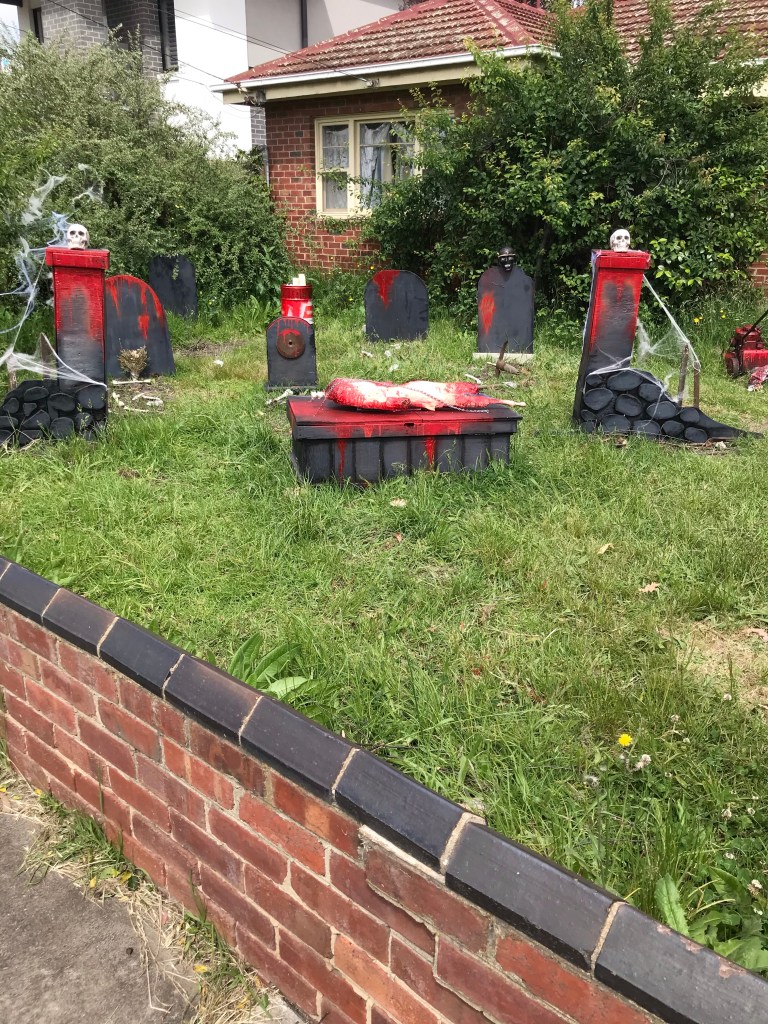
And the supermarkets are keen to jump on board, selling not just chocolate and other sugary products, but also decorations. I have noticed quite a lot of homes have really jumped on the Halloween theme this year. For the first time, people are actually decorating their houses for it. Look at this front yard above, in Gordon Street Maribyrnong, which I passed this morning. They have gotten into the Halloween spirit (sic) with great enthusiasm and fake gore.

At least this year, there are no trick or treaters – the pandemic has kept everyone inside. But in anticipation of trick or treaters, people do tend to buy some bags of lollies etc these days, which was not the case 20 years ago.

I do half wish that I was cynical enough to say ‘Ba Humbug’ or some such about it, but somehow I find that I cannot. It’s all just some harmless fun.

Australian Rules Finally Becomes The National Football Code

The reason why Melbourne is the sporting capital of Australia, and quite possibly the world, can be summed up in one simple word: economics. This one word masks a lot of complicated history and social progression.

Organised sport is a very recent phenomenon. Before the industrial revolution, the vast majority of people lived in absolute poverty, where the struggle to avoid starvation took up much of their time and energy, and what little rest time was left was devoted to worship.

There is a good reason why horse racing is called the sport of kings. Maintaining any horse, such as those for working the fields or for warfare, is an expensive proposition. Having specially bred horses which are not suited for work or warfare is even more expensive, as it is the sort of leisure practice only open to the very rich, and which does not yield any productive return, except in conspicuous consumption.

And so it is that organised sport started to develop with the industrial revolution, where, for the first time, an increasing volume of people had sufficient means above the mere struggle for subsistence to have both the leisure time and the energy to regularly compete together, albeit in sports where the equipment required was minimal, such as those vaguely related codes we call ‘football’.

From the 1850s when the Gold Rush occurred through to the 1890s, Melbourne was one of (if not THE) wealthiest cities on Earth. This transformed society in the colony in many ways. One was that the relative wealth available and the value of the labour of most of its denizens meant that they could all bargain more competitively for higher wages, and hence led the world in better working conditions and the development of trade unions. Education, of an increasingly universal nature, flourished in the colony, as it could afford to keep children in school for longer and invest more in making them more skilled future members of the work force.

And the increased leisure time meant that organised sport could emerge much sooner in Melbourne than in most other places in the world. The Melbourne Football Club, started in 1859, is much older than any of the great English Premier League soccer clubs. [Even my own club, the Footscray Football Club – aka the Western Bulldogs – dates to 1883, giving it an ancient lineage.]. The immediate predecessor to the Australian Football League, the Victorian Football League, spun off in 1896 from the somewhat older Victorian Football Association.

Need I mention as well that Melbourne, in 1877, was the birthplace of Test Cricket? And that the wealth our city had meant that the Melbourne Cup horse race started in 1861 (remember what I just said about horse racing being very expensive). [Other famous races are often either younger, like the Kentucky Derby in the USA merely started in 1875, or not much older, like the Grand National in the UK in 1839.]

That Melbourne currently celebrates two public holidays dedicated exclusively to sporting events is probably unprecedented in the world, and indicative of the significant wealth which drove the establishment of the unique sporting culture in Melbourne during the Gold Rush.

The AFL home and away season, driven by the 10 Victorian based clubs, usually has the 4th highest average attendances in any domestic sporting competition in the world, and the AFL Grand Final, when held at the MCG, is the most highly attended domestic sporting completion final in the world.

The AFL, under that name, has existed since 1990, but it had been 8 years in the making, starting from 1982 when bankrupt VFL club South Melbourne relocated reluctantly to Sydney and became the Swans, followed by the inclusion in 1987 of the West Coast Eagles and Brisbane Bears as expansion clubs. The Adelaide Crows joined in 1991, followed by Fremantle in 1994, and Port Adelaide in 1997 on the demise of Fitzroy (I doubt any Victorian based Lions supporters will disagree too vehemently there). The inclusion of Gold Coast and Greater Western Sydney circa 2012 took the competition to its current 18 teams.

Horror in Melbourne greeted the first time, in 1991, a non-Victorian team played in the AFL grand final, and even more so the following year, when West Coast won it. But that was nothing as compared to the period from 2001 to 2006, where six successive premierships were won by non-Victorian teams, and where, in the latter 3 seasons, no Victorian team even made the grand final. By then, a team in each mainland state had won the AFL premiership at least once, and you could could say that the league had become a national competition in fact as well as name.

However, Australian Rules Football, as we used to call it, has never been very widely supported north of the Murray River prior to the expansion of the AFL. NSW and Queensland have mostly been devoted, albeit in a half hearted way, to Rugby – mostly the League variety which is almost unique globally in its degree of support in Sydney, and to a lesser extent Union.

I intentionally say that the support for Rugby League and Union in NSW and QLD is half hearted. They do not have the same sporting culture as Melbourne or Adelaide (which is like a smaller more concentrated version of Melbourne in all the things that we like). Take for example club membership figures. South Sydney Rabbitohs, in 2015 (the most recent year I could find figures) had a membership of 35,000 – and they are one of the most successful and popular NRL clubs. In 2015, the Western Bulldogs (one of the least popular and most unsuccessful Melbourne based AFL clubs) had a shade under 36,000 members. The Sydney Swans had 49,000 members in 2015, and now have over 60,000.

And so we come to October 2020. The AFL Grand Final was played at the Gabba in Brisbane last night. Most of the AFL season has been played in Queensland this year, with the remaining games played in WA and SA. The AFL has left its cradle in Melbourne and established itself, for the time needed for the competition to survive, outside its home state, and indeed in Queensland, a state where AFL is almost a novelty sport, rather than a part of its sporting culture, a place where they supposedly prefer Rugby League.

That the AFL has been able to do this represents the maturity of the competition and its importance to Australian society on a national level. It has shown now that it can survive outside Melbourne, and that there are political and business leaders elsewhere willing to support it.

It is now an opportunity for the AFL to build on this, as it has progressively done so in the 39 years since the decision was made for South Melbourne to relocate to Sydney, to consolidate greater support for Australian Rules Football in Queensland and NSW. I believe that soccer (ugh!), and the two forms of Rugby do not offer much competition – the conduct of NRL players makes AFL players look like saints, and Rugby Union is in a state of growing chaos both nationally and within this hemisphere.
A Plea To The “Honourable Men” Of The Victorian Parliamentary Labor Party….

Brutus: Let them enter:

They are the faction. O conspriracy,

Sham’st thou to show thy dangerous brow by night

When evils are most free?

(Shakespeare, Julius Caesar, Act 2, Scene 1)

Julius Caesar is, in my view, one of the most under rated of Shakespeare’s plays, one which I feel belongs right up there with the four great tragedies Hamlet, Macbeth, Othello, and King Lear. The great tragedies each not only have pathos, but they explore an existentialist dilemma. Hamlet is about the earliest pre-fall dilemma – knowledge and innocence. Macbeth is about guilt and innocence. Othello is about love and hatred. King Lear, the only of Shakespeare’s plays which approaches Greek tragedy in its themes, is about trust and betrayal.

Julius Caesar, at its heart, is about the dilemma of love and duty. Its hero is Brutus, who must choose between his love for his best friend, Caesar, and his duty towards his country. Appalled and horrified by the unlimited power which Caesar has seized as dictator, undermining the Roman Republic’s institutions and rule of law, Brutus is reluctantly persuaded that he must become a tyrannicide, even though the tyrant is his closest friend and benefactor.

And at the heart of the play is one of the four most powerful passages written by Shakespeare, right up there with Juliet’s balcony scene, Macbeth’s lament after his wife has killed herself, and Hamlet’s famous soliloquy. I’m talking, of course, about Marc Antony’s funeral oration, which has captured imaginations for four hundred years and inspired countless other artists in different ways, including Charles Bronson and Ringo Starr.

At the start of Caesar’s funeral, the tyrannicides appear to have won, and in the fall of the tyrant they have restored the Roman Republic. In the surviving consul, Antony, they do not see a threat to their agenda. And his speech starts off fairly mildly:

Friends, Romans, countrymen, lend me your ears.

I come to bury Caesar, not to praise him.

The evil that men do lives after them;

The good is oft interred with their bones,

So let it be with Caesar.”

But the mood of the crowd does shift, as with biting sarcasm, Antony gradually turns the crowd from relief at the death of the tyrant to anger at the tyrannicides. His constant use of the term ‘honourable’ in describing Brutus and his co-conspirators, suggests that they are anything but:

“O masters, if I were disposed to stir

Your hearts and minds to mutiny and rage,

I should do Brutus wrong, and Cassius wrong,

Who, you all know, are honourable men.

I will not do them wrong; I rather choose

To wrong the dead, to wrong myself and you,

Than I will wrong such honourable men.”

Politicians who either have held a ministerial position, or who sit in the Victorian Legislative Council, are entitled to use the title ‘The Honourable’ in front of their name. So, many of the members of the Victorian Parliamentary Labor Party are “honourable” men (and women).

Of course, right now as they sit passively in their offices like so many sheep, I use the term ‘honourable” ironically, just like Marc Antony.

There is a tyrant in the state of Victoria, Premier Daniel Andrews. With the complicity of his parliamentary party, and three irresponsible cross benchers in the legislative council, (again ‘honourable’ men and women), he has used the excuse of a pandemic (which his own incompetence and lack of accountability caused to run out of control, killing 800 people needlessly) to suspend the Rule of Law in Victoria, to suppress the right to protest and freedom of speech, and to enable the police to operate in a heavy handed and oppressive manner against the citizens of this state.

Given that the right to protest has been suppressed to the point where people get arrested for even suggesting it, is there any surprise when people start vandalising the office of such a tyrant in the dead of night – it is the only form of protest that they feel is left to them?

But I make a call to the “honourable” men and women of the parliamentary Labor party, such as my rather goopy looking local MP, the Honourable Ben Carroll. It is time for you people, like the Roman senators led by Brutus, to turn tyrannicide (metaphorically of course) and sack Daniel Andrews as leader of your party.

Do something decent for a change instead of being complicit in the destruction of the Rule of Law in Victoria whilst you keep your swinish snouts firmly in the feeding trough. Sack Dan. Perhaps then people might not throw you out at the next election.

The Space Race Without Heroes – Retelling The Right Stuff

The late second temple Jewish general and historian known to us as Flavius Josephus is one of the most interesting characters of his society and time in history, not so important as Jesus or as influential as Paul, but perhaps just as fascinating in his own way. After all, his very survival of a suicide pact at the end of the Jewish War and his subsequent patronage by the Flavian dynasty makes for an interesting story in itself, even if he had not sat down to write about his times, and the history of his peoples.

I got around to reading Josephus just over a decade ago, and the thing that really struck me when reading The Jewish Antiquities is that it is a retelling of the Bible with one major omission: God.

Today on Disney +, I watched the first two episodes of the series retelling Tom Wolfe’s The Right Stuff, the dramatic history he wrote 40 years ago about the origins of the space race and the Mercury astronauts, and it struck me that the script writers have created a story without a hero.

I was 16 when I read The Right Stuff, and I guess you could tell then, a couple of years before Bonfire of the Vanities took the world by storm that Tom Wolfe was a novelist in a journalist’s body, just waiting to burst out. Kauffman’s film adaption of the book, which I saw within a year of reading the book (when it premiered on TV), was epic big event cinema for the mid 1980s, and faithful, in its own way, to the book, whilst retelling it through a much more spectacular medium.

But what Kauffman and Wolfe both had in their version of the space race story was a hero, straddling the sky and overshadowing all other characters, a protagonist whom all others measured themselves against, and each in their own way was found to be lacking.

That was depicted most graphically in the climatic scene of the movie version of The Right Stuff, where the Mercury astronauts are taken to a Texas celebration in their honour by Vice President Johnson. There, a fan dancer gyrates and turns on stage, whilst the scene cuts away to where the real hero, test pilot Chuck Yeager is trying to push a modified F104 Starfighter to an altitude record, before he spins out of control and finally ejects. Gordo Cooper (played very aptly by Dennis Quaid as brash and shallow), one of the Mercury 7, is asked by a journalist who is the best pilot he ever met, and fumbles as he remembers Yeager and tries to name him, before giving up and just claiming he himself is the best.

Of course, the audience knows the truth, as Yeager marches triumphantly out of the wreckage of his plane, helmet under one arm and parachute under the other. He might not have the fame, nor have reached the stars, but he has conquered adversity, and shown himself to be the true hero.

The problem with the National Geographic series Disney is now streaming is that it picks up the story halfway through. The Right Stuff is not so much about the Mercury 7, as it is about the culture of the pioneer test pilots who rode their rocket planes and early jets through the late 1940s and early 1950s over the high desert, wrestling them through the sound barrier and frequently cratering into that desert. Most of the Mercury 7 astronauts hated The Right Stuff when it was released, as it was a fly on the wall depiction of that era, and portrayed them more as flawed but acceptable supporting characters in a much more epic story.

Starting the story with the selection of the astronauts and focusing on their flaws and struggles, particularly those of Alan Shepherd, John Glenn, and Gordo Cooper, is to present a story where there are no real heroes, no figures to admire and respect. Instead, we see them as the imposters that they may have seen themselves, masquerading as great American heroes.

Don’t get me wrong – I will be watching the entire series, and I do have respect for the men who can fly those monsters across the sky and into space. But this is not epic storytelling the way that Wolfe and Kaufmann produced when they made The Right Stuff the story that we know and love. For that, you need epic heroes, not imposters.