This is way too funny not to share.

I'm old enough to know that I don't have any answers, but that won't stop me talking
This is way too funny not to share.

I have always been rather skeptical about Crikey, a subscriber only alternative news website which has been in existence since around 2000.
It was originally started under the name ‘Jeffed’ (a verb which came into being in late 1992 to describe the various unpopular decisions newly elected Victorian Premier Jeff Kennett was taking) in late 1999 by its founder Stephen Mayne, a former Kennett government media advisor who became disillusioned by various of Kennett’s actions and decided to try and put a stop to him. He announced his intentions to run as an anti-Kennett, pro-Liberal, independent in the state election against Kennett in his seat of Burwood. (Due to some technicalities around his electoral enrolment, this did not eventuate, but his campaign did take on a novel dimension online.)
Since that time, Mr Mayne has undertaken various ’tilts’ as he calls them (possibly intentionally Quixotic in his reference, although I am unsure whether he has either read Cervantes or seen the musical) with varying degrees of unsuccess – for state parliament, various local councils (he did manage to get elected to the Melbourne City Council once, if I recall correctly), and the boards of numerous publicly listed companies. He also has a hobby which has more or less become a job (gotta do something you love after all) of grilling company boards at AGMs.
He also was able to sell Crikey to a new owner for a tidy sum fairly early on in the piece (2005), so his early ’tilts’ have paid off handsomely.
Whilst his apostasy to the Liberal cause might lead some (possibly even me – although to be honest I am not too sure) to have a degree of skepticism about Crikey and its motives, I am more critical of Crikey because of some inherent hypocrisy within its smug commentary. Not too long after its creation, it referred to an acquaintance of mine (a friend of a now former friend) as a ‘serial pest’.
When I read that, I thought that it was a rather smug throwaway line from a website lacking in some self-awareness, given the many enthusiastic ’tilts’ by its founder rather eclipsed anything my rather quirky acquaintance (a rather unique top hat wearing devotee of Ayn Rand) had been doing to merit the title of ‘serial pest’.
Well, as I am not chairman of a publicly listed company, I cannot find Mr Mayne’s love of attending corporate AGMs to be an annoyance personally (except for when he started asking politically correct questions at a Foster’s AGM well over a decade ago – Foster’s used to have an hour of free booze after the AGM was officially closed and I was keen to get stuck in asap!).
The takeaway from all this is that I do not take the journalistic integrity of Crikey all that seriously.
Which brings me to Jordan Shanks Esq, otherwise known as the Youtuber ‘Friendly Jordies’. His views on many things are rather different to my own (my views are best described, if you have not worked this out already, as being rather on the ‘Right’), but what I admire about him is that he has a deep intolerance of hypocrisy and dishonesty (both the actual and the intellectual variety).
He is also very funny, and I do not get offended by his constant use of a mocking Italian accent when discussing one of his regular targets.
Crikey recently made the mistake of nominating Friendly Jordies for the award of ‘Arsehat of the Year’. He then campaigned for, and apparently won this award (I am not definite about this as I do not waste my money subscribing to Crikey). He recently posted his acceptance speech for this award to his you tube channel, which has some 472,000 (as of today) subscribers. Do yourself a favour and have a look at it on this link:
Being some 20 years or so older than Mr Shanks, I hope that I have outgrown the desire for ad hominem attacks on people, but I must say that I find him very funny, and clever, and that I strongly suspect that the various journalists he savages (from Crikey, the Fairfax media, and Murdoch press) all probably have done something to deserve it.
And I wryly note, with 472,000 subscribers, Friendly Jordies has a much larger audience than the 17,000 subscribers Crikey purports to have.
Elvis Presley’s granddaughter Riley Keogh is an uberbabe. I first heard of her a few months ago when I first heard of an upcoming show she is to star in on Amazon Prime Video: Daisy Jones and the Six. She plays the eponymous character.
Daisy Jones and the Six sounded to me like it is all about a lead singer and her band, with all the sex, drugs and rock n’ roll of the 1970s. That in itself made it an appealing story to look forward to watching, when it finally does come out (hopefully soon). You would hope as well that the song writers on the series make the music really good, as that would add to the enjoyment greatly.
But I decided not to wait for the streaming TV show, and went out and bought a copy of the novel the show is based on a few months ago.
And, like the 80 or so books on my coffee table, it has been gathering some dust lately (I have an 8 year backlog of books to get through, and I buy at least 3 books for every book I actually finish).
Until last night. Realising that the battery on my iPad was running low, I decided to plug it in the charger and pick out a book to read. I don’t do that as much as I used to do anymore, given I can either stream on demand from Amazon Prime, Stan, Netflix, Apple, or Disney (spoilt for choice, no?), or fiddle around with my iPhone when bored.
So I started reading Daisy Jones and the Six. Much as the cover says that it is the sort of book you will stay up all night reading, I do not have that sort of stamina. I lay on the couch much of the day (it has been raining since before sunrise) listening to the rain and reading.
And no book is ever quite what you expect it to be from before you open it. For this one, my first impression is to say WOW! The narrative is not in the first person or third person, it is in the multi-person, in the form of interviews, decades after their break up in 1979, with the various members of the band, rock journos, producers and managers, friends and family.
From the prehistory of the act, when Daisy Jones is just Daisy Jones, gifted and beautiful child of neglectful but prosperous parents, and The Six are still just the two Dunne brothers arguing over who is to play their deadbeat dad’s guitar, the separate voices of the various interviews cut in and out into a mostly coherent narrative of the rise of two different rock acts, which then coalesce into the one story of the creation of a classic rock album and the tour which saw that act’s dialectically inevitable implosion.
There is love, loathing, longing, doubt, denial, drugs, hedonism, regret, anger and so much raw emotion that the narrative channels into the creation of their great album and implosion.
And of course, Sex, Drugs and Rock N’ Roll. But all unpacked and explained in a way which makes you think that perhaps people like Jimmy Page and Robert Plant had a lot more to them at the time they were throwing TVs out of hotel rooms than you might think.
According to the Worldometer website this morning, 100 million people have now been infected with the covid since the pandemic first broke out some 13 months ago.
I expect that by Easter (or not too long after that), this will double to 200 million.
I do not want to guesstimate when the current 2.1 million fatalities doubles.
The news that the vaccine will merely stop people from developing a severe version of the illness, and that vaccinated people may still spread the disease even if they do not develop the illness themselves, does not augur well for a return to normal life anytime soon.
I would not be surprised if this plague remains a problem for humanity well into 2022, if not longer.
After the cool change this afternoon, I went for a walk upstream along the Maribyrnong River from Solomon’s Ford.
About 2km up from the ford, a kangaroo hopped across the path and into the long grass just in front of me.
Sadly, it was so quick that I did not have time to get the video out on the phone and record it.
Actually, I don’t think it was a kangaroo. Apparently the type of hopping marsupial which inhabits the upper reaches of the Maribyrnong are swamp wallabies. And this was a rather small and dark cousin of Skippy.
It’s not the first time I’ve seen a wallaby in Avondale Heights. I last saw one 15 years ago in Grimes Flat.
I’m not sure whether it counts officially as lucky, but I do feel very lucky to have seen the wallaby.
The phrase “Land of the Long Weekend” was coined by the late conservative Melbourne psychologist and sociology commentator Ronald Conway, as the title of a book he published in 1976.
I have not read that book, but I consider, just like Donald Horne’s 1963 classic The Lucky Country, the phrase itself has passed into Australian conceptual memory as an expression to be dredged up from time to time, devoid of its original meaning, by people who want to make a point (whether or not the point is connected to what the author originally meant).
In appropriating that phrase from Mr Conway, I am at risk of using it ignorantly in a way estranged from whatever he wrote in his book. However, unlike the industrial relations commentators of the 1990s who sought to use it to argue in favour of less public holidays and longer working weeks, I want to use it simply as a segue into a discussion on Australia Day.
We have a lot of public holidays in Australia, which are leveraged into either long weekends, or, if the day falls on a Tuesday or Thursday, into a four day weekend. This is part of our way of life, and something which I think is pretty much sacrosanct in a country as wealthy as ours. In Victoria alone, there are 11 public holidays (not counting those like Easter Sunday which fall on the weekend).
One of those, which is rather contentious at the moment, is the 26th of January, currently known as Australia Day but which previously was known in various guises as Settlement Day and Foundation Day.
This day is the one which marks the anniversary of the landing of the First Fleet in 1788, and which is called Invasion Day by indigenous Australians and many other Australians.
I am a patriotic Australian, but I also believe in respecting the feelings of other people, particularly fellow Australians. And perhaps, as I get older, I get more progressive about some things. Hence, much as I strongly believe, for hedonistic reasons, that we need a public holiday at this time of year, and for patriotic reasons that we need to have an inclusive national day, I am now sympathetic to the idea of moving the date of Australia Day.
This is probably going to happen organically, and I think that PM Scott Morrison’s campaign to try and rebrand Australia Day as an inclusive event is bound for failure for as long as it falls on 26 January. Too many people (including me) now feel that it is hurtful to the indigenous original inhabitants.
But the whole idea of promoting 26 January is a fairly recent thing. Older friends tell me that it was the Fraser Government in the 1970s who really first sought to promote it, because the real national holiday, Anzac Day, was not really inclusive of all the post war migrants who had not served or were descended from those who had served in the two world wars in the Australian forces.
I am not impressed, despite being a very conservative person, with some of the populist dog whistling which has gone on in recent years about the sanctity of Australia Day. WA Senator Dean Smith proposed, a year or two ago, a private member’s bill requiring a popular referendum or plebiscite before the date could be changed. Well and good for Senator Smith (who is mostly a good bloke) to become a born again populist. But I do remember that he very firmly argued against the idea of a plebiscite on same sex marriage not long before that because the federal parliament should not seek to abdicate its responsibility to make laws.
So, as I have said, there is at least a twofold problem. One is to find a decent reason to have a public holiday in late January or early February because this is something we are used to having. The second is to have a more inclusive national day. And perhaps a third is to mark a day for national reconciliation with the indigenous inhabitants.
And being me, born and raised in The Land Of The Long Weekend, my solution is a threefold one, that is, replace Australia Day with three public holidays.
Taking late January or early February first, we could either make the final day of the Australian Open a public holiday (in Melbourne we already have 2 public holidays to mark sporting events), or we could celebrate Lunar New Year, which happens around now. [As close to 2 million Australians are now of Chinese or Vietnamese ancestry, Lunar New Year might be a worthwhile alternative public holiday at this time of year.]
Alternatively, 13 February, which is the anniversary of the 2008 apology to the Stolen Generations, could serve perfectly for both the need for a summer holiday and indigenous reconciliation.
Then there is the idea of when we should celebrate Australia Day?
My personal choice is 8 August, the date of the Battle of Amiens in 1918, when the five divisions of the Australian Corps, under the command of General Monash (along with various other forces also placed under the command of this unique Australian), broke through the German lines at the start of the final offensive which led to the defeat of Germany 3 months later. General Ludendorff (who, contrary to what is shown in the first Wonder Woman movie, lived into the 1930s and got up to lots more mischief) called that day the ‘Black Day of the German army’. Hence we could call 8 August either Amiens Day or Schwartzertag, the day when Australia first took a significant step on the world stage as a young nation.
Or there is 9 May, which is the anniversary of the 1901 opening of the first parliament of the Commonwealth of Australia. That day, marking the birth of a progressive and inclusive democracy which preserves one of the freest nations on the planet, could be considered more inclusive than 26 January.
For a day for national reconciliation with the indigenous original inhabitants, 13 February, as indicated above, does tick two important boxes. But 27 May, which is the anniversary of the 1967 referendum which gave aborigines the full rights of citizenship finally, is probably a very worthy day to be considered.
Australia is a very rich country. We can afford to have several more public holidays. Moving Australia Day, either to a day significant to reconciliation with the original inhabitants, or to a day significant to a stride in the development of the Commonwealth, would be a worthy step to take. Having a day to mark either of these themes separately is something that we should consider.
Aside from my occasional fix of AFL, I am not really that interested in sport, although I wish I had bothered to watch the Indian test team win against the odds in the final batting session of the fourth test today.
Reading on my news feed stories about how many of the tennis players and their entourages, in town for the Australian Open, are now not just in quarantine, but lockdown due to covid tests, does not really perturb me.
After all, tennis is not a sport which I particularly enjoy watching, and whilst the Australian Open is the most significant tennis tournament in both the Indo-Pacific region and the Southern Hemisphere, I do not think, during this time of Plague, that a disastrous or sub-standard tournament, or even a cancellation, is going to make all that much difference to the long term standing of that tournament in future years.
Nor do I have too much sympathy for those players and their companions, stuck in their rooms. I assume they have access to Netflix? Or perhaps they could catch up on their reading? When I travel, I usually carry a bag of books to keep me amused on the plane or the train (there is little countryside to admire in Italy when the train is hurtling through a long mountain tunnel at 240kmh) or when resting in the hotel (I do like spending time resting in my hotel with the door locked and my feet up).
But we have to wonder what sort of sporting events we are going to have between now and the end of 2022, given that I believe that the covid plague is going to keep us off balance for at least that long.
The Australian F1 GP has already been postponed, and I am going to wonder as to whether that event is ever going to happen in Melbourne again. There are many oil rich countries in time zones friendlier to the US and European TV audiences who would love to bid for it, and who would be more attractive to the masters of Formula One.
And then we have the 2020 Olympics. They were deferred until this July, which is only 6 months away. With 96 million cases of covid worldwide and over 2 million deaths just at this moment, I am skeptical about the Olympics going ahead. As Tom Clancy proposed in his late 1990s techno thriller Rainbow Six, an Olympics can be the perfect super spreader event for a pandemic.
But perhaps I am being naive. The Olympics are not about a live crowd anymore, they are there for the TV audience. Of course, if they go ahead in front of empty stadia, the Japanese government will be rather peeved – I would assume billions have gone into building state of the art facilities that are not even going to be sat in once before the tumbleweeds start ghosting through.
Much as I only think the summer Olympics count, we also have the Winter Olympics to contend with too, next year. They are scheduled for February 2022 in Beijing, one of the most popular cities in the world right now, with the most popular political leaders (well, 74 million more people voted for Trump than they did for Xi).
Will the Winter Olympics go ahead, and if so, will anyone bother to attend? I personally think that this is a good time for the rest of the world to do a Moscow 1980 or a Los Angeles 1984 style boycott, in order to acknowledge the laudable human rights record of the PRC government and the biosecurity lapses which are likely to have caused the covid to escape from a Wuhan laboratory 14 months ago.
But that is not the only event at risk. The 2022 Commonwealth Games (which I wish were still called the Empire Games) are due to be held in Birmingham in July next year. With the UK currently ‘enjoying’ a wave of especially contagious covid, does anyone really think that the Commonwealth Games can go ahead in 18 months’ time?
And then, to round out 2022, the Soccer World Cup is due to be played in Qatar in November-December. If I remember correctly, there were a lot of irregularities regarding Qatar’s campaign to be awarded the tournament by FIFA. And more recently there was that unfortunate incident where misogynist clowns (not to call them airport police) arranged for female Australian passengers to be removed from their flights at Qatar’s airport and subjected to illegal mass gynaecological examinations. I already dislike soccer enough that I rejoice when the Socceroos get eliminated, but to have a tournament in Qatar?
Of course, the bright side to a tournament in Qatar is that it is well on the way to achieving herd immunity against covid. In a population of 2.8 Million, there are 147,500 covid cases (ie one in every 19 people so far, which compares slightly better than the one in every 14 people in the USA). Given the World Cup is in 22 1/2 months, there is plenty of time for everyone in Qatar to get and get over the covid by November 2022. If so, I can then still cheer on England (yes I am funny that way) as they attempt to replicate the spirit of ’66.
As I said at the start of this entry, I am not really interested in sport. But if you are, you are likely to have some lean lean lean times in front of you in the next two years.
In the mid 1980s, a little known cult known (in as original a way as possible) as the Jesus Christians decided on a major publicity stunt. They announced that several of their members were to prove their faith in the Lord by walking across the Nullarbor without supplies.
For those of my readers in mainland China, or in that wasteland of ignorance of geography which is the USA, the Nullarbor Plain is a flat, treeless expanse which straddles the eastern portion of southern Western Australia and the western portion of South Australia for, perhaps, a thousand miles. [To be honest, I have no real idea when it stops and starts, but most of my fellow Australians are under the general impression that it covers most of the land mass between Perth and Adelaide.]
Most people were under the impression that this was suicidal, but these acolytes made it across successfully, mostly because the occasional driver would stop and give them food and water out of kindness for their fellow humans.
The writer Jon Ronson has written at least one very interesting article in the intervening years about the Jesus Christians, which perhaps has added to their fame more than that walk across the Nullarbor.
As it was, a few years later I was to briefly work with one of the people who had walked across the Nullarbor. I found this out many years later when I read something about the walk – it was not something he used to talk about. He did not strike me as particularly unbalanced at the time we worked together, although I did find him a little quirky (but that is a pot and kettle thing, to be honest). He decided that the conformity of office life was not for him and he departed a couple of years later.
I was thinking about this today when I was reading my feed on MeWe, my half abandoned social media account which crashed on me 18 months ago. I recently discovered that MeWe is a haven for conspiracy theorists of all sorts, so I decided to give MeWe another go, just for laughs.
Given that there is a large number of people in the world who suffer from mental illness, and many others who suffer from substance abuse, and many others who might not suffer from either, but still believe in matters which are not exactly rational, there are all sorts of bizarre things that people believe.
Like, did you know that 8% of Americans believe that Elvis is still alive? That sounds pretty wacky to me.
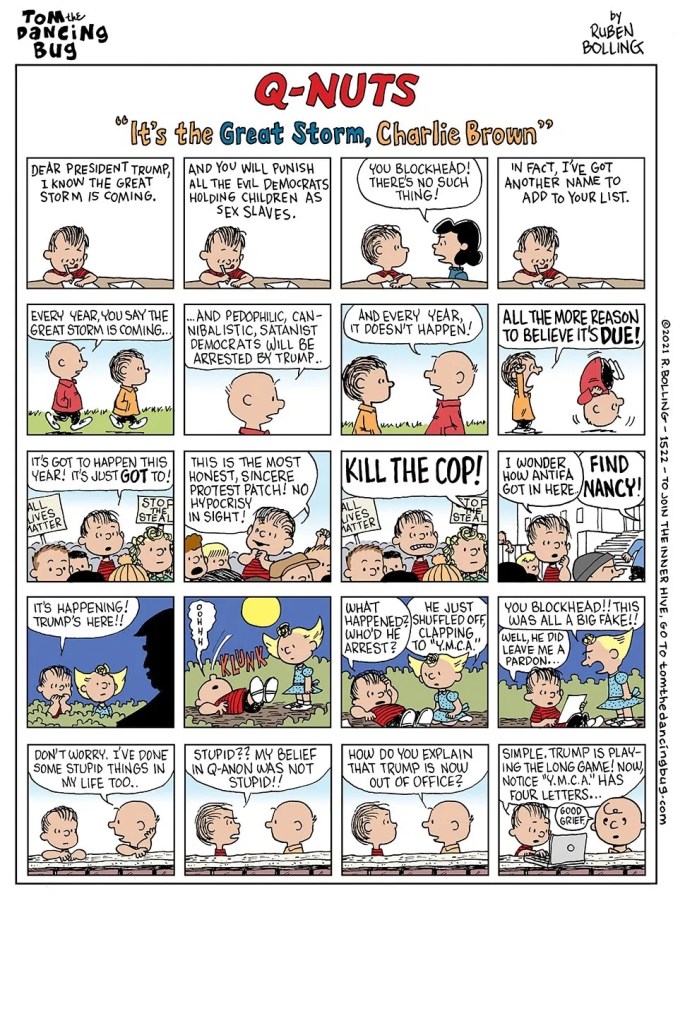
Of course, right now, we have QAnon being really topical. QAnon seems to be all about how Donald Trump is leading a secret fight against a Satanic cult of pedophiles and cannibals who really rule the world.
People actually believe this stuff.
But some do not, and I found someone who does not believe it on MeWe this morning. This person has been studying QAnon’s revelations in detail and has become disillusioned. He writes:
‘Q lies about vaccines not all being bad, lies that a plane hitting the pentagon 9/11, lies that aliens exist in fake outer space, and tells you to believe the globe while making a SPACE FORCE with ‘GUARDIANS’ for the fake alien invasion, and go research flat earth.’
I cannot make this stuff up! If for no other reason, that, as you would see from reading this blog, I am able to write in a clear and coherent manner, with few grammatical or other errors.
This writer goes on to warn us that:
. all vaccines are bad
. the Earth is flat with a firmament dome
. aliens are fake and made in cloning labs
. UFOs are from stolen Tesla tech (I assume he means the physicist and not the electric car company)
. they are about to fake the alien invasion
. a plane did not hit the pentagon – it was a cruise missile.
Evidence was provided to the MeWe poster by God when he popped the song Masquerade from Phantom of the Opera into his head. He concludes: ‘Q is not of God and will not save you from New World Order. Only Jesus can save you from New World Order. TURN TO HIM!‘
Hmmm….
So, what this chap is really letting us know is that compared to the 9/11 Truthers, the Anti-Vaxxers, and the Flat Earthers, QAnon actually seems relatively reasonable – although ONLY in comparison to those three former groups.
I guess the jury is still out on whether QAnon is acceptable to Obama Birthers, or to people who believe in the Roswell crash etc.
But I probably should not laugh about these bizarre matters at the moment. The same sort of people who are waiting for Elvis to reappear or for the second coming of Jesus are the same sort of people with a hard wired eschatological outlook who are going to believe the ideas of QAnon or that vaccinations are dangerous or that 5G causes COVID or that the US election was not fair and free (for the record, I believe it was a fair and free election).
In the USA right now, there are people praying for Trump to declare martial law the way that General Flynn has suggested he can do to remain in power, or waiting for the Insurrection Act to be invoked. I read idiotic posts where people are asking whether Trump remains President as well or simply remains Commander in Chief after he invokes such powers. Good grief!
I was hoping, when the internet became ubiquitous, that people would become smarter. Instead, the computing power in your phone (which is more than what sent man to the moon) is no longer being used to post cat videos or to have arguments with strangers, it is being used to foster a new crazy kind of stupid.
The first Sinclair Lewis novel I read, probably most aptly, was ‘Can’t Happen Here’. It is a dark and pessimistic story about a populist demagogue, probably based in part on Huey Long, who turns himself from US President to Fascist Dictator.
It was one of his later novels, written in the 1930s, where issues in his own life collided with the darkness of world events. Critics have contended that Sinclair Lewis probably was drunk whilst he wrote the second half of that novel.
Drunk or not, the themes in that novel are similar to what he raised in his earlier, greater, novels, Arrowsmith, Main Street, and (my personal favourite) Babbit. That is, that the American Dream can very easily be turned into a nightmare.
At age 27, when I read it, I was quite disturbed about it. My undergrad studies of US history and politics (enough points to add up to a full semester’s worth of full time study) were still recent enough that I was familiar with a lot of the underlying personalities and events which Lewis was basing his work on.
You wonder sometimes whether books like that are warning, prophecy, or merely the posturings of an embittered old man.
Another Sinclair, Upton Sinclair, writing a generation earlier in The Jungle, painted an even bleaker picture of America, as seen through the eyes of an Eastern European migrant, whose family and innocence are corrupted through the depravity of American capitalism and Tammany style machine politics.
Which is to say that it would be naive, when looking at what happened on 6 January in the Capitol Building in the USA, to think that there have not been issues in the Republic for a long time.
Corrupt politics, in the form of Tammany Hall and similar machines, has existed since at least post-civil war. Demagogues have used cheap populism to seek power since at least the 1890s.
And as for riots and civil disobedience? The 1960s included very much of that, let alone the past year’s BLM and Antifa protests – which could only be described as non-violent by either the naive or the dishonest.
What is unprecedented in the events of 6 January is that the holder of the highest office in that land, the US president, was actively inciting his mob of supporters to march on the Capitol. Mussolini did something like that in 1923, in order to seize power in Italy. The ancient Romans had a problem along those lines for the last century of their Republic, and that did not end well for their constitution.
It would be interesting to know what was going through the mind of President Trump? Was he hoping that his mob would intimidate the Congress into voting to throw out the results of a legitimate election, based on insane conspiracy theories circulating online as the primary evidence? Or was he regretting that he did not take the advice of General Flynn, his disgraced former advisor, who was openly advocating the declaration of martial law in order to conduct fresh and ‘free’ elections?
The insanity and sheer idiocy of this past week, and of many of the participants, is something best seen, if at all, in a tinpot third world dictatorship. Seeing it at the heart of the USA, historically the global champion of democracy and freedom since the last days of the First World War, is disturbing.
This is particularly the case because there are some countries out there which are large, powerful, and definitely anti-democratic. Russia is authoritarian and interested in expanding its hegemony. China is both communist and aggressive, showing more of the latter than it has in six hundred years. The USA is needed as a bulwark for the rest of the world against those potential hostile powers. The USA’s nuclear umbrella is what has kept us safe from invasion for a very long time.
Early last year, I wrote in this blog that I had chosen to adopt the NFL’s perpetual underachiever, the Cleveland Browns, as my NFL team. After all, as a lifetime supporter of the Footscray Football Club (aka Western Bulldogs), I find underdog teams quite endearing.
Well, perhaps my decision to adopt them has proven lucky, as the Browns are in the NFL playoffs (what Americans call the finals series) for the first time in many years. On Sunday, they play the Pittsburg Steelers in the first week of the playoffs.
I wish them well. Hopefully they can emulate my beloved AFL team’s miracle run in 2016 and win their way through to the Super Bowl. If they do that, I might consider buying a Browns hat or t-shirt or jersey and make my support more tangible.