When Does The Suburban Dream Become A Nightmare? Reflections On Home Ownership

IF it makes you happy, can it be that bad?

The cliche we know as the ‘Great Australian Dream’ is not new, nor original to Australia. Captain John Truslow Adams popularised a similar but not original idea in 1931 as the ‘American Dream’, which then became aggrandised.

And even before such ideas of mundane, suburban, petit bourgeois prosperity and moderate affluence became clearly defined, we had critics of those concepts.

Perhaps the first such critic was the Roman satirist Juvenal, who sneered at the bread and circuses which kept the Roman populace contented in the time of empire.

My favourite philosopher, the quite insane Friedrich Nietzsche, definitely despised the suburban bourgeois life of mediocrity which contented his neighbours in late 19th century Germany.

American writers, like Sinclair Lewis in novels like Main Street and Babbit, and then, a generation or so later, John Updike in his Rabbit series, did write about the stifling nature of the middle class American life in a way which presented the American Dream as a nightmare.

I do get these people. I occasionally, in my more deluded and megalomaniacal moments, do think that I am destined for greater things than my blog and veggie patch and brick veneer pile in Avondale Heights.

But then I wake up to myself and realise that stifling though the lack of creative expression might be in this existence, I still have far more in material security, educational opportunity, and a peaceful environment than my peasant forebears did, and for that I am truly grateful.

Perhaps it is that few writers in Australia get a widespread platform to sneer at the mundane and materially secure lives of their neighbours. No one reads Jane Caro, nor Clementine Ford (so I rely on reports of their lawsuits and twitter tantrums to know what ideas might pass through their heads), and when I did read something by an actually talented Australian writer, David Malouf’s novel Johnno as a teenager, the self hatred and general loathing of the protagonist was something, to be honest, I found utterly repulsive.

And so it goes that I still believe in some sort of myth such as a banal but materially secure suburban existence, and wish for such both for myself and for all of my fellow Australians (yes, even for smug writers like our friend Clementine). Our local culture does not enable our literary glitterati to impose such self-doubts upon our society.

Let’s face it: what is wrong with having a reasonably secure and well paying job and a modest house with a garden (and a few gumtrees in the front yard, and at least a lemon tree and perhaps a few other fruit trees, in the back)?

It won’t make you a literary giant like Patrick White or David Williamson, but it is better than what Henry Lawson had (plus, if you had Henry’s predilections, you would appreciate a garage and a few vines over the driveway so that you could make your own plonk!).

Which is probably why home ownership keeps getting raised by both parties at election time, and both keep coming up with sad policies which do cause the prices of houses to keep getting inflated.

It is election time this month, and let’s pause and look back at what house prices are right now. Median house prices in Melbourne are about 10 times the average wage. When I bought my brick veneer pile almost 20 years ago, they were 5 times the average wage. In 1980, when a Space Invaders arcade machine was installed at my still extant local milkbar and I was in my last year of primary school, house prices were 3 times the average wage.

The media is full of the speculation about how the high (for 22 years) inflation rate of 5.1% and the first interest rate increase for 11 years (0.25%) are going to impact on current mortgage holders.

Politicians keep coming up, like Albo this week (and ScoMo during the Plague), with ways of making housing affordable by pumping more taxpayer money directly into the pockets of potential homebuyers.

What everyone is missing is economic reality.

Taking government interventions first, first home buyer subsidies just cost the taxpayer and the home buyer by increasing the amount which each home buyer has available to spend on a house, which enables them to borrow more and to bid more on each house, which will force house prices up even further out of reach.

Taking interest rates next. In the late 1970s and early 1980s, or the early 1990s for that matter, double digit interest rates kept house prices affordable for most people, whilst wage inflation kept pace with consumer inflation, making it easier for people to pay their houses off in a a reasonable period.

Trick Question: What would you rather have: a $700,000 mortgage at 1.8%, or a $70,000 mortgage at 19%? It depends of course on what wages are, and wages right now have not kept up with the increase in value of house prices over the past 30 years.

The political debate needs to shift to a more honest level. Do we need to increase the demand for housing through increasing migration? Do we need to subsidise house purchases by providing subsidies to potential home owners which then cause further house price inflation? Do we need to pursue monetary policies which inflate assets generally by keeping the cost of borrowing money artificially low?

And possibly most controversially… do we need to reward people for acquiring real estate, particularly, investment properties, with tax benefits, or should we be broadening the idea of land taxes to a lower threshold – perhaps even to owner-occupiers? This is something which would reduce the tax minimisation value of real estate as an asset class for investors and which might start to deflate its value.

Until such a discussion, raising interest rates is a crude but effective mechanism for reducing real estate prices, and which might make housing more affordable to owner occupiers rather than investors.
Broo’s Ballarat Land Sale Sunk By Red Tape

Not too many Australian beer companies are owned by Australians. Broo, the publicly listed micro-brewery, is the exception that empathically proves the rule. You can’t own shares in Fosters (aka Carlton & United) or Lion Nathan (aka Tooheys) anymore unless you buy shares in Asahi or Kirin on the Tokyo stock exchange, and where is the joy in that?!?

Late last week, Broo announced to the ASX that the sale of its Ballarat land (which could have brought in a profit of some double the initial price paid for that site) has fallen through. It did not come as a surprise to me – the required approvals to sell that land for development to another party have been held up for many months, and obviously do not look like being forthcoming.

Here is some more informed beer related journalism on this topic:

As I am a long standing shareholder of this company, with my colourful share certificate from the 2011 Australia Day promotion (buy a slab and get 10 shares!) newly framed and occupying pride of place in my water closet, I do pay more than passing attention to the activities of this company.

After the commencement of the recent board room ‘putsch’ (an apt but still unfortunate term to describe such machinations in a beer company), I started reading http://www.brewsnews.com.au which is a website dedicated to the Australian beer industry. It has various interesting and quite fascinating articles on the subject of how Broo has attempted various ambitious undertakings, which have all seemed to remain unfulfilled. The attempt to develop a high tech brewery in Ballarat is the most high profile of those.

Where now for Broo? 6 years ago, when they were about to IPO, I felt fair value for the shares was 2 cents each, rather than the 20 cents of the float price. Now, with the tangible real estate assets only worth about $3.5 million, and a potential fire sale in front of them, I think that the 0.8 cents the shares are currently trading at is a somewhat optimistic valuation.

Allegro Non Troppo Part 3: Posh People With Very Deep Pockets

What was it that the shade of Achilles said when Odysseus met him in Hell (or Hades if you prefer) on the latter’s long journey home to Ithaca? It was something along the lines of much preferring to be a day labourer in the world than a prince in Hell.

Well, I am an office worker rather than a day labourer, and perhaps as a middle manager of such people, in a bit of a better situation than what Achilles aspired to resume. But I am 53, slightly older than the recently demised Shane Warne and Senator Kitching, and about the same age as Robert Holmes A Court, descendent of hereditary barons, and mostly self made robber baron, was when he suddenly died in 1991.

Much as I do not have a dog in the fight for the current federal election, the idea of various supposedly independent candidates being funded by some very rich posh person with deep pockets does intrigue me.

The ability for people with any significant wealth, particularly unearned and inherited, to potentially shift election results, is of concern to myself and other responsible citizens.

Simon Holmes A Court, one of the younger children of 1980s corporate raider Robert Holmes A Court, and descendent of the 2nd Baron Heytesbury (after whom his father named his main investment vehicle) is a person whom we do need to examine a little closely.

His patronage of the Climate 200 group, which is funding supposed independents to compete with Liberal Party moderates in safe Liberal seats, is a matter of concern.

We do not examine the motives of our own oligarchs and timocrats anywhere near as well as we do those of tyrants we criticise. Yet Simon HaC is a timocrat with great privilege in the form of his deep pockets of inherited and unearned wealth, which he is now using to try and turn the outcomes of elections in key seats.

He is worse than the Oligarch Clive Palmer, who is, like me, born in Footscray and who has (unlike me) earned his own fortune rather than inherited his wealth which he now wants to use to influence the outcome of our democracy.

Some 30 years ago, when the late Brian Buckley wrote the authorised biography of his friend and former employer Sir Phillip Lynch (a book sadly titled ‘Lynched’ which reflected poorly on both the author and the subject, alas, although I was too naive to quite understand why until years later), some of the ending paragraphs were devoted to Lynch’s interactions with the hubris driven Robert Holmes A Court.

At page 224 of that book, it does talk about the family’s history of supporting socialist causes and a Soviet-front peace group. Lynch (he is from what I have heard of him, sufficiently an arrogant a-hole that he does not deserve the deference I usually would show to a Knight of the Realm – ie I would call him Sir Phillip) apparently observed that he felt that Robert Holmes A Court did not feel ‘comfortable with our side of politics’.

The family continued at the time of that book’s publication in the early 1990s to financially support independent anti-defence senator Jo Valentine, leading that author to suggest that the Holmes A Court family and their holding company had a contempt for ‘democratic capitalism’.

That is what we plebs all love to see, poor little rich boys (and girls) like Simon and Allegra who have lots of money and privilege and power, who want to manipulate our democracy in favour of their own little agendas, whilst they at the same time maintain and protect their own wealth and power.

Allegro Non Troppo Part Two: The Hegemony Of The Posh People

A friend of mine read my posting about the rise of independents like Allegra Spender, and immediately sent me a detailed text with her thoughts. She is obviously not as generous as I am about posh patricians like Allegra Spender.

I must say that her words have resonance with me, given that the involvement of my mother and other female relatives of the migrant generation in the fashion industry was restricted to working in textile workshops, rather than the glamorous life of Allegra’s mother Carla Zampatti.

Here are my friend’s words in italics:

Allegra Spender is not an independent, she is a largely out of touch elitist:  a new class of candidate. 

She is staunchly running on gender equality from a place of privilege, and like other ‘voices of’ candidates, Allegra has little understanding of gender equality and it’s locations, manifestations and dynamics.  I note she has no acknowledgement of intersectionality in her discourse on gender inequality.  Allegra does, however, represent an arrogant and paternalistic reformulation of privileged women seeking to fight for the rights and equality of less privileged women.  Advocating for greater voice and empowerment of those women, while ensuring at all relevant times, that their privileged voice is the loudest and they get all the accolades.  The absence of those gender oppressed women in their campaigns actually disempowers the women whose status they are grifting to advance their own political standing.  Irony, no?

What people like Allegra reflect is that the Liberal Party has lost some of its broadness because privilege and money can buy a person (not just a party) a seat.  This is something we should all be concerned about.

I have to wonder whether Allegra Spender and Zoe Daniel will be campaigning and pushing for electoral reform to make it much easier for poorer and less privileged women AND men to run for a seat in Parliament.  Now THAT would be genuinely pursuing equality and democracy.

Not all men are equal and privileged and not all women are underprivileged, discriminated against and face inequality.

As for being a champion of climate change based on her concern for the environment, the narrow range of policies she has put forward do not reveal a depth of appreciation of the issues and considerations.  I wonder, whether as Managing Director of her mother’s fashion business, they stopped producing dry clean only clothes, or whether they sought to improve the longevity and wear of the clothes they produced, or whether they sought to use recycled fabric or to have product stewardship built into their business model?  Perhaps Allegra was waiting for a government subsidy to push them into the sustainability direction.

Allegro Non Troppo: What Happens When The Posh People Turn Against Their Party

I heard John Spender QC speak once. It was July 1989 and the topic was the Tiananmen Square Massacre which had happened weeks earlier. I am not sure whether he was shadow foreign affairs minister at the time, but that was a portfolio which he had held recently.

He impressed me as well-informed, intelligent, articulate, and perhaps, most importantly, highly likeable.

Eight months later, his political career hit a brick wall when he lost his safe Liberal seat to Ted Mack, a popular independent.

A generation later, his daughter, the joyfully named Allegra Spender (Allegra is the Italian word for Cheerful), is standing against a federal Liberal MP in a safe Liberal seat as an Independent.

There are several ironies, nuances, and takeaways from this.

The irony is obvious: the daughter of a 1980s Liberal MP and front bencher (and granddaughter of a Menzies era cabinet minister) has decided to stand as an independent against the party which her father and grandfather represented for many years, particularly given that another independent prematurely ended her father’s political career.

But there is a nuance. Grandfather Sir Percy Spender KC did not enter parliament on the endorsement of the Liberal Party’s predecessor, the UAP (no resemblance to Clive’s current vehicle). He defeated a sitting UAP member as an independent and then was accepted into the UAP (and then Liberal) fold, whilst continuing to assert his affinity for independent action.

So Allegra’s current action in standing as an independent does not really go against the grain in terms of the family history, even though father John came off worse for wear against an independent 32 years ago.

And there is also a takeaway. Amongst us, there are those who are more privileged, powerful and propertied, the posh people who usually vote Liberal and who trust their Liberal party representatives to best serve their interests.

The Spenders have, ever since the future Sir Percy obtained his law degree a hundred years ago, been counted amongst the posh people.

What we are now seeing is that many of the posh people of privilege are now turning against the Liberal Party, an organisation which they have long seen as the vehicle protecting their interests. They cannot bring themselves to support the social democratic (and occasionally democratic socialist) machine which is the Labor Party, as to do so would be tantamount to a peacock demanding that Colonel Sanders extends his menu to include game birds rather than mere poultry.

But they are finding the Liberal Party repulsive to their own sensibilities and interests. There is nothing genteel, subtle, or opera going, about the brutally ruthless and blunt steam roller which is the political machine the Liberal Party has now become. Such directness and tactlessness is vulgar to the posh people.

When the posh people turn against their own party, as is happening at the moment, the result is an existentialist crisis (and not of the Nietzschean variety). The Liberal Party needs the votes and the chequebooks, and perhaps even the physical support, of the posh people in their nominally safe upper middle class seats.

Where that is lacking, there is no amount of support from cashed up bogans in marginal seats which will make up for the loss of the lost soul of the Liberal Party in its heartland.

Bring popcorn, my friends, and beer. Especially beer. The next few weeks will be interesting.

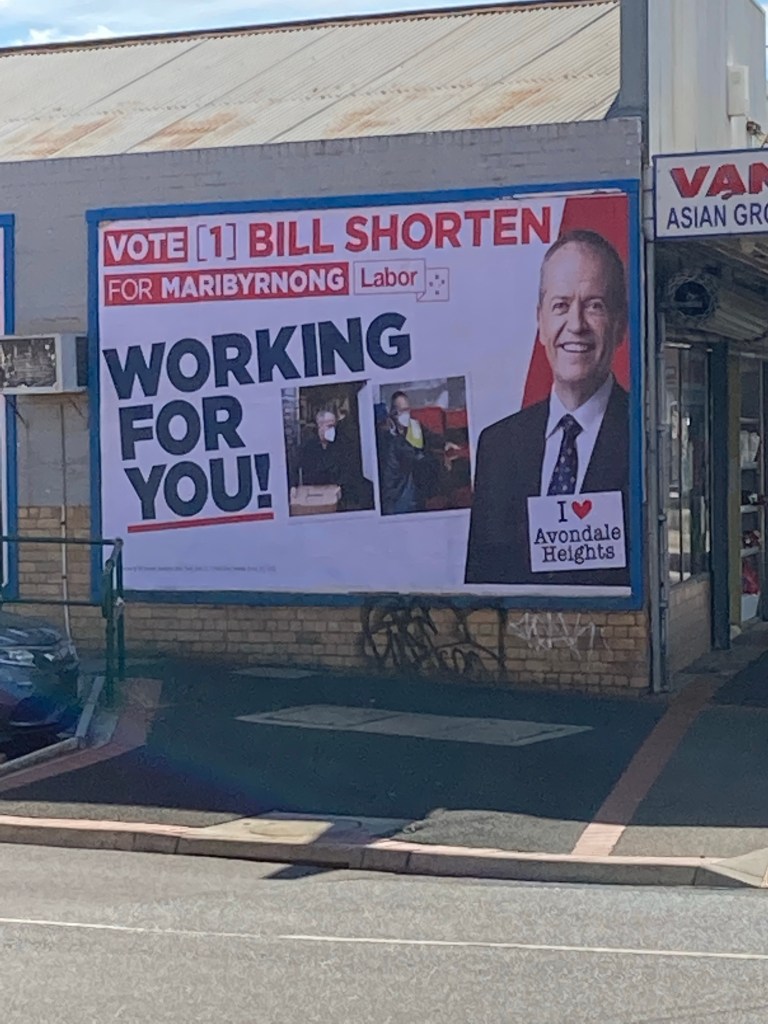
A Good Reason To Leave Avondale Heights?!?

He actually lives in Travancore – which is about 7km down the road!

Saw the above campaign poster on a wall just off Military Road last night.

Much as some might find it reassuring to think that our rather inauthentic local federal MP loves Avondale Heights (read the small print in the bottom right hand corner), one of my friends suggested that this is a good reason for me to sell up and move.

Happily, I have not seen him dining out in any of our few local restaurants, although if he (or any other candidate) comes knocking on my door, he is welcome to share a bottle of garage wine with me, much as I tend to disagree with his politics.

McDonalds now has competition on Good Friday

I usually only actively practice my Catholicism once a year or so – I sometimes attend the Italian service of the Stations of the Cross at the local Catholic Church in the evening of Good Friday.

Last night, I chose not to do so, as it was dark and gloomy at 7.30pm. But I did go for a walk earlier on before sunset.

What I found was that there were a lot of local restaurants and takeaways open: the seafood restaurant on the corner, the Thai restaurant near the church, the fish & chip shop, the pizza shop, and the gourmet burger joint.

And of course, the McDonalds near the supermarket.

Back when I first moved into Avondale Heights 19 years ago, when wandering off to the Catholic Church on Good Friday to attend that Italian service in the evening, there would only be the McDonalds open.

I think that what has happened in the past few years has not been a growing secularisation of society, but that the Covid induced lockdowns which shut down small business and civil society for two years have taken an indirect toll. That is, small business people do not take the right to open their doors for granted at the moment, and so they treat Good Friday not as a solemn public holiday to close up and stay home, but as another business day where they have an opportunity to try and earn some money and keep their businesses afloat.

Shen Yun Dance Company is touring Australia

I am not really into attending the ballet or opera or such high culture – my main interest in the performing arts is watching Shakespeare and other great plays live.

However, when out for a walk yesterday, I noticed a huge banner in the front window of the local pizza joint promoting a tour which is about to play at the Palais Theatre: China Before Communism, by the Shen Yun Dance Company.

This below link tells you more about how members of the Chinese diaspora are trying to keep alive and to promote aspects of their culture which have been suppressed by the communist regime which currently infests China:

On The Blandwagon – The 2022 Election Campaign So Far….

When covering the 1988 US Democratic Convention, the recently late P.J. O’Rourke aptly titled his article ‘On The Blandwagon’. Less aptly perhaps, he included this essay in his next book, ‘Holidays in Hell’. He probably should have waited a few years and then included it in the much more suitably titled ‘Holidays in Heck’.

Coverage of the 2022 Federal Election Campaign, up to Day 4 now, is similarly bland. The main colour to the campaign so far was Albo making a faux pas when he did not know the current unemployment and official interest rates. That more than makes up for ScoMo not knowing what a loaf of bread might cost when he was asked a couple of months back.

To be honest, there is very little difference between the parties in their policies, according to the main coverage which I have been reading. Both of them are trying to buy our love… or at least our votes.

Someone wrote a piece somewhere recently with a photo of the Opposition leadership group (ie Albo, Marles, Penny and Kristina) standing together and saying something to the extent that would you really want those people running the country? That is a bit ad hominem perhaps, but a photo of the Liberal leadership group could probably raise even greater expressions of horror (ScoMo, Josh, and Senators Birmingham & Cash).

If you were to include the leadership of the coalition partners (ie Barnaby and his entourage), your hair might stand on end.

But most of the actual participants are playing nice, and not making such direct attacks on each other’s likability (or lack thereof).

The Coalition’s main current theme seems to be a familiar mantra that Labor cannot be trusted to properly and responsibly manage the economy. This has frequently worked well in the past, although I think that Hawke-Keating did more for economic rationalism (something I mostly still believe in) than any of the Liberal-led governments which had come before.

Now that there is, as Clive and his new sidekick Craig keep reminding us, a trillion dollars of government debt on ScoMo’s watch, I am not sure that this sort of argument holds as much water. If we are going to denounce governments (and potential governments) for printing money and then spending it wantonly, I think that there is little difference between Kevin Rudd at the time of the GFC and Scott Morrison during the Pandemic, except that ScoMo has clearly spent far far more.

The second theme that the Coalition is running with is that you cannot trust Labor as there will be a Labor-Greens-Independents alliance which will end up running the country. I am very skeptical about this for two reasons.

One is that when Albo was manager of government business during the Gillard government, where there was a hung parliament, they were able to get a lot of legislation through the House of Reps despite the lack of a majority, and with limited compromise. Gillard was able to outmanoeuvre naive independents like Andrew Wilkie with pledges which did not end up benefiting them or their agendas the way that they had hoped.

The other is that historically, changes of government do not occur with slim majorities or hung parliaments. There have been 7 elections which have resulted in a change of government since the Second World War: 1949, 1972, 1975, 1983, 1993, 2007, and 2013. In only one of those elections, 1972, was the result anything less than a very clear and decisive victory – usually a landslide. If the election goes Labor’s way this time, I think that history shows us that it is more likely that it will have a very clear mandate to govern.

But it really does appear that this election is not currently being contested on policies, much as the Coalition wants to paint the Opposition as unable to manage the economy or control sympathetic fellow travellers. It is being contested on likability – ScoMo versus Albo.

People have now had three years to get to know ScoMo much better than they did when he pulled off his electoral miracle in 2019. Many do not like what they see. Whilst the government has been much more controlled and competent than it was under Abbott or Turnbull, it has developed a facade of almost Tammany-like machine politics, with spoils, purges and patronage, which responsible citizens will find disturbing. Nor do the denunciations from many senior people on the same side, such as Gladys and Barnaby, present ScoMo as particularly trustworthy or likeable.

Albo, from what we see of him, seems to be the last of the True Believers (FYI, ‘True Believers’ is a Labor myth created by the odious Bob Ellis in the late 1980s). It may be that he is merely more effective than others at hiding his ruthlessness from the public eye, or that his internal victims within the ALP have much more to gain from his success than from his failure so that they stay silent. (Note that this is in vast contrast to ScoMo – whose victims and opponents within the Liberal Party are all coming forward right now to try and tear him down and settle their scores immediately.). I like to think that Albo is both an authentic champion for the Aussie Battler and a truly loveable character. But I am not naive enough to unquestioningly believe it.

Vox Populi Vox Dei – Reflections On The Upcoming Federal Election

Most days, I enjoy reading the Pearls Before Swine comic strip, which alternates between childlike innocence (in the character of Pig), and dark cynicism (in the form of Rat). One story arc from 2016 saw Rat, the anti-hero of this comic, run for US President, mostly on the platform of being more likeable than either of the alternatives. He won.

This does speak to me about the level of disenchantment and cynicism many of us in our anglo-phonic liberal democracies feel about the current state of the political alternatives we are offered.

The Australian Federal Election has now officially been called for Saturday 21 May. This will be the 13th time in my adult life that I have voted in a federal election, and I suppose, like many of my fellow voters, I do not feel particularly excited about either of the alternatives, even though, if I must admit it, Albo is the most authentic Labor leader since at least Bill Hayden, and probably since Chifley.

I read somewhere a few years ago that in the mid 1950s, when Australia had a population of some 10 million, about 500,000 citizens were members of a political party. That represents a very large proportion of the adult population being actively engaged in the democratic process – something which is needed to safeguard the strength of our democracy.

Now, in a population of some 26 million, it is probably less than half that. Officially published figures put Liberal and Labor each on approximately 50,000 members, with the Greens on 10,000 members. It is difficult to measure how many people actually belong to the National Party, because they like to count unfinancial members (once you sign up, you are a National Party member until the grave, and possibly even beyond then…).

And the UAP claim to have over 80,000 members. As I do not have any idea about how one joins the UAP, I suspect that, like Tory-Cory’s ill fated conservative movement, you probably get counted once you sign up to a mailing list, rather than paying up a membership fee and getting accepted by a vote at a party meeting.

All that suggests that active political and civic engagement right now is probably less than 1% of the total population, rather than the 5% it was in the 1950s.

Similarly, the primary vote of the major parties has been declining consistently in the past 35 years. In 1987, when I first voted as an 18 year old, the primary vote for both the Coalition (in its then 3 separate components) and Labor was 45.90%. When I last voted in 2019, the Coalition (with now 4 separate components) had a primary vote of 41.44, and Labor had 33.34.

Preferential voting does cause protest and third party votes to flow back to the major parties, but there is no denying that not only have the major parties been losing active members, they have also been steadily losing the support of a larger part of the public.

There are several reasons for this.

One is that people frequently wish that there was an alternative to the major parties, but in the past did not see an alternative as electorally viable, so they did not bother. Now, in the past 15 years, we have seen the Greens taking lower house seats off Labor, and independents taking seats off the Coalition. Given that the electoral viability of an alternative candidate is much greater than was the case traditionally, there is a snow ball effect, feeding the viability of alternatives to the major parties.

Another reason is money. Since the early 1990s, public funding has been assigned to candidates based on what proportion of the primary vote they win (with some minimum limits). This was done so as to try and prevent political parties from becoming too beholden on large influential donors (not that this seems to have stopped Communist China from buying influence through various sympathetic billionaires), and also because political parties are rather lazy about needing to fund raise – public funding makes it so much easier. An unintended consequence is that a strong independent or third party candidate can end up with a war chest for a future campaign.

On top of the public funding, we now have crowd funding. If you feel strongly about an issue or an independent candidate, then you can donate to their crowd funding campaign.

A third reason is that the major parties are alienating their supporters. Showing up at 6am on Election Day to decorate a polling booth and then stand there coping abuse from the odd moron who does not appreciate your civic contribution til 6pm, and then scrutineering til 8 or 9pm is a thankless task, and the parties are not exactly great at thanking their supporters for doing it. Party members have very limited say in selecting their candidates, with interventions by state or federal executives increasingly frequent.

Take for example two recent examples. Branch stacking by machine politicians in the Victorian ALP has resulted in the disenfranchisement of the entire state party, which is now ruled by a committee appointed by the federal executive. ALP members in Victoria have no say in anything to do with the election except whether or not they should make the individual effort to actually campaign.

On the other side of politics, the NSW Division of the Liberal Party was unable, due to deliberate bad faith behaviour by the Prime Minister and his nominee to a key committee, to endorse its candidates through the usual process (ie a ballot which involves local party members in each seat). This recently resulted in a very cynical intervention which enabled candidates to effectively get appointed by the Prime Minister. Matthew Camenzuli, a member of the NSW Liberal Executive, unsuccessfully challenged this bad faith behaviour and was summarily expelled from the party last week.

Both examples show how the major parties are holding their grassroots members in contempt, and seeing them as solely campaign fodder for election day and its lead up, rather than as partners deserving of a say in the way their political parties are run and who represents them.

The consequences downstream will be that people will not volunteer their time and their money to support the parties with whom they normally feel an affinity.

Whilst the major parties are increasingly alienated from (and alienating) their grassroots supporters, they are still both very willing to look after their semi-retired apparatchiks with plum appointments at tax payer expense. Six days before the election was called, the Attorney General announced a giant life raft of appointments to the Administrative Appeals Tribunal. The count of apparatchiks appointed to those positions is higher than the 6 or 8 reported in the mainstream media – at least 13 Liberals and 1 National were appointed. Whilst such appointments have long been regarded as spoils by both parties, who have long rewarded (or pensioned) senior supporters accordingly, this does not make such conduct at all laudable, especially where it flies in the face of the spirit, if not the letter, of caretaker conventions.

Whilst Albo has claimed underdog status and said that Labor has, post war, only won government from opposition three times (Whitlam, Hawke, Rudd), we should remember that the Coalition has similarly only won government from opposition three times (Menzies, Howard, Abbott), given that Fraser was, post dismissal, caretaker PM when the election occurred in December 1975. Also, in that time, there have only been three governments which have won more than three terms (Menzies-Holt-McEwan-Gorton-McMahon, Hawke-Keating, and Howard), and three governments which lasted two or three terms (Whitlam, Fraser, Rudd-Gillard-Rudd).

So what is the takeaway for 21st May? I think that the electorate will probably see a major swing to the opposition, and that the Coalition will lose a significant number of seats, including potentially several to independents. The Greens probably will not gain more seats, as there is an “It’s Time” vibe to the campaign. I see parallels in this election to the 1996 and 2007 elections – where a change of government followed a previous upset defeat of the Opposition in an unlosable election.

You have to ask yourself whether an Albanese led Labor government would be necessarily a bad thing? A healthy democracy requires strong competition, and governments do get stale, arrogant and out of touch when they are in power for too long. I just hope that Albo is too busy doing necessary things to safeguard our national security and economy to go off and do silly (but still highly destructive) things like trying to implement a republic or increasing taxes on middle Australia.