Broo, Craft Breweries and Beer Generally

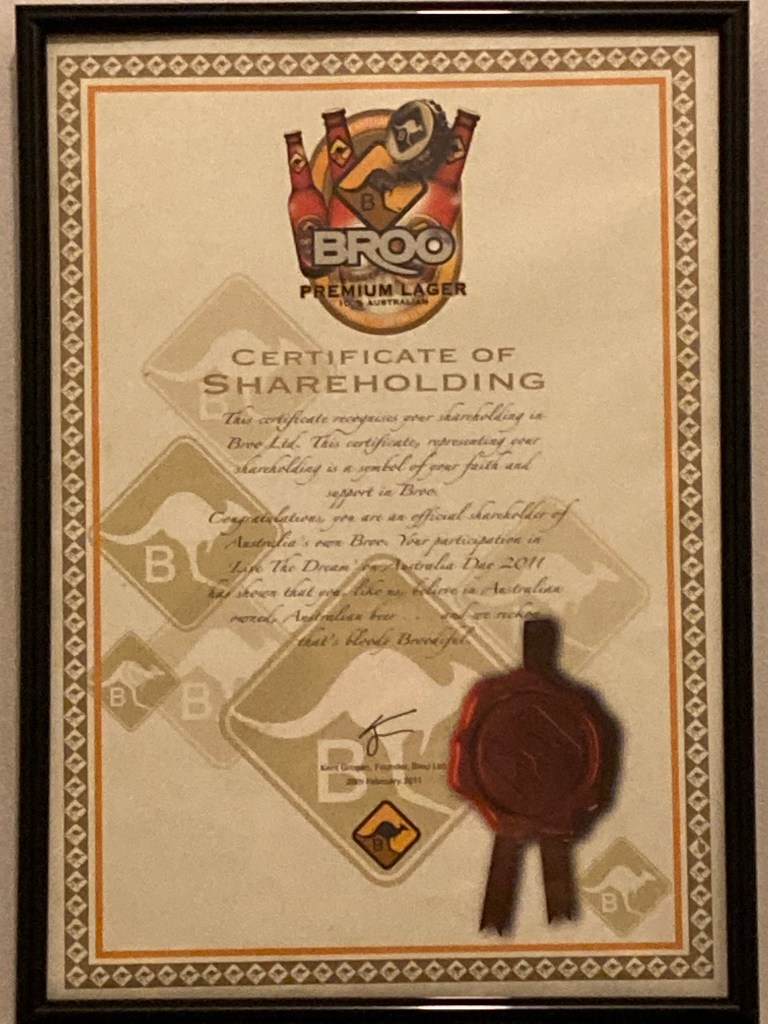
Guess which room in my home this hangs in

About a decade ago, my best friend invited me along to one of his family functions, at which event his rather bogan brother-in-law totally surprised me.

It turns out that this bloke is quite the connoisseur when it comes to craft beer, and was in the habit of visiting many micro breweries around suburban Melbourne and regional Victoria (wife in tow as designated driver of course) to sample their wares.

This did quite take me aback, as this is the sort of fellow who, earlier in life and in previous generations, would have stayed completely loyal to one particular brand of beer – most likely a Carlton United Breweries product like Carlton Draught, Victoria Bitter, or Fosters Lager (oh for the days when that was widely sold in Melbourne).

As it was just after I had received my first twenty shares in Broo as a direct consequence of buying two slabs as part of a special promotion, I was rather interested in his opinion of Broo.

He was not enthusiastic. I do not remember exactly what he said, but he had tried it once, and he was not going to ever try it again.

This was useful market research on my part, as a sort-of investor in Broo, and might have partly informed my decision not to participate in the Broo IPO in 2016, when the punters could buy shares in the soon to get listed beer company for 20 cents each.

I have been paying closer attention to Broo in recent weeks, as readers of this blog might aver, given that there have been changes at the helm of the company.

The most recent changes, after an amicable (?) deal was reached to see the company founder and his close allies leave the board quietly, have been to abandon the long delayed deal to sell the Ballarat brewery site, and a suspension of trading on the ASX pending an announcement on a company restructure.

Monday will be three weeks since the initial trading halt, which was followed by a more formal suspension pending the restructure announcement, which was meant to be forthcoming by Friday 13th May.

No announcements have been made, and the shares remain suspended from trading.

I have speculated previously as to what the real value of Broo is, and what the directors could do with the assets of the company. Sad to say, I have little faith in the company’s short term viability, let alone its prospects for long term success.

My predictions are that they will terminate the bulk production of beer via their contract with CUB, and take steps to wind down the company, perhaps keeping beer production going at the Mildura Brewpub, pending the sale of that asset.

The main assets – the Mildura Brewpub and the land in Ballarat – are only worth about $3-4 million, and I am not sure that the Broo brand and recipes have any inherent value.

I hope I am wrong, as I feel a little sentimental about Broo.

I will be travelling to Mildura on Thursday, so I am really curious to see what this much vaunted Mildura Brewpub is like (if in fact it is still up and running), and to drink some Broo beer for the first time in over 10 years.

Bye Bye Bernie: But Matthew Guy is not off the hook….

The Hon Bernie Finn MLC, my longstanding upper house state Liberal MP, got expelled this week from the state parliamentary Liberal Party.

Ostensibly, his recent social media utterances about potential US Supreme Court developments on the issue of reversing long standing case law (Roe Vs Wade) on abortion were the last straw for the state parliamentary Liberal Party, and they decided to expel him rather than continue to put up with his peculiarities leading up to the state election in 6 months time.

Abortion is a very serious issue, and I will not trivialise it by discussing it here. Most people who take either a pro-life or a pro-choice position are cautious and moderate about it, and it is only the extremists on either side who are going to foam at the mouth about it.

I do not believe that Bernie Finn was expelled this week because he was foaming (or drooling) at the mouth about this particular issue, although I am quite certain that he probably was.

I have, in recent years, read about many of his peculiarities, and how he has been tolerated for them, over an over-extended career as a rather underwhelming parliamentarian.

Suddenly, late in his fourth term as an upper house MP, his colleagues have finally had enough of him and decided that he is no longer fit to be in their company.

Why now?

There is a particular matter which occurred at Easter 2018, which cast doubt on both his probity and honour, and that of the then leadership of the State Opposition. There was a tight vote on a particular bill, and the Legislative Council was (from memory) going to sit and debate and vote on that bill on Good Friday.

Bernie Finn, claiming to be a good Catholic, sought a pairing with a government MP so that he could excuse himself from attending (this is a Gentleman’s agreement common to the Westminster system where people from either side are able to not attend parliament and not disadvantage their side by having the other side agree to recuse one of their own members from attending and voting).

However, Bernie Finn hid out in his office, and then, when the divisions were called, sneakily returned to the Legislative Council and voted, regardless of his pairing arrangement. Reneging on his pairing agreement in this way is at best dishonest, and at worst, highly dishonourable, and an undermining of the democratic conventions of the Westminster system.

But it is not just Bernie Finn’s honour which was besmirched by his actions. At that time, Matthew Guy was Opposition Leader. Guy did nothing to sanction Finn for this conduct at that time – conduct that was far worse then than Finn’s current pathetic and dogmatic tweets in support of anti-abortion laws (tweets which I do think show a lack of empathy towards the unfortunate people who actually find themselves in the position of having to decide whether to seek abortion – not a problem Finn himself will ever be in).

Why did Matthew Guy not denounce Bernie Finn then, at Easter 2018, for his dishonourable conduct? That he did not, and that he accepted Finn’s vote in the Legislative Council then, casts significant doubt right now on Matthew Guy’s actions in expelling Bernie Finn this week.

Accepting dishonourable conduct at that time makes Matthew Guy, by association, dishonourable. Expelling Bernie Finn now, instead of four years ago when he proved himself a disgrace to the good name of Victorian Liberals, renders Matthew Guy a hypocrite, a cad, and a blackguard.

Wither The Liberal Party?

Please show some dignity
At least it’s not Shorten

I love the nuance of the English language, the only language I really feel comfortable writing in. I can speak Italian well enough, and I can struggle along to mostly comprehend (and occasionally actually enjoy) some limited Latin (written of course), but English is the only language in which I feel confident to fully express myself in the written word.

Take the wondrously ambivalent word ‘wither’, as in the heading to this blog. Do I mean it as an adverb to an implied verb, as in ‘Wither goes the Liberal Party?’ (and there I was, taught in grade 4 that adverbs almost always end with ‘ly’), or do I mean it as the verb in the sentence ‘Wither the Liberal Party?’ as some sort of quaint Elizabethan era way of saying ‘Will the Liberal Party wither?’. Wither, in the latter case, would be a rather malevolent question to ask today, after yesterday’s Federal Election defeat.

To be honest, I did not come up with this train of linguistic thought this morning, nor indeed recently. I borrowed the blog heading from the title of an article (which I did not bother reading) written over 30 years ago by some pretentious and self-important git whom I rather disliked. I read the heading then and wondered to myself back then as to which of the two meanings he intended, and then archived my thoughts until this morning.

English language lesson aside, let us turn to sober reflection (I did only have one bottle of red whilst streaming the election coverage on my iMac) on what some aspects of the election results mean for our democracy. The health of our democracy is something that I care deeply about, and I do not really give two hoots about the health of the Liberal Party, except in that it is one of the two main parties whose ongoing competition keeps our democracy healthy.

I do not really know what Sydney is like, as I rarely visit it and do not enjoy such trips. The claustrophobic nature of the city unsettles me. But I do know Melbourne extremely well, and I will focus my observations here.

The Liberals lost many seats last night, including many supposedly rusted on safe seats to what are commonly known as ‘Teal’ independents (ie rich privileged Anglo women with powerful connections). Let’s face it, the Coalition deserved to lose this election for many reasons, and I predicted their defeat at the start of the campaign:

However, the implications for the Liberals in Victoria out of the loss of three key seats has serious implications for the viability of the Liberal Party in Victoria. Those three seats are Kooyong, Higgins, and Goldstein. These seats are usually held by senior or potentially senior Liberals, and rarely by mediocrities.

There is a lot of talk about the loss of those seats meaning a generation of senior Liberals have been wiped out. Personally, I do not think Tim Wilson is any great loss:

https://realfreedomnews.com/vale-tim-wilson/

However, the loss of those premium blue ribbon seats does have serious implications, as Julie Bishop alluded to during Channel 9’s coverage of the election last night. She said that many of the volunteers and much of the fund raising is done in those seats.

I am an enthusiastic outsider rather than an insider, but what little inside information I have tells me that the situation is far more serious than that. The lion’s share of actual grassroots Liberal Party members who make up the rank and file membership of the party in Victoria live in Kooyong, Higgins and Goldstein.

Sure, there are other seats held by the Liberals, and they do have members in those. But in Kooyong etc, the membership lists number in the thousands, not in the hundreds or (much more likely) dozens in those other outer Eastern and North Eastern suburban seats.

The members in Kooyong etc are of a higher socio-economic status than members elsewhere – they are both posh in background and rich. This means that they can write large cheques as their contributions towards maintaining their half of a health democracy.

It is very early to tell what the implications are, long term. However, without the anchor of a local Federal MP to rally around, morale amongst party members in those electorates is going to deteriorate and many may abandon their commitment to their party. The loss in both people-power and donations will have lasting implications, as it is now accepted wisdom that dislodging a Teal MP will be a difficult process.

The viability of the Coalition as a credible opposition is significantly diminished as a result, and not only because of the decapitation of Josh Freydenburg as a potential leader. The potential loss of thousands of engaged members is far more serious.

And that is a serious problem for the health of our democracy. There needs to be an ability for a strong opposition to hold the government of the day to account. Right now, the opposition looks like needing at least two terms before it can rebuild into a credible alternative government.

The incompetence shown by the Liberal Party, both at an administrative level locally, and at the political level (both in the pathetic nature of the state opposition and in the conduct towards Victoria of the former federal government) in its showing in the federal election in Victoria is something which all responsible citizens are going to have to worry about.

Without a decent opposition, there is a high risk that the new Albanese led government could quickly deteriorate into the unaccountability and arrogance which both the former Rudd-Gilliard-Rudd and Abbott-Turnbull-Morrison governments did within their first terms, a degree of deterioration only shown in the two previous governments within their third or fourth term.

And that is what is not going to be good for our democracy.

Democracy Sausage Sizzle Fizzle

Whilst I am habitually much more interested in politics than the average person (the average person currently needs to significantly lift their game in order to preserve our democracy), I recently decided very reluctantly after weighing up many salient concerns that my obligations for civic duty towards our democracy would be better served by me spending much of Election Day on the couch, watching Netflix (more specifically a new rom-com about brash hot American babe finding love with a Jackaroo on an Australian vineyard) and napping, and letting market forces take their proper course.

So hence, in my deliberately disengaged state, I did vote on the second day of pre-polling, not that my vote will make any difference in a safe Labor seat. (My investment in Thursday’s Powerball draw did not come off, so I am very likely to still be living in this same safe seat in 3 years’ time.)

Hunger cravings did overcome me around 4.30pm, so I put on my overcoat and wandered down to my local polling booth (ie the local primary school) to grab a ‘democracy sausage’.

Democracy sausages have been a part of our language for at least the past decade, but the whole tradition of some concerned local citizens doing a fundraising sausage sizzle at the local polling booth has been in existence a lot longer – I recall it in the 1998 Federal Election at the very latest.

But alas, I was too late. The sausage sizzle was over. It had all fizzled out.

Perhaps the local polling booth sausage sizzle turning into a fizzle like that is metaphorical for the state of our democracy at the moment.

We need to do better, much better. And that is not just in terms of what our political leaders do for us, but what we as citizens need to do to become more engaged, more responsible, and to actively expect better from our political leaders and their parties.

The deliberate inaction that I chose to exercise at this election, as someone who considers himself normally to be a highly politically engaged citizen, is something that I consider as a drastic step – one of staying silent as the best way of expressing my disapproval.

I do not recommend it as a sustainable solution.

The major sin that we as supposed citizens commit is that of Apathy. It has many faces.

Within Apathy, the most appalling aspect is Ingratitude. The poor mug punters standing out there on Election Day handing out how to vote cards, regardless of which party they are supporting, are worthy of our thanks. They are out there, unpaid, in all sorts of nasty weather, actually supporting some party or candidate they believe in, leaving themselves open to verbal abuse from all sorts of irresponsible morons who are angry at being forced to vote to avoid a fine.

This activity by those people, the very few, is the mortar that holds together the bricks that comprise our democracy, and they need to be thanked for that the same way that we applaud volunteers for any charity.

Irresponsibility is another aspect of our current democracy prevalent amongst our fellow citizens. So many people vote informal, either because there is no major party which appeals to them in particular, or because they are so mindlessly indifferent as to take their democracy for granted.

To them I just say this: Russia, China, North Korea, Iran.

Ignorance is a common face of apathy. I can laugh at the misinformation contained in spam texts from a certain billionaire, or when that same billionaire pays for a folksy country theme song to serve as the new ‘anthem’ for his vanity party in place of the Twisted Sister song he blatantly ripped off 3 years ago.

However, the amount of blatantly inaccurate information which circulates, with motives ranging from the militant to the insidious, and which is inadequately called out, is a problem.

But it only coalesces as a threat to our democracy when we choose to be ignorant, to either believe such nonsense and to accept it, or to choose not to be more informed and responsible as citizens.

It is our civic duty, particularly in an educated and wealthy nation like Australia, to be informed and responsible citizens. We need to actively think about what our politicians and would be politicians are doing and saying and promising, and to try and establish some semblance of truth.

And finally we suffer from Acquiescence or Complacency. We take our democracy for granted that it will always be there, the same way that I took the local democracy sausage sizzle for granted this afternoon.

This is despite the fact that democracy takes hard work, over many generations, to achieve and to maintain. There are many flaws in whoever is our elected government at any one time. But we don’t need to acquiesce that their flaws are just endemic to the system and shrug it off til the ballot box. We should not shrug off the behaviour of our elected officials for three or four years.

What we need to do is to take account of their flaws, to determine whether their behaviour amounts to misfeasance or an unacceptable and unprecedented level of corruption or abuse of power, and then to talk about it. Talk about it with your family, your friends, your colleagues, your social media contacts.

Apathy is the many faceted major flaw of our democracy at the moment. So what do we as responsible citizens need to do?

First, STOP WHINGING! I hear so many people complaining all the time about the current government (or its predecessor), but they have never belonged to a political party, or volunteered on Election Day, or signed a petition, or participated in a protest march, or donated to a cause.

There is no right to whinge. This is the mark of the politically apathetic and impotent. Whinging does not make a difference. Try to find a more constructive outlet for your concerns.

Second, GET INFORMED. There is no excuse for ignorance. Learn what the underlying political philosophies and platforms are, and what the politicians are saying and doing. Only by knowing what they are meant to stand for and what they are actually doing, are we able to take steps to hold them to account.

Third, GET INVOLVED. As I have written previously, political party membership in the 1950s was about 5% in a much smaller population. We probably, in a population two and a half times larger than then, have less actual political party members in numbers, let alone as a proportion of the population.

Democracy involves work, and that involves people actually signing up to their party of their preferred choice and showing up to meetings and paying their membership dues.

Chinese billionaires affiliated to the Communist Party have been making heaps of donations to both major parties until very recently. Does this worry you? It worries me. The only way to fix this, and the other problems with the appalling way that our major parties operate and treat their rank and file members at the moment is for the actual supports of each party to join up and be active voices in those parties.

So, fellow Citizens, it is time we all got off our butts.

STOP WHINGING

GET INFORMED

GET INVOLVED

Let’s work to preserve the democracy and free society we have inherited.

Top Gun 2 – Why Bother Now?

You won’t see any F-14 Tomcats on static display outside US Naval Bases or in aviation museums. It is a shame as they were beautiful planes to watch flying, as evidenced in that 1986 classic movie Top Gun.

That is because, after they were all retired, they were shredded into very small pieces of scrap, to prevent the only other user of the Tomcat, the Iranian Air Force (who acquired them pre-1979 revolution when Iran was the USA’s friend), acquiring any spare parts by hook or by crook.

I am pretty sure that I saw the film Top Gun in the cinemas, although I cannot actually remember seeing it there. It was 1986 and I was in my last year of high school and I did have a lot on my mind.

I do remember that someone wrote a review of the film, presumably for their English class, and proudly typed it up and posted it on the school bulletin board. The one bit of that piece of brilliant prose that sticks in my mind was the passage which read ‘This is a State of the Art movie’.

‘State of the Art’… I suppose that we all revert into established cliches (many of which come from the plays of Shakespeare) rather than invent witty phrases of our own, so I cannot sneeringly condescend about that teenage reviewer, especially not with the hindsight of 36 extra years.

But even with the leading stars of the day, Tom Cruise (clearly in the ascendant after ‘Risky Business’ was a breakout hit), Kelly McGillis (in the second of her three noteworthy roles), Val Kilmer (why was he not Oscar nominated for playing Iceman?), Anthony Edwards (I saw him recently in ‘We Crashed’ – he looks like a late middle aged accountant now) and Meg Ryan (three years before she became America’s sweetheart), the F-14s were the real stars of the film.

And now, 36 years later, we have a sequel: Top Gun: Maverick. I saw promo posters for it at the tram terminus yesterday.

Top Gun was a very successful film in its day, and it probably did deserve a sequel or two – but back in the 1980s and 1990s. It is not a film that you can realistically park for three and a half decades and then do a sequel. I was, as I have said, still in high school when it came out, and these days, I am a deeply middle aged man counting down to my retirement in months, rather than years (still more than 12 months, though).

The only way in which Top Gun 2 can credibly work as a film now is in a similar way to The Colour of Money, which was a sequel to The Hustler where Tom Cruise co-starred in with Paul Newman soon after Top Gun. But even then, there was a 25 year gap between the two films.

With fighter pilots (or naval aviators as they prefer to be called in this context), I am not sure that a 36 year gap works. The F-14s have been retired, Kelly McGillis cannot come back as a credibly cine-genic love interest, and a 59 year old Tom Cruise should, as Maverick, have been drawing his navy pension long before now. Having him in an F-22 or F-35 in this day and age definitely does make him, in the words of Val Kilmer’s Iceman in the original film ‘Unsafe’.

How to create Housing Affordability: The Nuclear (or Austrian?) Option

Where do I start to write about how to salvage the Great Australian Dream for most of my friends and the next generation?

Do I start with a much younger me, too arrogant to know my own financial ignorance, but very very very lucky?

Or is it about interest rates, and how we all were slaves to The Man for a whole lot less time at high interest rates compared to now?

Or is it my favourite asset class (aside from the roof over my head), that is, superannuation?

And how about the big question – Housing Affordability for most of my fellow Australians?

Perhaps we might discuss Austrian Economics – or at least my twisted take on it.

Let’s start with the younger me. As Dexy’s Midnight Runners put it in their signature song: We are far too young and clever.

I was a very financially ignorant 21 year old. My idea of financial sophistication was to keep money in term deposits (well, in 1990-91, term deposits DID pay over 10% in interest…). I used to pass over the stock market pages and the turf guide in the Herald-Sun in equal indifference on my way to reading the comic strip page.

OK – full disclosure – none of my friends doing commerce or economics degrees ever talked about the share market or investing, and most of them turned when life came calling a few years later to be even more financially illiterate than me despite ‘Sandstone League’ degrees in finance or economics.

To borrow from Robert Heinlein – anyone can be a military genius til the bullets start flying. That does apply to smart Alecs who think they know anything about money, especially those without skin in the game.

So anyway, back to Ernest at 21. I was indignant that money was being mandatorily set aside for me in superannuation. In my financial ignorance but great personal arrogance (well, I had recently read a toxic dose of Ayn Rand) I believed that the money was better off in my pocket because I would find a better use for it.

Let’s park my clever 21 year old ideas. We will come back to that. Maybe we can smack 21 year old Ernest on the back of the head on the way through.

I sure would.

Perhaps let’s just pause and discuss Austrian Economics. This is one of the free market schools of economics, the one which is most Laissez Faire (which is French for ‘leave us alone’ – I know this because the equivalent Italian phrase is ‘Lascia Fare’).

Many economic theories try to predict and manipulate human behaviour. They have very limited understanding of humanity and how individuals behave, which is that humans are harder to herd than cats, which is unsurprising because we are smarter and more unique.

Austrian economics, particularly through Ludwig Von Mises in his book Human Action, does explain this. He also debunks Marxist economics in this, although I personally prefer a moral discreditation of Marxism (ie Stop thinking of Humans as Hive Insects).

I think that Austrians try to simply predict that we will act in our own self interests, and that those interests are a lot harder to define and quantify than what other economic theorists argue.

I hope I get that right. I am about as good at defining Austrian Economics as I am at defining Existentialist Philosophy, even though I like both of those very much.

Let’s now turn to Superannuation.

I am a big believer in Superannuation. I am, if my superannuation fund was the movie Tigerland, Colin Farrell…. I know exactly how to game it and why. When new colleagues are introduced to me, they are warned not to get me started on superannuation.

Which makes it very hard for me at the moment to say that perhaps, for most people (except for me dammit), mandatory superannuation is not a good thing in the long term.

It is very complicated, and whilst I am wily, I am not an economist or an accountant or an (God forbid because they are so boring) actuary.

But let’s start at why we have universal superannuation.

When the (post 1996) permanently embittered Paul Keating was Treasurer and then Prime Minister, he decreed that all Australians were to have mandatory superannuation accounts.

In the long term, this would save the taxpayer a great deal of money because most people would have self-funded retirements, and therefore they would not need to rely on the old age pension.

That, however, has come over the past 30 years at a cost in two ways.

The first is that workers have had to defer immediate gratification in order to save for their futures. That has involved part of their wages being set aside for a rainy day (ie when they are 60 instead of 21).

The other is that people have been given many tax incentives to put some of their income and wealth aside for that ‘rainy day’, such that the more well off who might not otherwise need to provide for their future can use superannuation to minimise their taxes and plan for intergenerational wealth transfer.

The later involves a lot of cost to the taxpayer. I personally am starting to think that if we were to stop tax subsidies to superannuation, and just let most people have access to the old age pension, it would be cheaper to the tax payer.

Which means that the original purpose for universal superannuation has been defeated – it probably does not save money for the taxpayer.

This is particular the case where most people can find ways of gaming the system and maximising their ability to obtain pensions whilst either enjoying their superannuation early, or planning their retirements in other ways.

Letting all first home buyers access $50,000 of their superannuation funds to buy homes is not a great idea for the nation. If everyone doing that is in a couple, and the banks then add a multiple of five to what that deposit represents, it will artificially inflate house prices by $500,000. This is not good for the community, except for those who already own several homes, and for those who are very sophisticated property investors (or such companies).

So let’s go back to a few other of the original ideas I had parked at the start of this post.

Let’s go to inflation and interest rates now.

Where interest rates go up, it tends, unless there are other factors involved (eg $50G super releases into house deposits) to force house prices down.

Interest rates tend to be forced up when inflation goes up. Interest rates are there to rise to slow the rise of inflation.

One of the things which causes inflation to go up is when people have more money to spend. They spend more and that causes the velocity of money to increase, and the demand forces up prices.

So, let’s go back to superannuation. If all tax incentives to put extra money into superannuation disappear, and all the mandatory requirements for employers to put part of your salary away for your retirement disappear, we are talking about an immediate gross increase in pay packets for about ten percent for all Australians.

Even where some people will be like the 21 year old version of me, who smugly believed without any ideas to back it, that I would be able to be more responsible with that money than anyone else (and who might have tried to do so), most people are just going to squander it. The rest they will spend on wine, women and song.

All of that spending of that extra money is going to increase demand and the velocity of money, and in turn is going to drive up inflation.

Which in turn will force interest rates to rise.

Which will then push housing prices down, at which time, some of those silly 21 year olds will be ready to settle down and will have the high cash incomes to afford a lower sized mortgage at a higher interest rate. [I will qualify that by saying that any money currently in a superannuation fund needs to stay there, to avoid distorting the housing market and in order to serve its original purpose – ie to fund your retirement.]

I think that this is the nuclear option to housing affordability – your home or your retirement – but it might well be time that we look at the paradigm of superannuation (and all the vested interests parasitically clipping the ticket there in terms of fees) through another lens, an Austrian lens.
Allegro Non Troppo Part 4: How Woke are the Teal Candidates?

I would love to consider myself a protest voter these days, given I am rather skeptical about the sincerity or general decency of the current government, and have never been particularly enamoured of the current opposition, much as Albo seems, on the surface at least, to be authentic and (formerly) cuddly.

However, living out in Avondale Heights, I can have the luxury of protest voting all I like, or remaining a rusted on voter for my usual party of choice, and it will not make any difference, it being a very safe ALP seat.

Whilst I am probably far better off financially than most people, I do not come from money and could never afford to live in a potentially Teal seat.

In those lush upper middle class seats in the fashionable parts of Melbourne and Sydney, where people far more posh and privileged than I am dwell, protest voting actually can be quite powerful, if you are trying to unseat your local Liberal.

There is a hilarious article in Quadrant online at the moment about the spam texts the joyously cashed up and woke Allegra Spender has been sending out about her Teal campaign, in which you can dialogue with her automated text bot about all sorts of issues which are near and dear to her woke patrician heart. Turns out that 50 shades of diversity, along with the environment, is an issue very important to her.

And herein lies one of the many paradoxes about the Teal candidates. They are all highly privileged, wealthy, white, Anglo women (Allegra is half Italian, I admit, but that half is probably even more posh than the Anglo half) from well connected backgrounds.

Amongst the Liberal MPs they are trying to unseat, there are three Jews (Zimmerman, Falinski and Freydenburg), one Indian, and two Gays (Zimmerman and Wilson). Take out the penises, and there is far more diversity amongst those than there are amongst these somewhat petulant Teals.

It does strike me that the Teal surge is more about the highly privileged gentry angrily protesting that their elected servants (ie MPs) are not obeying them to the degree that they would like.

I am reminded of reading the Phones Finn novels in Anthony Trollope’s superb Palliser series, where pocket (aka ‘rotten’) boroughs still proliferate and the aristocrats can nominate their boon companions for an almost guaranteed admission to the Commons.

And behind the Teals, we have Simon Holmes A Court, descendent of the 2nd Baron Heytesbury, a man from the class whose most powerful members used to hold their pocket boroughs close to their hearts.

The question does arise as to whether I would vote Teal if I was in one of those seats? The answer is simply that I do not have the wealth or luxury to have that choice. Living in Brighton or Kew is way beyond my means.

And that just illustrates how out of touch the Teals are – even if their current Liberal representatives are not exactly men of the people.

Who cares about French Submarines: We need French Scuba Divers. Right Now!

The news that a Communist Chinese naval vessel with surveillance facilities has been sailing in international waters (albeit part of our exclusive economic zone) not far off the coast of Australia near to some of our more sensitive naval facilities has been greeted with the proper expressions of horror by our Defence Minister, Lord Voldemort.

Proper that is, several days out from a federal election. Calling it a provocative act might not be diplomatic but it is probably a good short term way to drum up the fear and alarm of voters and corrale them in the right direction on Election Day.

This also coincides with denunciations about how Lord Voldemort’s current overlord, Prime Minister ScoMo, kept the negotiations on the AUKUS pact very hush hush, to the point where he not only did not adequately consult with the Federal Opposition in a timely manner (as required by US President Biden in one of his rare lucid moments), but apparently misled the French President (and cougar affectionado) Macron about our intentions in relation to the French submarine contract.

Well, right now we are a long way from acquiring any sort of submarine, be it French, British, or American, and with the Communist Chinese navy peeping over the horizon at our bases, we need a practical and immediate solution:

French scuba divers.

Since the end of the Second World War, few powers have had any experience in sinking hostile vessels in the Indo-Pacific region. The French are probably the exception to that rule. In 1985, in Auckland Harbour, two French scuba divers from their secret service successfully sank the Greenpeace protest vessel The Rainbow Warrior.

We do have some similar experience in wartime – Australian and British commandos successfully raided Singapore Harbour when it was occupied during the Second World War and sank a number of Japanese ships with limpet mines. But that was a lot longer ago. For panache and sheer effrontery, no one can compete with the French.

Let us mend our relations with Macron now. Let us hire some of his scuba divers in case the Communist Chinese send another ship into international waters near our shores.

Contemporary Cargo Cults in the Pacific

I like a good cargo cult. Last April, at the time of the sad demise of HRH Prince Philip, Duke of Edinburgh, I wrote at length about how he had his own cargo cult in Vanuatu, The Prince Philip Movement, which worshipped him as a god. (I do hope that they have chosen one of his descendants as a successor by now.)

Cargo cults appear to have emerged as a result of the US Armed Forces dropping what seemed to Pacific Islanders like unimaginable bounties of plenty during the Second World War, the surpluses of which the islanders got to keep and enjoy. The Prince Philip Movement is the offshoot of the John Frum (as in John From America) cargo cult.

Pacific Island nations have, post colonialism, a lot of challenges facing them. There are the threat of rising sea levels, limited resources, petty official corruption, no industries, and few opportunities for economic activity aside from tourism.

As a result, it is not surprising that political leaders in this region turn to a new international form of cargo cultism to guarantee them the bounty which the John Frum of legend used to drop on them.

The security deal between the Solomon Islands and Communist China is the most blatant of this new internationalist cargo cultism manifested so far.

For well over 20 years, Taiwan and Communist China have been competing, with larger and larger chequebooks, for diplomatic recognition as the legitimate Chinese government in the Pacific. Countries in that area have frequently, depending on what they have been offered, changed their official recognition between Taipei and Beijing.

Until Xi’s moves to be more expansionist in recent years, this sort of shuttlecock diplomacy was more a source of bemusement to nearby observers, such as Australia.

But now, with the Solomon Islands, which occupies what is potentially a very strategic corridor in the approaches to Australia, signing a deal with Communist China, it appears that our security may be threatened.

I am not one of those people who argue that we should abandon foreign aid to our neighbours. The goodwill and soft power which accumulates from a well managed and generous foreign aid budget will serve us a whole lot better and more cheaply than having, later on down the track, to commit a whole lot more funds to defence spending.

[Let’s try not to dwell too much on the far greater resources and manifold lives inevitably lost if an actual shooting war breaks out where we could have avoided or minimised the threat by building strong friendships with our neighbours.]

A lot of recriminations have been flung about, possibly with less responsibility than would otherwise have been the case if an election campaign was not underway, about whether the Morrison government has been asleep at the wheel in allowing matters to get to the point where Communist China has been able to saunter in and sign such a deal with a near neighbour.

What little reading I have done on the subject in the past few days suggests that we have been reasonably generous with the Solomon Islands. There is currently an ongoing plan to spend $250 million there in foreign aid in coming years, as well as a rugby league development program. We have also risked the lives of numerous of our police over an extended period in helping to keep the peace in times of civil unrest there.

However I think that perhaps we needed to be a little more observant about our near neighbours, rather than taking them for granted the way that we have. Whilst the world stage is a big arena to strut on, you cannot really get there unless you can perform in the local suburban theatre first. We have not paid close attention to those neighbours, or listened closely to their concerns.

It does not help when former treasurer and subsequent ambassador to the US Joe ‘Shrek’ Hockey describes the Solomon Islands in an interview as corrupt. Nor it is smart when an international relations commentator writes that if soft power fails to stop the China pact, Australia and the US need to invade. Diplomacy is meant to involve the most subtle form of tact, and soft power remains our best tool to prevent the situation from escalating into one where a genuine threat to our security emerges.

Solomon Islands PM Manasseh Sogavare appears to be playing a masterful role as high priest of this modern internationalist cargo cult. Communist China will inevitably give him the resources he wants for his nation state, and quite possibly the muscle to help him stay in control. Taiwan will continue to try and bid to keep itself relevant in the area. Now Australia, New Zealand and the USA will also have to pay closer attention, and deliver ‘cargo’ in greater quantities.

However, doing deals with dictatorships have their risks. I doubt very much that Sogavare really would like to see Communist China base warships or planes in his country, or to see the South Pacific militarised. Whether he is able to keep control of the situation to his own and his country’s benefit, remains to be seen.

The lesson for Australia is that we do need to work a lot harder, and spend a lot more, to keep our Pacific neighbours contented and willing to shun PRC overtures in favour of our security interests. There has been talk of PNG allowing a Communist Chinese fishing base in the south part of their country, facing Australia. That would be a much more serious escalation of the diplomatic crisis than we currently face.

Every dollar we spend on foreign aid now is a hundred dollars less than we will have to spend on our defence budget later, and a thousand dollars less than we would lose if a war transpired.

The Elephant in the Heavily Mortgaged Room – More Thoughts on Home Affordability

Remember when the banks were friendly?

The above image was the Commonwealth Bank’s mascot back in the 1980s, when I first seriously engaged with them as a customer as a teenager. I think I took out a term deposit with a 13.75% interest rate in 1982.

Back then, I think we saw our banks, particularly our local branches, as trusted partners in our financial lives. Interest rates, both as a borrower and as a depositor, were much higher than we have now, but home loans were a whole lot smaller, particularly as a ratio of the average wage.

But I digress, mostly to explain the use of the elephant image to match the title of this post. One of my friends texted me after I wrote last night’s posting about house prices to point out another particular elephant in the room which both major parties do not really want to talk about, and which really does impact severely on home affordability.

That is, that foreign investors are able to buy homes in Australia.

Kevin Rudd, probably in order to encourage more investment in Australia from communist China, opened up home ownership to non-permanent residents after his election in 2007. In the intervening 15 years, house prices have continued to spiral upward as a result of the clever policies of both sides of politics, and neither has been willing to address the foreign ownership issue.

I see three upward drivers on house prices from permitting foreign ownership: increased competition for housing from the increased demand, misplacement of capital investment in housing construction to target the new foreign market, and land banking.

The first of these is obvious. Rich non-permanent residents either park their children here (obviously a better place to live than under a Communist dictatorship) or otherwise choose to buy property here, particularly in premium areas. This increased demand results in direct competition for existing and new housing stock with locals, driving up the prices and driving locals out of the market.

The second and third are closely connected. Have you ever been to Melbourne Docklands? It is a hole, a soulless and sterile place. Many of the giant apartment towers there, anathema to the way that Australians prefer to live, have been built to particularly target the foreign investor market.

I would suggest that government policy should have encouraged construction firms to invest their capital in ways which were more likely to target the local market, and perhaps to invest in infrastructure to make outer suburbs more accessible, rather than hoping to hive off existing infrastructure in the inner city.

Land banking is widespread in places like Docklands. Foreign investors consider a property as new for as long as no one has lived in it. Therefore they are happy to not rent out properties and to leave them to sit vacant. Vacancy rates in Docklands, based on water usage, are estimated at 25%. A lot of apartments have been built which are not being released onto the local rental market.

The consequences of government policy enabling foreign investment and then structurally encouraging it have contributed greatly to forcing ordinary Australians out of the suburbs where they have grown up and into more distant suburbs on the outer fringes of the metropolitan area, suburbs where new houses are being built on much smaller blocks and with very little infrastructure in terms of transport, established parklands, schools, and amenities.

My friend has suggested to me that one of the matters causing angry voters in the safe Liberal seats targeted by the ‘Teal’ independents to turn to those new candidates is that they see themselves and their families being forced out, by unrelenting policies driving up house prices, from those suburbs they have considered their intergenerational home towns. The Teals do not offer solutions, but a protest vote is the best way that a message can be sent to try and cause politicians to seriously consider the consequences of these policies and end what is starting to seem like intergenerational theft.

We talk about being ‘slaves to the Man’, about having 30 year mortgages that stifle the quality of our lives in order to keep a roof over our heads. However, that was not previously the case for most people. Mortgages were smaller and houses more affordable, and people would pay their homes off much sooner than 30 years.

A society where a large proportion cannot afford to ever own a home, or spend a large part of their lives in financial serfdom to a crippling mortgage, is not a happy society, and not one which can remain stable and prosperous. This is an issue, an elephant in the room, which the politicians are failing to address, at their own cost.