When I was nine years old, I became aware of the extent of the Roman Empire, in which Italy, my ancestral homeland, was the dominant part. I felt rather indignant (being ethnically Italian) that Rome did not still rule all shores and hinterlands of the Mediterranean.
Without knowing it at the time, I was an Italian Irredentist, a believer in the political fiction that a modern state has a right to reclaim (with or without consent of its inhabitants) territory formerly ruled by a predecessor state.
A nine year old can be excused for being an Irredentist. It is, after all, an ideology extremely appealing to the immature, and who can be more immature than a nine year old?
Irredentism is a fairly new addition to both my vocabulary and my working knowledge of political philosophy. It came into my consciousness mostly thanks to the recent manifestation of Russian Irredentism through Putin’s aggression towards the Ukraine.
But it is very much Italian in origin. The term comes from the slogan Italia Irredenta (Unredeemed Italy) relating to the late 19th century desire by Italian nationalists to reclaim various areas occupied by other adjacent states to the newly reunited Italian nation.
[As an aside, there is another similar nationalist ideology, Revanchism (from the French word Revanche – for Revenge), which relates to wanting to recapture territory lost in a recent war and which arose around the same time.]
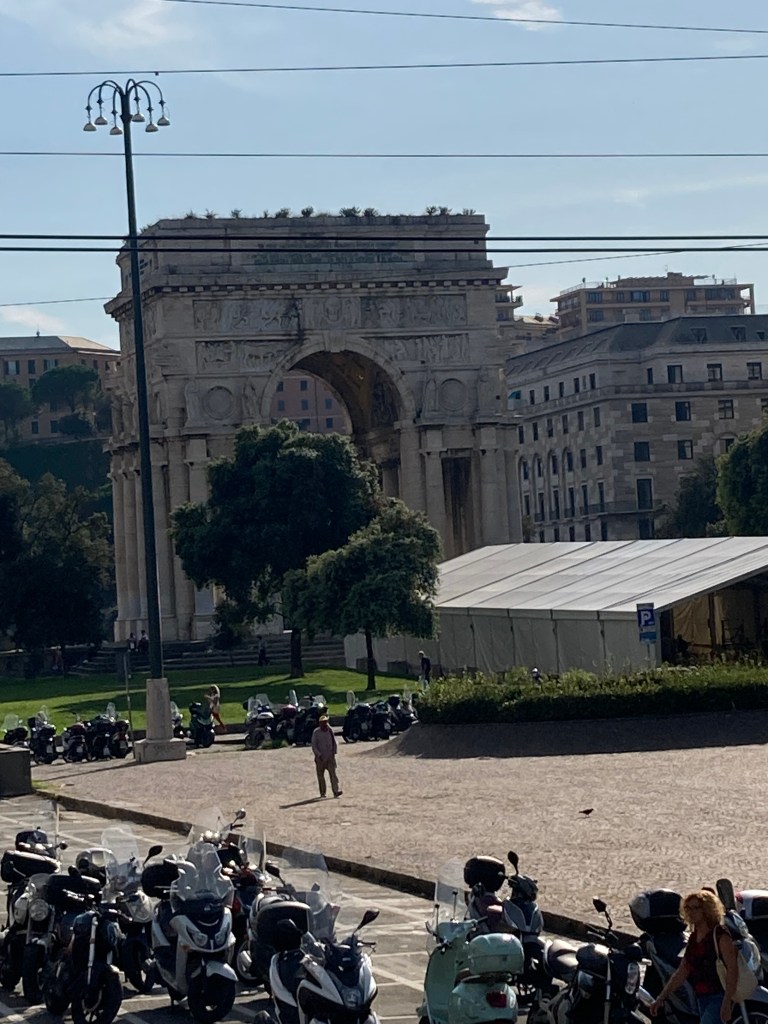
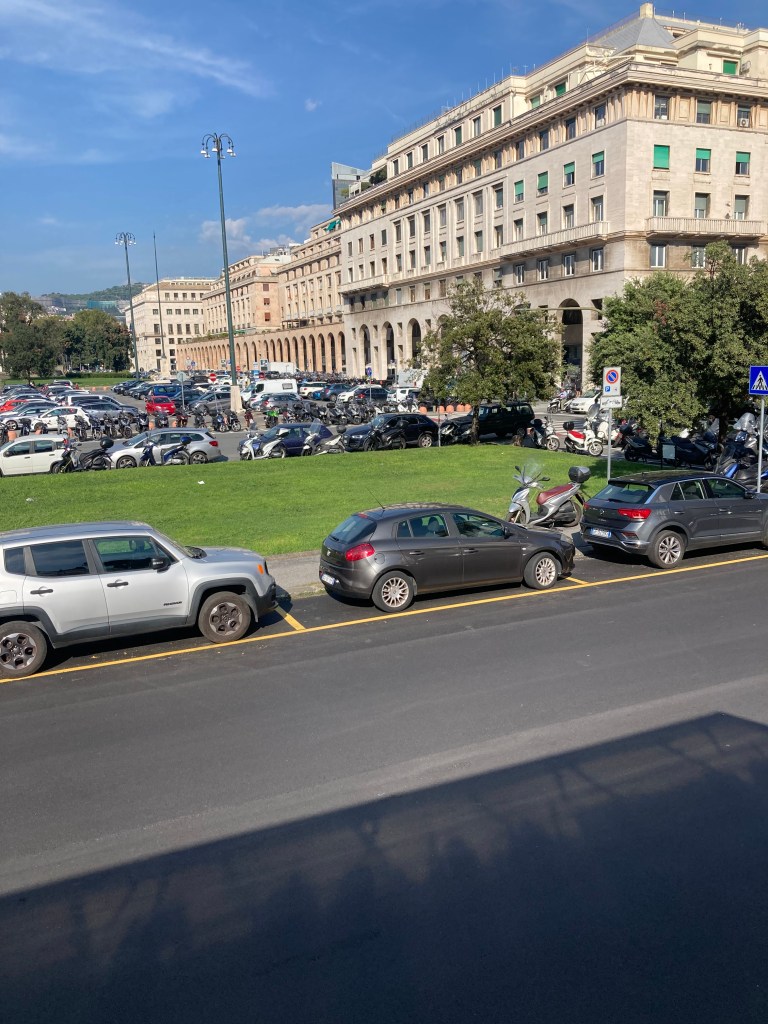
When I was in Genoa during my recent trip to Italy, I found myself highly disturbed by a particular public square, in which there stands a war memorial dedicated to all the Italian soldiers lost during the First World War. This square is surrounded by buildings, which, from their architectural style, were clearly built during the Fascist era.
I saw the entire square as a tragic but unconscious memorial to Italian Irredentism, which prompted me to want to write this post.
For me, it is a highly personal matter. Both my grandfathers served on the Italian front in the First World War. My namesake grandfather, a corporal-major in the infantry, suffered capture and was a prisoner of war in Hungary for several years. The other grandfather was a machine gunner throughout the war, a macabre and violent duty that would have haunted him the rest of his life.
Looking at the maps of the front, I am well aware that my paternal ancestral village was as far from the front line as my mother’s home in Maribyrnong is from Solomon’s Ford, the river crossing near my home. That puts the war in sobering context, right on my family’s doorstep.
Then, with the debacle that was Italy’s participation in the Second World War, there was fighting around both my parents’ villages, at either ends of the country. They were children at the time, and they both vividly recounted their memories of that period.
Members of the extended family were killed in both wars. And for what?
In, as a mature adult, denouncing the highly immature and irresponsible idea of Irredentism, I see that there were two types of Irredentism at play in the Italian state, driving Italy unnecessarily into two costly and devastating wars.
The first form of Irredentism is bourgeois in nature. This is what we have to thank for plunging Italy into the First World War. A desire to claim territory occupied partly by Italian speakers which was within the Austro-Hungarian empire drove the Italian bourgeois to force the government to declare war.
The government of the time had little ability to control this groundswell of idiocy. Austria-Hungary, already beset with its own commitments through having started an ill-considered war, was anxious not to have to open a new front on the Italian border. It was willing to make territorial concessions and let Italy have much of what it wanted without a fight.
However, the irredentists felt that land gained without the shedding of blood was unearned. War was seen as necessary. [If you want to read more for yourself on this mindset, I suggest the biography of Gabriele D’Annunzio by Lucy Hughes-Hallet: The Pike, London 2013, pp 352-369.]
The direct result of that war was 351,000 dead Italian men – few of whom were professional soldiers, and the suffering of many others forced to participate in this needless war.
Another result of that war was the disaffection of millions of Italians, particularly in the less politically empowered lower classes, with the Italian state, who had bankrupted the nation and failed to deliver the promised territorial gains. Call them peasants, or proletarians, or plebeians, or what you will, there were millions of men who had not had much of a say in the decision to go to war, but had suffered the brunt of it, both at the front and in the bread basket.
Which lit another form of Irredentism, a proletarian form (if you pardon my decision to use Marxist terminology for convenience’s sake). Suddenly, Irredentism became a mass movement of the disempowered and disaffected, people willing to follow the lead of Mussolini, the most bombastic arch-irredentist.
This then led to the Second World War. There were fewer deaths in this one in Italy, 457,000 (of which a third were civilian), but the entire country was devastated by the fighting and by German occupation of much of its territory. This was then followed by the loss of most of the territorial gains from the First World War.
So, when I look at monuments erected a century ago, and the public buildings of that era which surround them, I think of the sad losses which immaturity and stupidity amongst political leaders and their followers caused through their belligerent decisions.
Whilst Irredentism can be excused in children, it cannot be excused in adults. Adults hold political power, both through their individual vote and through holding office. Making decisions based on ideologies based in deep and childish immaturity and petulance is dangerous and inexcusable. For that, Irredentism is, despite the origin of its name, Irredeemable.


 Lost For Words!
Hi Ernest-we we’re at the Kelvin club last night as we have joined Residents 3000 and looked out for/ thought of you. Also I think you said you liked the Carmina Burana so letting you know my choir is doing this – it’s going to be a big show. Hope you are well, Catherine https://rmp.org.au/concert/2024/vines-choral-symphony-orffs-carmina-burana/
Get Outlook for iOShttps://aka.ms/o0ukef
LikeLiked by 1 person
Hi Cath
I really hope you and Paul consider joining the Kelvin Club. I was there on Tuesday evening for a while
LikeLike